

Nehru’s legacy of science & right to question
The Tribune
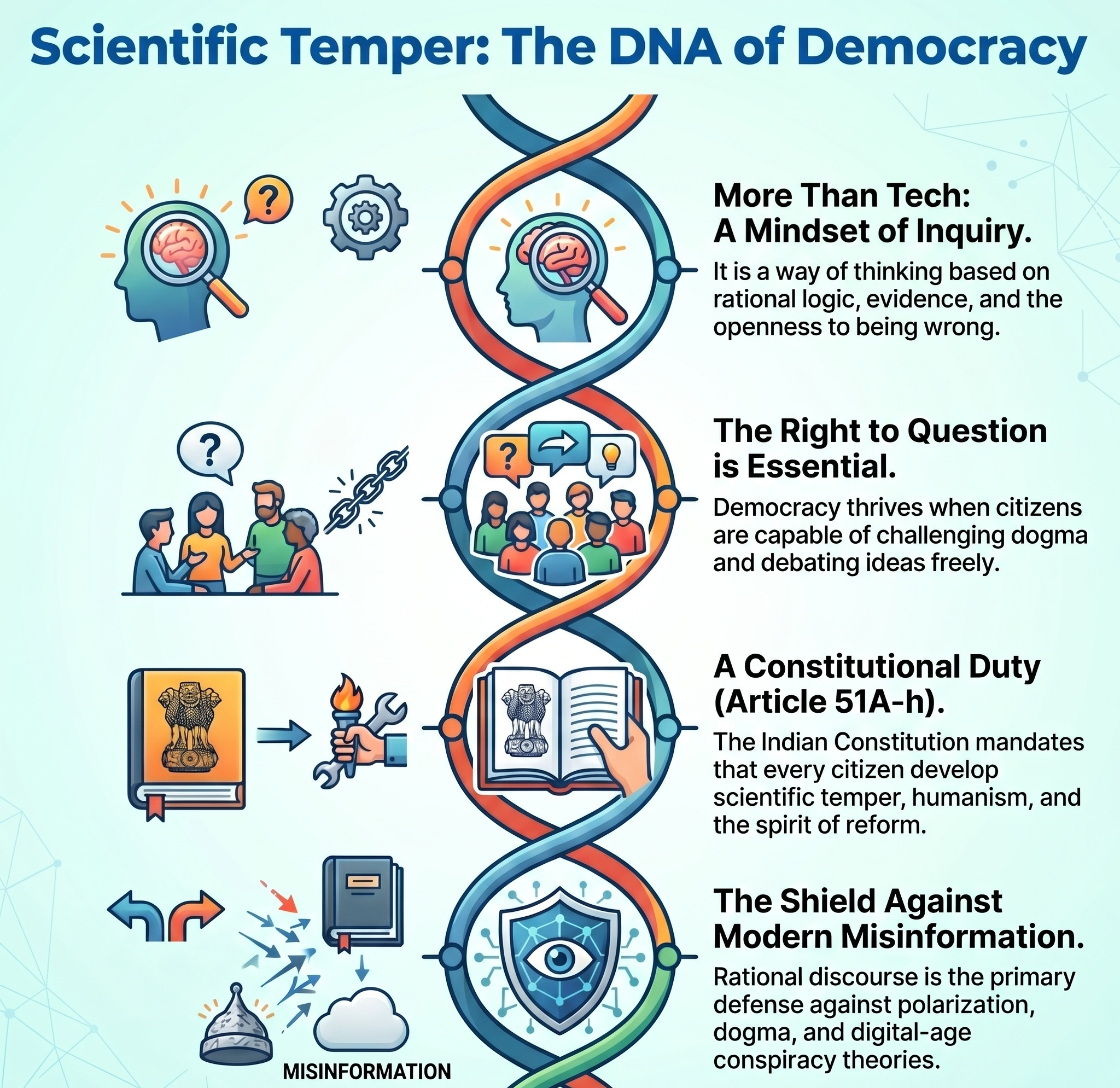
1. Core Arguments of the Article
Science for Nehru was not merely technological advancement
The article argues that:
- Nehru viewed science as a way of thinking rather than only a technical discipline.
Scientific temper is described as:
- Rational inquiry,
- Logical thinking,
- Evidence-based understanding,
- Openness to questioning.
Scientific temper is central to democracy
The article strongly links:
- Scientific thinking,
with: - Democratic citizenship.
The ability to:
- Question authority,
- Debate ideas,
- Challenge dogma,
is presented as essential to democratic life.
Nehru institutionalised science in India
The article highlights Nehru’s role in:
- Establishing IITs,
- Research institutions,
- Dams,
- Laboratories,
- Space and nuclear programmes.
These institutions are portrayed as:
- Symbols of modern India.
The right to question is foundational to scientific progress
The article repeatedly stresses:
- Knowledge evolves through criticism and questioning.
Science is portrayed as:
- Anti-dogmatic,
- Dynamic,
- Self-correcting.
Scientific temper is now under pressure
Though not explicitly stated aggressively, the article subtly suggests that:
- Rational discourse and scientific temper face challenges from:
- Dogmatism,
- Polarisation,
- Anti-intellectualism,
- Blind belief systems.
2. Author’s Stance
Strongly pro-Nehruvian
The article clearly admires:
- Nehru’s intellectual and institutional legacy.
It adopts a:
- Liberal-democratic,
- Secular-modernist perspective.
Supportive of rationalism and constitutional liberalism
The author strongly supports:
- Scientific reasoning,
- Intellectual freedom,
- Critical inquiry,
- Democratic debate.
Implicit critique of anti-scientific tendencies
The article indirectly criticises:
- Dogmatism,
- Blind faith,
- Majoritarian irrationality,
- Politicisation of knowledge.
3. Ideological and Structural Biases
Nehruvian-modernist bias
The article strongly reflects:
- Post-independence liberal-modernist ideology.
It celebrates:
- State-led scientific development,
- Institution-building,
- Secular rationalism.
Limited engagement with alternative viewpoints
The article does not substantially engage with critiques of Nehruvian development such as:
- Excessive centralisation,
- Bureaucratic planning,
- Elite institutionalism,
- Limited mass scientific literacy.
Urban intellectual bias
The article largely frames scientific temper through:
- Intellectual and institutional discourse.
Less attention is given to:
- Grassroots scientific education,
- Rural knowledge systems,
- Traditional ecological knowledge.
4. Scientific Temper: Constitutional Perspective
A. Constitutional Foundation
Scientific temper is constitutionally recognised under:
- Article 51A(h),
which makes it a Fundamental Duty: - “To develop scientific temper, humanism and the spirit of inquiry and reform.”
The article effectively links:
- Constitutional morality,
- Scientific inquiry,
- Democratic citizenship.
B. Science as a democratic tool
The article argues that:
- Democracy requires informed citizens capable of rational debate.
Scientific temper therefore becomes:
- A civic virtue,
not merely: - A scientific skill.
5. Nehru’s Institutional Legacy
Creation of scientific infrastructure
The article correctly highlights Nehru’s role in establishing:
- IITs,
- CSIR,
- Atomic Energy Commission,
- Scientific laboratories,
- Dams,
- Space research foundations.
These institutions helped India:
- Build technological self-reliance.
Long-term nation-building
The article sees scientific infrastructure as:
- Foundational investments in sovereignty and development.
This was especially important in:
- Post-colonial India,
where scientific capacity was weak.
6. Science, Rationality and Society
A. Science as method, not dogma
The article’s strongest philosophical argument is that:
- Science is fundamentally about questioning.
This aligns with:
- Karl Popper’s falsifiability principle,
- Enlightenment rationalism,
- Democratic deliberation.
B. Danger of anti-intellectualism
The article indirectly warns against:
- Emotional politics,
- Conspiracy thinking,
- Rejection of evidence.
In modern democracies, misinformation can weaken:
- Public reasoning,
- Policy quality,
- Social cohesion.
C. Science vs blind technocracy
An important insight in the article is that:
- Scientific temper is not mere technical expertise.
A technologically advanced society can still lack:
- Rational public discourse,
- Ethical reasoning,
- Critical citizenship.
7. Critical Examination of the Article
A. Over-idealisation of Nehru
The article presents Nehru almost entirely positively.
However, critics argue that:
- Nehruvian development sometimes remained elitist,
- Scientific institutions were often disconnected from grassroots realities.
B. Limited discussion on educational failures
India still struggles with:
- Weak scientific literacy,
- Rote learning,
- Poor research culture,
- Low innovation quality.
The article insufficiently explores:
- Why scientific temper has not deeply penetrated society.
C. Rationality and cultural complexity
The article strongly associates rationality with modern scientific institutions.
However:
- Traditional knowledge systems,
- Indigenous ecological practices,
also contain valuable empirical wisdom.
A balanced approach requires:
- Dialogue between modern science and traditional knowledge.
D. Science and ethics
Scientific progress without ethical frameworks can also create:
- Surveillance systems,
- AI misuse,
- Environmental destruction,
- Technological inequality.
The article does not substantially engage with:
- Ethical limits of technological modernity.
8. Real-World Relevance
Public health
Scientific temper became critically important during:
- COVID-19,
where misinformation spread rapidly.
Climate change
Evidence-based policymaking is essential for:
- Environmental sustainability.
Technology governance
Modern challenges such as:
- AI,
- Biotechnology,
- Genetic engineering,
require scientifically informed democratic debate.
Combating misinformation
Scientific temper is increasingly necessary in:
- Social media-driven societies.
9. Policy Implications
A. Reforming education
India must move beyond:
- Memorisation-based learning.
Education should promote:
- Inquiry,
- Debate,
- Research,
- Critical thinking.
B. Strengthening public science communication
Scientific institutions must:
- Engage directly with citizens.
C. Research investment
India needs greater investment in:
- R&D,
- Universities,
- Innovation ecosystems.
D. Protecting academic freedom
Scientific progress depends on:
- Intellectual autonomy,
- Freedom of inquiry,
- Open debate.
10. UPSC GS Paper Linkages
GS Paper II
Relevant themes:
- Constitutional values
- Fundamental Duties
- Education policy
- Democratic citizenship
GS Paper III
Relevant themes:
- Science and technology
- Innovation
- Research and development
- Technology governance
GS Paper IV (Ethics)
Relevant ethical themes:
- Rationality,
- Intellectual honesty,
- Humanism,
- Public reasoning,
- Ethical leadership.
Essay Relevance
Potential essay themes:
- “Scientific temper and democracy”
- “Education as liberation”
- “Science without humanity is dangerous”
11. Pros of the Article
Strong constitutional grounding
The article effectively links:
- Scientific temper with constitutional values.
Broad understanding of science
It correctly explains that:
- Science is a method of inquiry, not merely technical expertise.
Democratic relevance
The article strongly connects:
- Rational inquiry with democratic citizenship.
Historical perspective
The article successfully contextualises:
- Nehru’s role in modern institution-building.
12. Weaknesses of the Article
Overly celebratory tone
The article largely avoids:
- Criticisms of Nehruvian planning and institutional elitism.
Limited grassroots perspective
Scientific temper is discussed more at:
- Elite institutional levels,
rather than: - Mass educational transformation.
Insufficient engagement with contemporary challenges
The article could have more deeply explored:
- Social media misinformation,
- Politicisation of science,
- Digital propaganda ecosystems.
13. Broader Political and Civilisational Context
The article reflects a larger debate in India:
Should modern India be guided primarily by rational constitutionalism or cultural majoritarianism?
The article strongly sides with:
- Constitutional rationalism,
- Scientific inquiry,
- Liberal-democratic values.
Science and nationalism
The article also implies that:
- Genuine national strength comes from knowledge creation and intellectual freedom,
not merely: - Symbolic nationalism.
14. Balanced Conclusion
The article presents a powerful defence of Jawaharlal Nehru’s scientific and intellectual legacy. Its central argument — that scientific temper is fundamentally about questioning, reasoning, and democratic inquiry — remains deeply relevant in contemporary India.
The article rightly highlights that Nehru viewed science not simply as:
- Industrial or technological progress,
but as: - A civilisational mindset necessary for modern democracy.
Its emphasis on:
- Rationality,
- Constitutional values,
- Freedom of inquiry,
is especially important in an era marked by: - Misinformation,
- Polarisation,
- Anti-intellectual tendencies.
However, the article tends to idealise the Nehruvian model while underplaying:
- Institutional elitism,
- Weak scientific literacy,
- Gaps between scientific institutions and ordinary citizens.
True scientific temper cannot remain confined to:
- Elite laboratories and universities;
it must become part of: - Public culture,
- Education systems,
- Democratic discourse.
15. Future Perspective
India’s future as a global power will depend not only on:
- Technological advancement,
but also on: - Intellectual openness,
- Critical thinking,
- Ethical scientific progress.
Scientific temper must evolve into:
- A mass democratic culture.
The real challenge is not simply producing:
- Engineers,
-
comments
