

NEP 2020: Six Years On, Implementation Falls Short — Experts

NEP 2020: Six Years On, Implementation Falls Short — Experts
Relevance: GS Paper II (Education, Government Policies, NEP 2020)
Why in the News?
- Six years after the Centre approved the National Education Policy (NEP) 2020 — its most ambitious education reform in over three decades — implementation remains uneven.
- Experts cite funding shortfalls, inadequate institutional capacity, and unfinished structural reforms as key constraints preventing the policy from achieving its full promise.
About NEP 2020
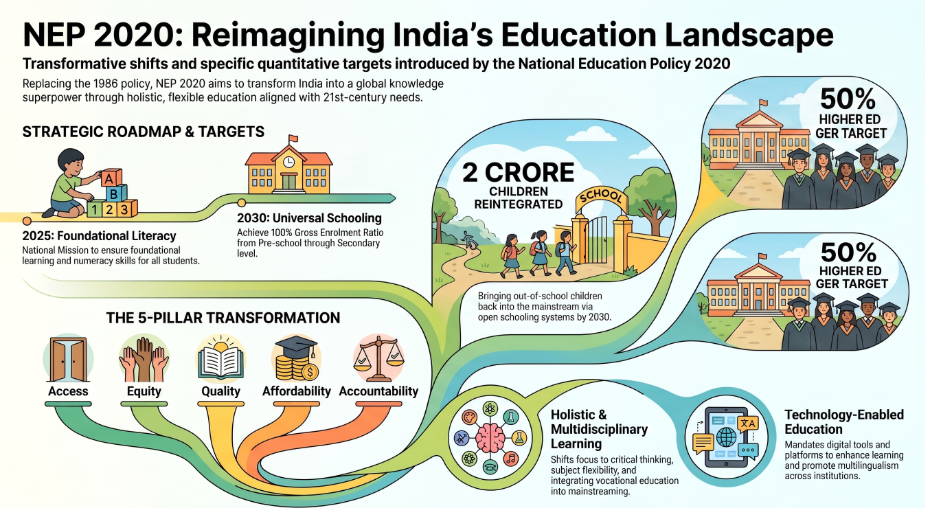
- Replaced the 1986 National Policy on Education.
- Key features introduced: the 5+3+3+4 school structure, multidisciplinary higher education, multiple entry/exit options, the Academic Bank of Credits (ABC), greater institutional autonomy, and a focus on research, internationalisation, and vocational education.
The Core Constraint: Funding
- Syed Sultan Ahmed, Chairperson, The Association of International Schools of India (TAISI), calls implementation the biggest challenge.
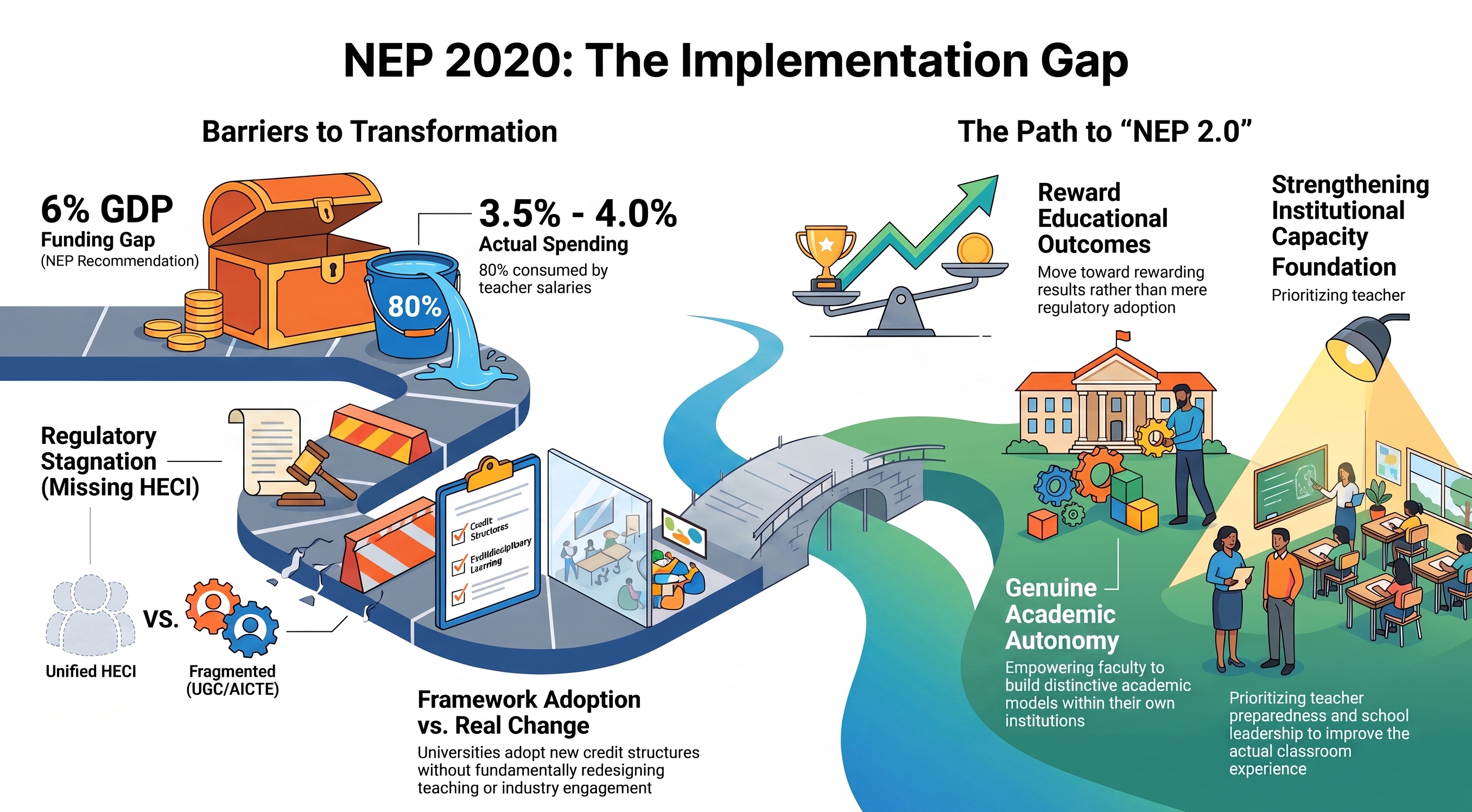
- NEP recommends raising education spending to 6% of GDP, but actual spending remains at 3.5-4% of GDP.
- About 80% of this spending goes toward teachers' salaries, leaving little for infrastructure development and upgradation.
Higher Education: Progress and Gaps
Academic Bank of Credits (ABC)
- Poornima Gupta (Great Lakes Institute of Management, Gurgaon) notes the ABC and multidisciplinary learning have the potential to give students flexibility to pursue courses across institutions.
- However, seamless credit transfer remains difficult since institutions continue to follow differing curricula, evaluation systems, and credit structures — limiting this flagship reform's effectiveness.
The Pending Higher Education Commission of India (HECI)
- The proposed HECI — a single regulatory body meant to replace the current tangle of UGC, AICTE, and other councils, easing institutions' compliance burden — has still not materialised.
- Six years on, this promise still awaits legislative action.
- Gupta also flagged uneven progress in industry internships and research, due to gaps in participation, faculty development, infrastructure, and funding.
Framework Adoption vs. Real Change
- Professor Keyoor Purani (Vice Chancellor, Prestige University, Indore) argues universities have largely adopted NEP's framework — multidisciplinary curricula, flexible regulations, credit structures — without fundamentally changing how they function.
- Far fewer institutions have redesigned how students learn, how faculty teach, or how institutions engage with industry and society.
- His recommendation: the next phase should reward educational outcomes rather than mere regulatory adoption.
- On autonomy: Purani argues true autonomy should be measured by whether universities can build distinctive academic models — not just by seeking reduced oversight from external regulators. He stresses that academic autonomy within universities (for faculty) is equally important, since faculty cannot innovate if internal governance simply replaces one form of compliance with another.
School Education: A Similar Pattern
- Ganesh Tiwari (Principal, Seth Anandram Jaipuria School, Kanpur) notes competency-based learning and experiential education have entered mainstream discussion, but implementation varies due to differences in resources, teacher preparedness, and school leadership.
- His recommendation: the next phase should focus on strengthening institutional capacity so good policy translates into better classroom experiences for every child.
- Manisha Malhotra (Director-Principal, Satya School, Gurugram) notes the policy has encouraged question-led learning and exposure to emerging fields like AI, but teacher capacity remains a critical bottleneck.
Key Takeaway
While NEP 2020 has succeeded in introducing new frameworks — multidisciplinary learning, flexible credit structures, competency-based approaches — genuine institutional transformation remains limited by funding shortfalls, uneven capacity, and the stalled Higher Education Commission of India. Experts broadly agree the next implementation phase must prioritise outcomes, institutional capacity building, and genuine academic autonomy over mere regulatory box-ticking.
