

NEPAL’S AGONY: THE HIMALAYAN WARNING TO INDIA

NEPAL’S AGONY: THE HIMALAYAN WARNING TO INDIA
Context
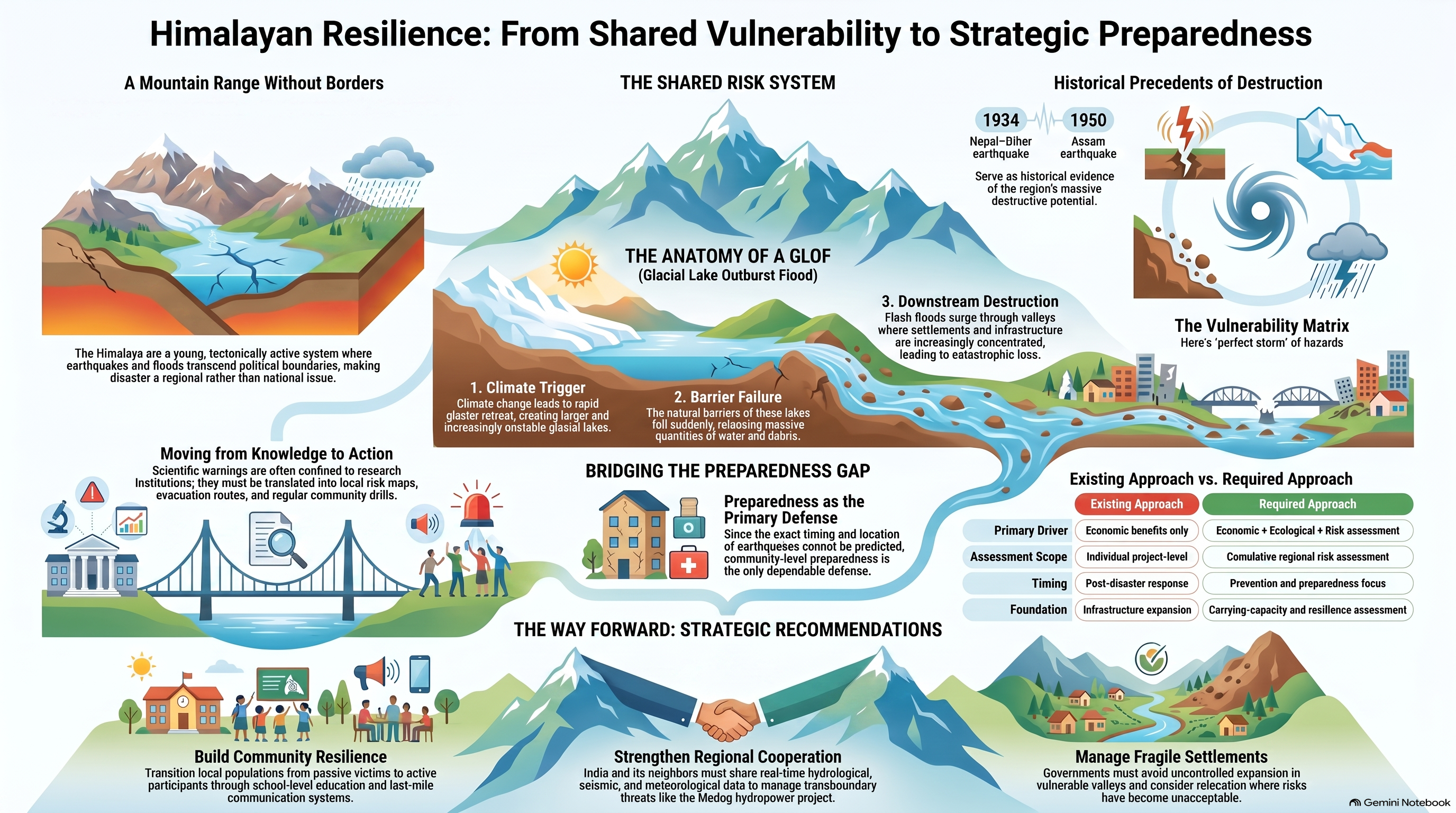
A recent disaster in Nepal highlights the vulnerability of the entire Himalayan region, where earthquakes, landslides, glacial hazards and floods transcend political boundaries.
For India, the key lesson is to convert scientific knowledge into community-level preparedness rather than relying primarily on post-disaster response.
The Himalaya: A Shared Risk System
The Himalaya are a young, tectonically active and environmentally fragile mountain system extending across several countries.
|
Hazard |
Emerging Risk |
|
Earthquakes |
High seismic vulnerability across Himalayan and adjoining regions |
|
GLOFs |
Glacier retreat → expansion and instability of glacial lakes |
|
Landslides |
Intensified by steep terrain, rainfall and infrastructure |
|
Floods |
Sudden high-intensity rainfall and glacial disturbances |
|
Climate change |
Amplifies multiple mountain hazards |
Past events such as the 1934 Nepal–Bihar earthquake and 1950 Assam earthquake demonstrate the region's destructive potential.
Since earthquakes cannot yet be reliably predicted in terms of their exact timing, location and magnitude, preparedness remains the most dependable defence.
India’s Preparedness Gap
India has institutions for seismic monitoring, disaster management and climate research, but the major gap lies between knowledge and action.
Scientific warnings often remain confined to:
- research institutions;
- technical reports;
- government departments.
What is required is their translation into local risk maps, evacuation routes, warning systems and regular community drills.
Growing Threat of GLOFs
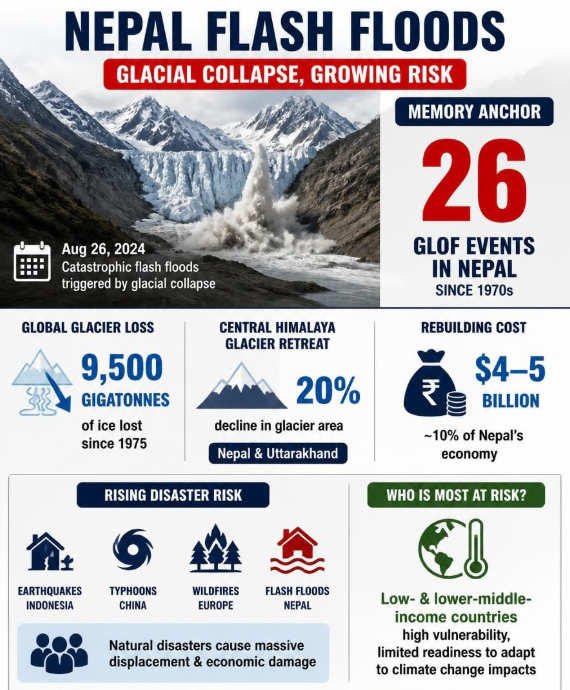 Glacial Lake Outburst Floods (GLOFs) occur when a glacial lake suddenly releases large quantities of water due to the failure of its natural barrier.
Climate change → Glacier retreat → Larger/unstable glacial lakes → Sudden outburst → Flash floods + debris → Downstream destruction
This is particularly dangerous because Himalayan settlements and infrastructure are increasingly concentrated in vulnerable valleys.
Development in Fragile Zones
Infrastructure development needs a fundamental shift from “development first, risk assessment later” to risk-informed development.
|
Existing Approach |
Required Approach |
|
Economic benefits as primary consideration |
Economic + ecological + disaster-risk assessment |
|
Project-level assessment |
Cumulative regional risk assessment |
|
Post-disaster response |
Prevention and preparedness |
|
Infrastructure expansion |
Infrastructure resilience and carrying-capacity assessment |
Large dams, hydropower projects, roads and other critical infrastructure in high-risk zones should undergo rigorous seismic, geological and climate-risk assessments.
Transboundary Dimension
Himalayan hazards can have downstream consequences across borders.
India therefore needs stronger cooperation with neighbouring countries, particularly on:
- real-time hydrological and meteorological data;
- GLOF and flood early warnings;
- seismic information;
- disaster-response coordination;
- environmental impact of major upstream infrastructure.
Projects such as the proposed Medog hydropower project near the Brahmaputra’s Great Bend underline the importance of transparency and transboundary risk assessment.
Way Forward
1. Build community resilience: Make local populations active participants through awareness programmes, evacuation drills and school-level disaster education.
2. Strengthen early-warning systems: Integrate satellite monitoring, seismic networks, hydrological data and last-mile communication.
3. Risk-informed infrastructure: Reassess existing and proposed infrastructure in high-risk zones using cumulative disaster-risk assessments.
4. Strengthen regional cooperation: Develop mechanisms for timely sharing of information on floods, GLOFs and other transboundary hazards.
5. Manage settlements: Avoid uncontrolled expansion in highly vulnerable valleys and consider safer relocation where risks become unacceptable.
6. Bridge the science-policy gap: Ensure scientific assessments directly inform land-use planning, building codes and disaster-management decisions.
Conclusion
Nepal's experience is a warning that Himalayan disasters are regional risks, not isolated national events. India cannot eliminate earthquakes, glacier-related hazards or landslides, but it can substantially reduce their human and economic cost.
The priority must therefore shift from reactive disaster management to anticipatory resilience—where science guides infrastructure, communities are prepared before emergencies and Himalayan development respects the ecological and geological limits of the region.
