

Neutrinos and IceCube: Opening a New Window to the Universe

Neutrinos and IceCube: Opening a New Window to the Universe
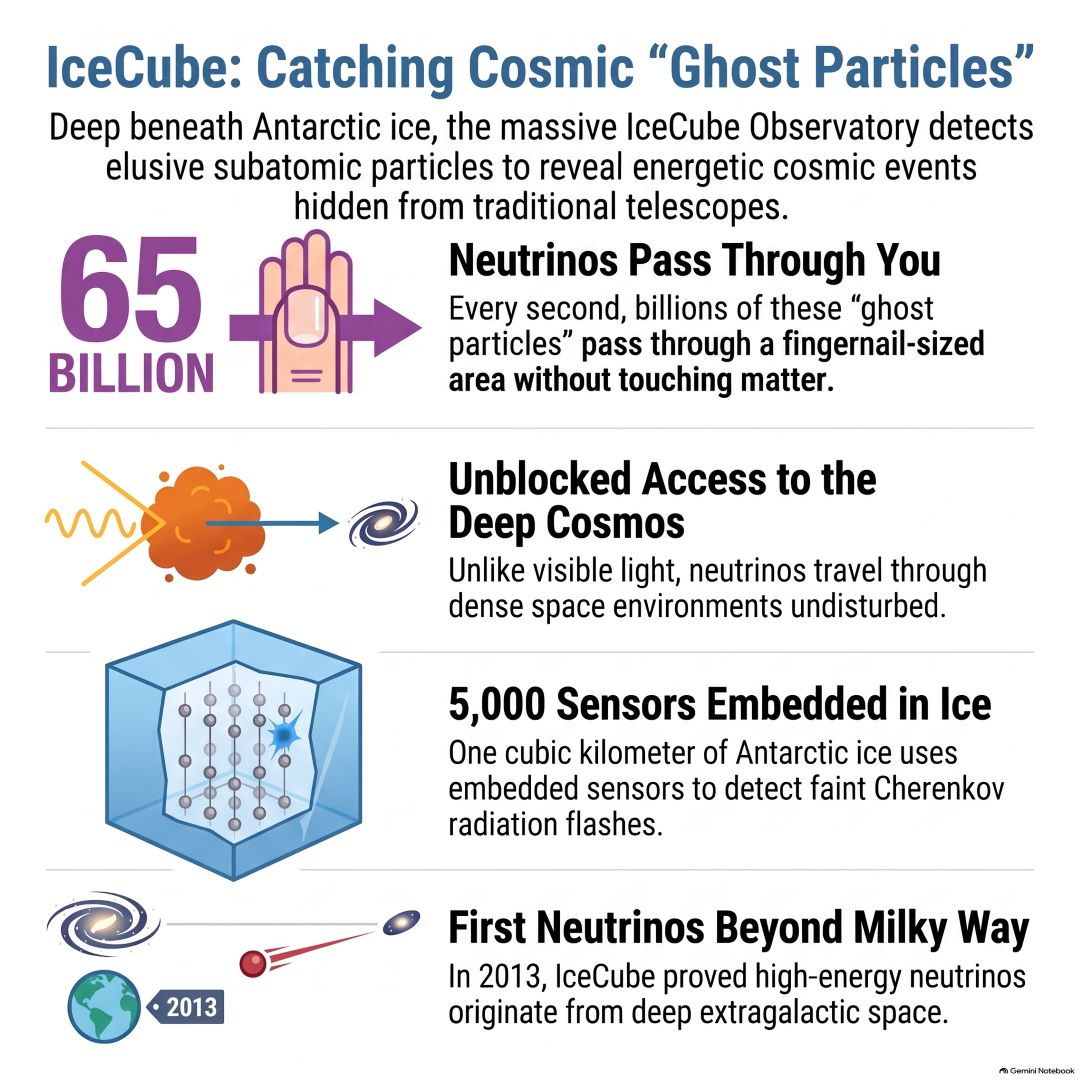
Neutrinos: The “Ghost Particles”
- Neutrinos are electrically neutral, extremely light subatomic particles produced in processes such as nuclear reactions inside stars.
- They are among the most abundant particles in the universe, after photons.
- Around 65 billion neutrinos pass through an area roughly the size of a human fingernail every second, yet most pass through matter without interacting.
- Their extremely weak interaction with matter makes them difficult to detect but also allows them to travel through dense cosmic environments largely undisturbed.
Why Neutrinos Matter for Astronomy?
- Electromagnetic radiation such as visible light and X-rays can be absorbed or scattered by dense matter, limiting our view of some cosmic events.
- Neutrinos can pass through such regions and therefore carry information from otherwise inaccessible environments.
- Their detection provides information about energetic astrophysical processes and complements observations based on light and cosmic rays.
- This has contributed to the development of multi-messenger astronomy, where the universe is studied through different types of signals, including electromagnetic waves, gravitational waves and neutrinos.
IceCube Neutrino Observatory
- The IceCube Observatory, designed under the leadership of Francis Halzen, is located deep beneath the Antarctic ice at the South Pole.
- It uses about one cubic kilometre of Antarctic ice and more than 5,000 light sensors embedded in the ice.
- When a neutrino rarely interacts with an atomic nucleus in the ice, it can produce a charged particle.
- If the particle travels faster than the speed of light in ice, it produces a faint flash of light known as Cherenkov radiation.
- Sensors detect this light, allowing scientists to estimate the energy and direction of the original neutrino.
- The deep, dark Antarctic environment reduces background interference and provides a vast natural detection medium.
IceCube’s Scientific Breakthrough
- IceCube became fully operational in 2011 and in 2013 provided the first strong evidence for very high-energy neutrinos originating beyond the Milky Way.
- Earlier neutrino astronomy had mainly detected neutrinos produced by relatively nearby sources, particularly nuclear processes in the Sun.
- Extra-galactic neutrino detection therefore created a new method for studying energetic processes occurring far beyond our galaxy.
- The breakthrough demonstrates how a particle that is extremely difficult to detect can become a powerful astronomical messenger.
India and Neutrino Research
- India’s proposed India-based Neutrino Observatory (INO) was initially planned in Kerala and later shifted to Tamil Nadu.
- The project has faced opposition related to land acquisition and environmental concerns, delaying its development.
- INO is intended to study neutrino properties and contribute to India's fundamental physics research.
- The broader lesson is that frontier scientific infrastructure requires not only advanced scientific capability but also effective environmental assessment, stakeholder engagement and public communication.
