

New Income Tax Act, PAN rules, HRA norms come into effect
The Statesman
1. Key Arguments
A. Structural Reform of Tax Framework
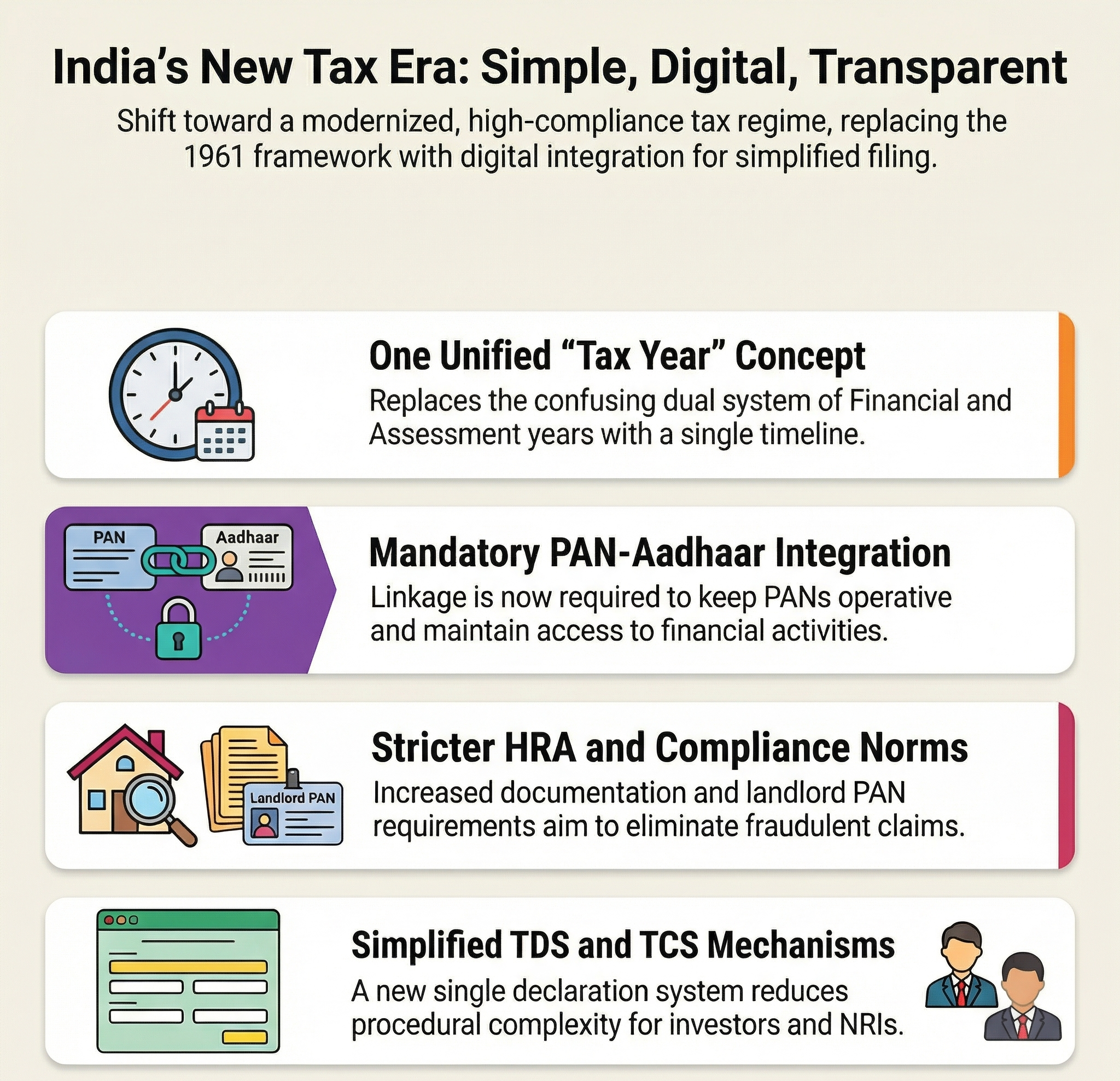
Replacement of the Income Tax Act, 1961 with a modernised regime.
Aims to simplify compliance and align with contemporary economic realities.
B. Introduction of ‘Tax Year’ Concept
Elimination of dual system (FY + AY).
Single timeline reduces confusion, especially for new taxpayers.
C. PAN–Aadhaar Integration
Mandatory linkage enhances transparency and data accuracy.
Non-compliance leads to inoperative PAN, restricting financial activities.
D. Tightening of Compliance Norms
Higher documentation requirements (e.g., HRA claims, landlord PAN).
Increased scrutiny to reduce tax evasion.
E. Changes in Allowances and Deductions
Revision of exemptions (HRA, education, meal benefits).
Expansion in some areas but stricter eligibility conditions.
F. Reforms in Capital Gains and Securities Taxation
Shift from dividend taxation to capital gains-based framework.
Impacts investor behaviour and market dynamics.
G. Simplification of TDS/TCS Mechanisms
Single declaration system reduces procedural complexity.
Particularly beneficial for investors and NRIs.
2. Author’s Stance
Moderately supportive with caution
Supports modernisation and simplification
Recognises need for updated tax architecture.
Highlights compliance burden and transition challenges
Notes increased documentation and adjustment costs.
3. Biases and Limitations
Urban taxpayer bias
Focus on salaried class and investors
Less attention to informal sector taxpayers.
Limited fiscal analysis
Does not deeply evaluate revenue implications
Impact on government finances remains underexplored.
Short-term lens
Focus on immediate changes rather than long-term outcomes
4. Strengths (Pros)
Simplification of tax structure
Single tax year reduces ambiguity.
Improved transparency and compliance
PAN-Aadhaar linkage curbs evasion.
Digitalisation push
Streamlined filing and verification processes.
Better targeting of exemptions
Reduces misuse of allowances.
5. Weaknesses (Cons)
Increased compliance burden
More documentation requirements for taxpayers
Exclusion risks
Digitisation may disadvantage less tech-savvy individuals
Transitional challenges
Adjustment to new norms may create confusion initially
Potential compliance overreach
Excess scrutiny may affect ease of doing business
6. Policy Implications
A. Strengthening Tax Administration
Data-driven governance using PAN-Aadhaar integration
B. Balancing Compliance and Ease
Need to avoid over-regulation while ensuring transparency
C. Financial Inclusion Measures
Support systems for small taxpayers and informal sector
D. Investor Behaviour Changes
Shift towards long-term investments due to capital gains taxation
E. Digital Infrastructure Enhancement
Ensuring accessibility and user-friendly systems
7. Real-World Impact
Individuals
Simplified filing but higher documentation burden
Businesses
Improved compliance clarity but increased reporting requirements
Government
Better tax collection efficiency and reduced evasion
Economy
Potential formalisation boost but short-term adjustment costs
8. UPSC GS Paper Linkages
GS Paper III (Economy)
- Tax reforms
- Formalisation of economy
- Investment behaviour
GS Paper II (Governance)
- Digital governance
- Transparency and accountability
GS Paper IV (Ethics)
- Tax compliance and civic responsibility
9. Balanced Conclusion
The new Income Tax regime marks a significant step towards a transparent and modern tax system. However, its success will depend on balancing simplification with accessibility and ensuring that compliance requirements do not become excessive.
10. Future Perspective
Towards faceless, seamless tax administration
AI-driven compliance and assessments.
Greater integration of financial databases
Holistic taxpayer profiling.
Simplification of exemptions regime
Move towards minimal-deduction structure.
Enhancing taxpayer awareness
Reducing friction in transition phase.
Final Insight
A tax system succeeds not merely by increasing compliance, but by making compliance simple, fair, and accessible to all sections of society.
