

New UGC regulations sharpen provisions against caste bias
Indian Express
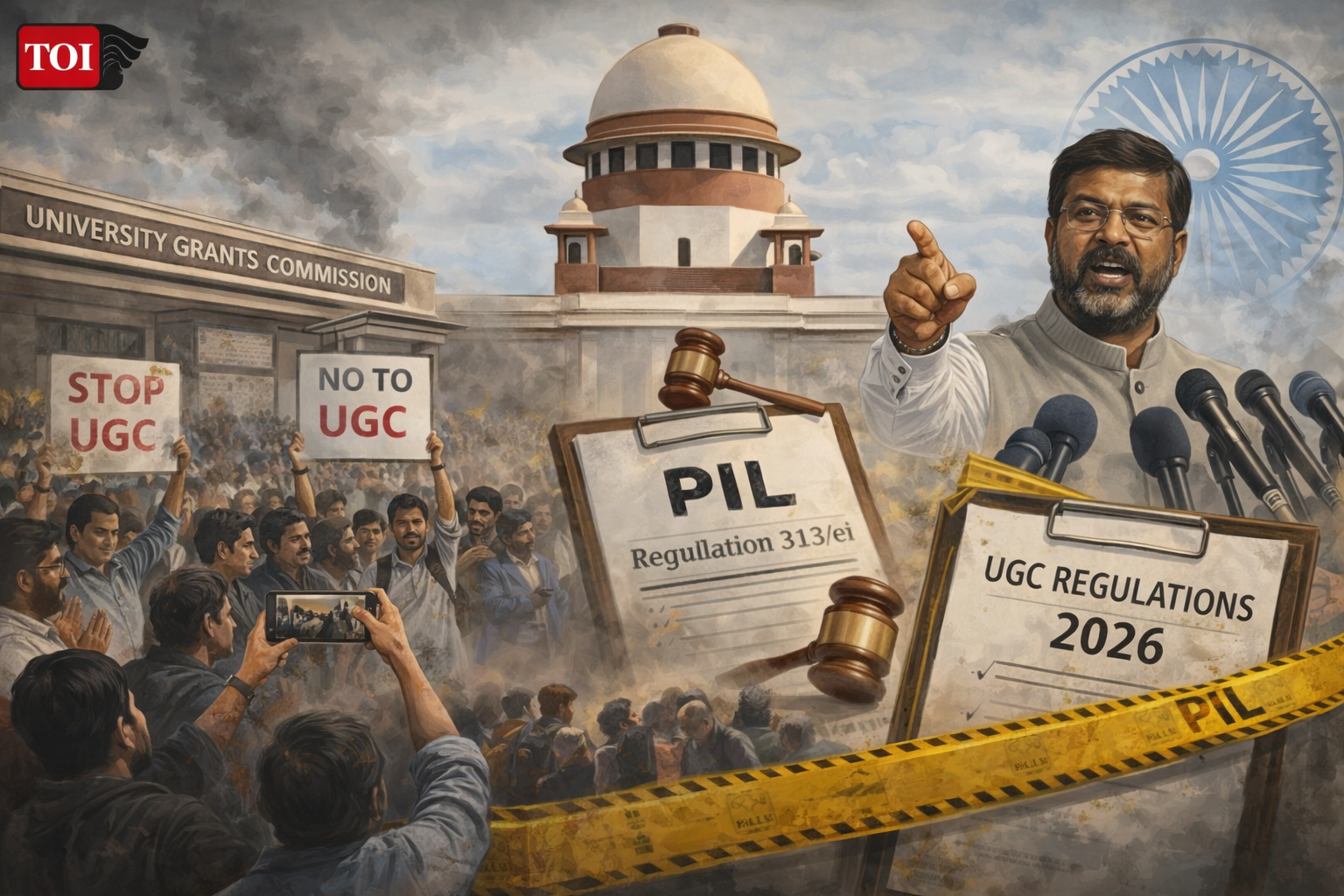
Key Arguments
Stronger institutional accountability
The regulations mandate every higher education institution to establish Equal Opportunity Centres (EOCs) and grievance redressal mechanisms to address discrimination based on caste, gender, disability and other identities.
Time-bound grievance redressal
A major shift is the introduction of clear timelines for inquiry and action on complaints, moving away from ad-hoc or discretionary handling by university authorities.
Preventive, not just punitive, framework
The regulations emphasise sensitisation, awareness and institutional processes, rather than treating caste discrimination only as an episodic misconduct issue.
Centralised oversight by UGC
The UGC is empowered to monitor compliance and take action against institutions that fail to implement or operationalise the mandated mechanisms.
Context of social justice movements
The article links the regulations to past campus protests and cases that exposed structural caste bias in elite institutions, underlining the moral and political urgency behind the reform.
Author’s Stance and Bias
Stance
The author adopts a broadly supportive yet cautious stance, recognising the need for stronger safeguards while hinting that regulations alone cannot eliminate entrenched social hierarchies.
Biases
The article foregrounds social justice concerns and student perspectives more prominently than administrative challenges faced by universities. The regulatory approach is treated as necessary, with limited exploration of implementation capacity or unintended consequences.
Pros Highlighted
Formal recognition of caste discrimination
The regulations acknowledge caste bias as a systemic institutional issue rather than an individual aberration.
Clear compliance framework
Defined roles, timelines and reporting requirements reduce ambiguity and scope for inaction.
Empowerment of marginalised students
Accessible grievance mechanisms may encourage reporting and reduce fear of retaliation.
Alignment with constitutional values
The rules reinforce equality, dignity and non-discrimination as core principles of public education.
Cons and Concerns
Implementation gap risk
Without adequate staffing, training and resources, EOCs risk becoming symbolic rather than effective.
Bureaucratisation of grievance redressal
Over-reliance on procedural compliance may dilute substantive justice if inquiries become formalistic.
Campus polarisation
The regulations may deepen ideological divisions if framed as punitive rather than corrective.
Limited deterrence
Rules do not automatically change social attitudes, power hierarchies or informal discrimination practices.
Policy Implications
Higher education governance
Signals a shift towards rights-based regulation and stronger central oversight in university administration.
Social justice in education
Reinforces the state’s responsibility to ensure that access to higher education is not undermined by social exclusion.
Need for capacity building
Institutions must invest in trained personnel, sensitisation programmes and independent inquiry processes.
Real-World Impact
If implemented sincerely, the regulations could improve campus climate for students from Scheduled Castes, Scheduled Tribes, OBCs and other marginalised groups. They may also increase institutional accountability and public scrutiny of elite universities. However, weak enforcement or token compliance could limit their transformative potential.
UPSC GS Paper Linkages
GS Paper II – Governance
Regulatory institutions, accountability, grievance redressal mechanisms.
GS Paper I – Society
Caste system, social inequality, education and social mobility.
GS Paper II – Social Justice
Policies for vulnerable sections, access to education, inclusive institutions.
Conclusion and Future Perspective
The article presents the new UGC regulations as a significant normative step towards addressing caste-based discrimination in higher education. While the regulatory architecture is stronger and more explicit than before, its success will depend on institutional will, administrative capacity and cultural change on campuses. Going forward, the challenge lies in ensuring that these provisions translate from rulebooks into lived equality, making universities spaces of genuine inclusion rather than procedural compliance alone.
