

NHB Reforms Commercial Horticulture Subsidy Rules

NHB Reforms Commercial Horticulture Subsidy Rules
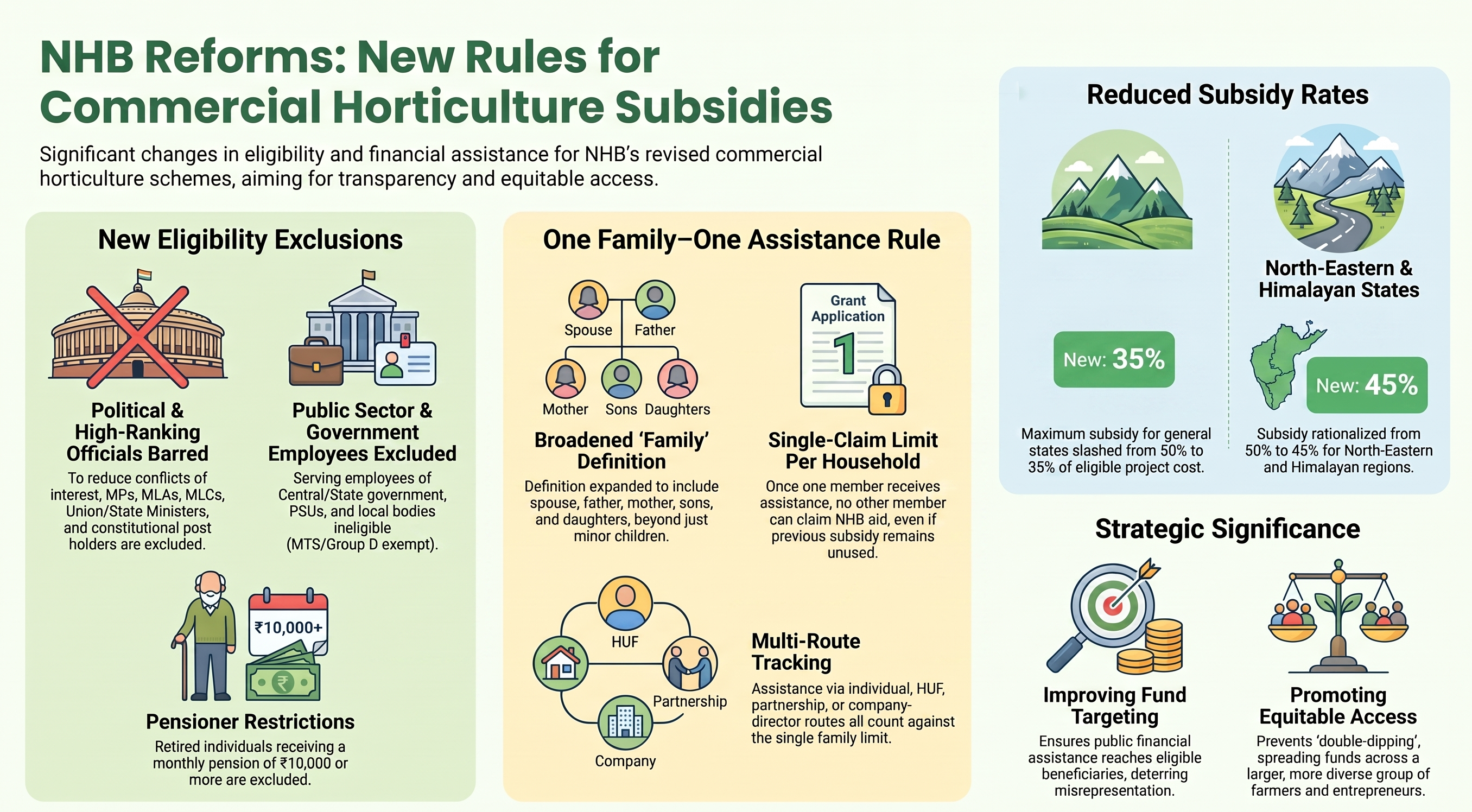
The National Horticulture Board (NHB), an autonomous organisation under the Ministry of Agriculture and Farmers Welfare, has revised its guidelines for commercial horticulture schemes. The changes aim to improve targeting, prevent duplicate benefits and strengthen transparency in subsidy distribution.
What is the NHB?
The NHB promotes commercial horticulture and post-harvest infrastructure. Its scheme for development of commercial horticulture provides financial assistance for large-scale cultivation of crops such as capsicum, cucumber, tomato, rose, lilium and chrysanthemum.
Major Changes in Eligibility
The revised rules exclude several categories from direct financial assistance, including:
- Holders of constitutional posts
- Union and State Ministers
- MPs, MLAs and MLCs
- Mayors and district panchayat chairpersons
- Serving Central and State government employees
- Employees of PSUs, autonomous bodies and local bodies
- Pensioners receiving monthly pension of ₹10,000 or more
- Groups of farmers
MTS/Class-IV/Group D employees are exempted from certain exclusions. Family members of excluded persons may receive one-time assistance subject to the revised conditions.
One Family–One Assistance Rule
The definition of family has been expanded from husband, wife and dependent minor children to include:
- Spouse
- Father
- Mother
- Sons and daughters
Only one member of a family can receive assistance under NHB schemes. Assistance received through an individual, HUF, partnership, proprietorship or company-director route will be treated as assistance to the same family.
Once one family member receives assistance, another member cannot claim further NHB assistance, even if part of the earlier subsidy ceiling remains unused.
Subsidy Rates Reduced
The maximum subsidy has also been rationalised:
- General States: reduced from 50% to 35% of eligible project cost
- North-Eastern and Himalayan States: reduced from 50% to 45%
Thus, the reforms affect both eligibility and the amount of public support available for projects.
Significance
The reforms aim to:
- Prevent multiple subsidy benefits within the same family
- Improve targeting of public funds
- Reduce potential conflicts of interest
- Strengthen transparency and accountability
- Deter misrepresentation and subsidy circumvention
- Promote more equitable access to horticulture support
However, lower subsidy rates could increase the financing burden on new commercial horticulture projects, particularly those requiring substantial upfront investment.
Conclusion
The revised NHB guidelines represent a shift towards tighter targeting and greater accountability in commercial horticulture subsidies. By combining stricter eligibility, a one-family-one-assistance rule, reduced subsidy rates and stronger recovery provisions, the framework seeks to ensure that public financial assistance reaches eligible beneficiaries while limiting duplication and misuse.
