

NITI Aayog Report: India as a Global Manufacturing Hub

NITI Aayog Report: India as a Global Manufacturing Hub
Why in News?
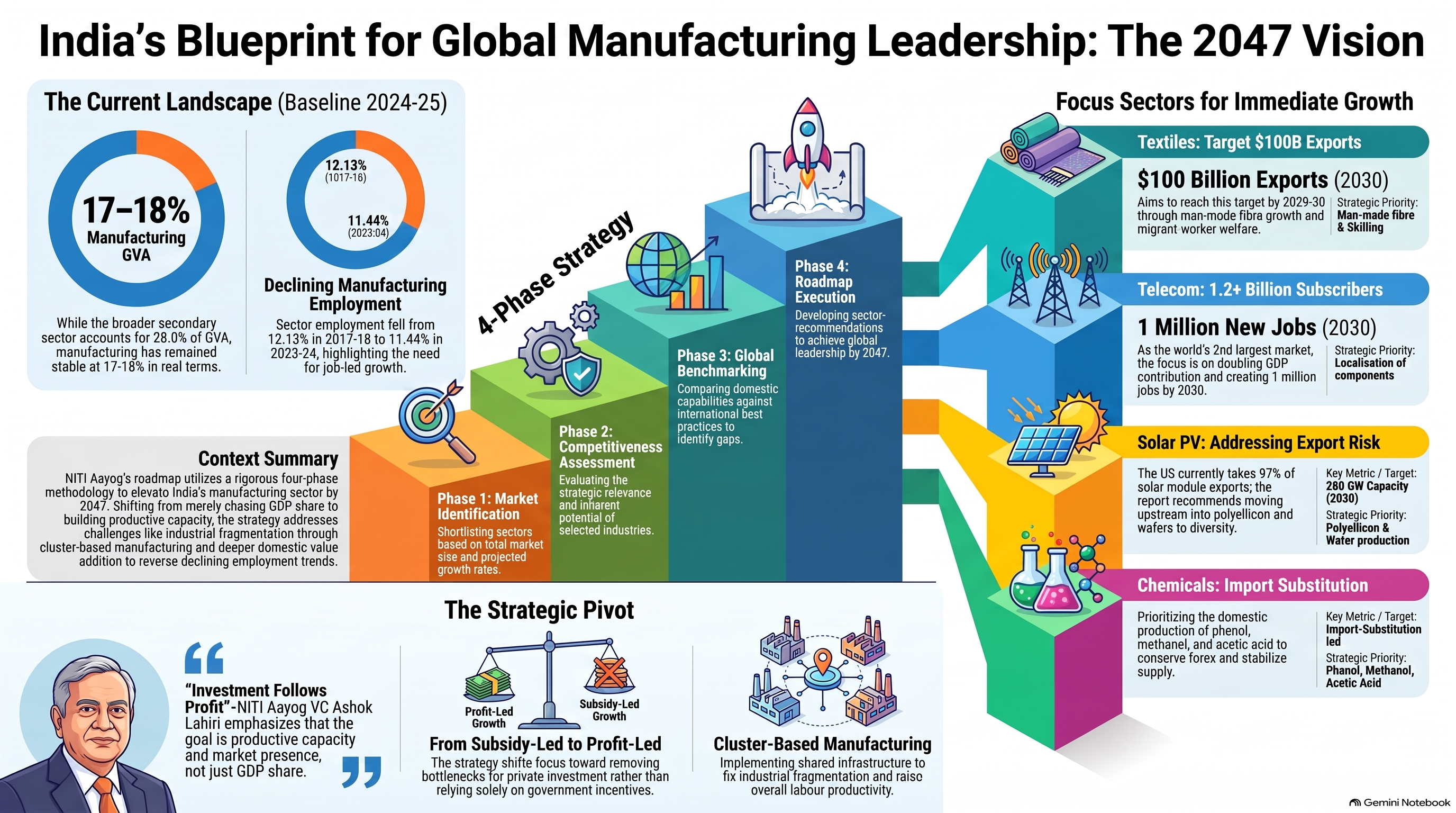
NITI Aayog released the first volume of its report "Key Sectors to Position India as a Global Manufacturing Hub," recommending cluster-based manufacturing, lower costs, and deeper domestic value addition to help India emerge as a global manufacturing leader by 2047.
Manufacturing Sector
- Transforms raw/intermediate goods into finished products; spans automobiles, pharma, textiles, chemicals, electronics, machinery, food processing, metals
- GVA share stable at 17–18% (real terms); GVO share around 38% (Economic Survey 2025-26)
- Broader secondary sector (manufacturing + construction + utilities) = 25.8% of GVA in 2024-25, growing 8.0%
- Share in total employment declined from 12.13% (2017-18) to 11.44% (2023-24) (MoSPI)
About the Report
- 12 shortlisted sectors for global leadership by 2047: Electronics, Telecom equipment, Solar PV, Pharmaceuticals, Chemicals, Automotive, Defence & drones, Steel, Capital goods, Textiles, Food processing, Leather & footwear
- This volume covers 4 sectors: Chemicals, Textiles, Telecom & Network Equipment, Solar PV
- Methodology (4 phases): shortlisting by market size/growth → assessing potential, competitiveness & strategic relevance → benchmarking global best practices → sector-specific recommendations and roadmap
Sector-Wise Findings
Chemicals — Led by petrochemicals/organic chemicals; priority import-substitution items: phenol, methanol, acetic acid; aim is to conserve forex and stabilise supply
Textiles — ~2% of GDP, 11% of manufacturing GVA, 9% of merchandise exports; 2nd-largest employer (45+ million people); $37.7 billion exports (FY2025); target $100 billion by 2029-30 via man-made fibre-led growth; needs skilling and migrant-worker welfare measures
Telecom & Network Equipment — World's 2nd-largest market (1.2+ billion subscribers, ~85% teledensity); National Telecom Policy 2025 targets doubling GDP contribution and exports, creating 1 million jobs by 2030; focus on localisation and domestic component manufacturing
Solar Photovoltaic — 106 GW installed (Mar 2025); needs ~174 GW more for the 2030 target of 280 GW; market growing at 17–20% CAGR; risk — US took 97% of solar module exports (2019-20 to 2025-26); recommends moving upstream into polysilicon/wafers
Cross-Cutting Recommendations
Cluster-based manufacturing with shared infrastructure • Reduce import dependency via incentives/VGF • Deepen domestic value addition • Promote JVs and tech transfer • Raise labour productivity through skilling • Diversify exports via balanced FTAs
Policy Shift: Profit over GDP Share
NITI Aayog VC Ashok Lahiri noted that India isn't chasing China's scale directly, but economies of scale/scope matter. Private investment must lead, with government removing bottlenecks. Investment follows profit — the real goal is building productive capacity and global market presence, not just raising manufacturing's GDP share.
Significance
Offers an evidence-based sector-prioritisation framework; shifts focus from subsidy-led to profit-led investment; promotes clusters to fix industrial fragmentation; flags export concentration risk (esp. solar); links manufacturing to youth employment generation.
