

OBC Creamy Layer: Supreme Court Clarifies Its Ruling on Parental Salary

OBC Creamy Layer: Supreme Court Clarifies Its Ruling on Parental Salary
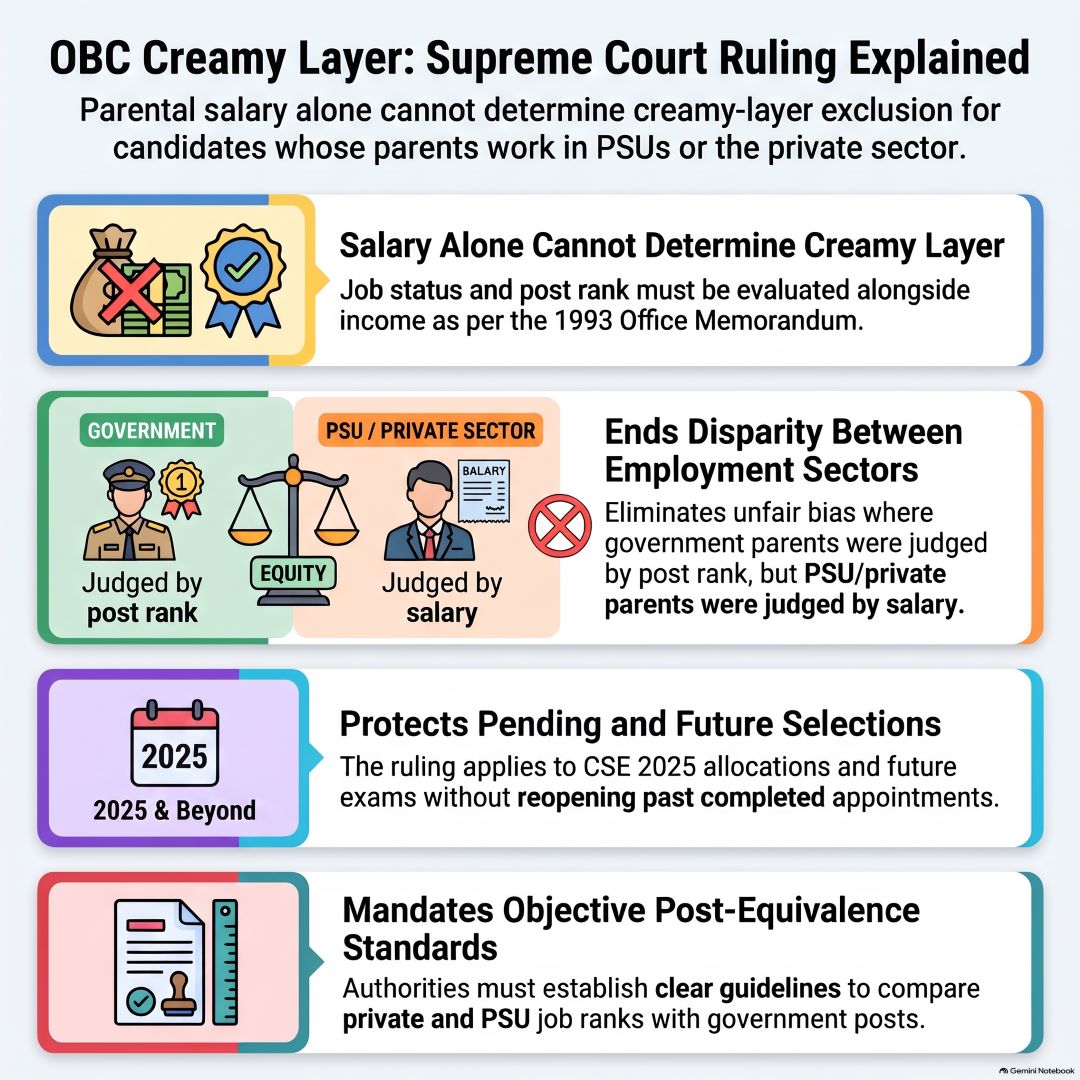
Source: The Hindu
Why in News?
On 6 November 2026, the Supreme Court clarified its 11 March ruling in Union of India v. Rohith Nathan (2026). The March ruling held that parental salary alone cannot decide the creamy-layer status of OBC candidates whose parents work in PSUs and private-sector organisations. The Union government asked for more time to implement it, and the Court gave it eight more weeks.
Understanding the OBC Creamy Layer
The creamy layer is the relatively advanced section of the OBCs, excluded from reservation so that benefits reach the genuinely disadvantaged.
How the idea developed?
- The Mandal Commission (appointed 1979, reported 1980) recommended 27% reservation for OBCs, implemented in 1990.
- Indra Sawhney v. Union of India (1992) upheld the 27% quota, capped total reservation at 50%, and introduced the creamy-layer exclusion.
How it is identified?
- Status and category of parents’ employment
- Constitutional and senior government positions
- Professional and business status
- Prescribed income and wealth criteria
Income ceiling over time: ₹1 lakh (1993), ₹2.5 lakh (2004), ₹4.5 lakh (2008), ₹6 lakh (2013), ₹8 lakh (2017).
Background: The 1993 and 2004 DoPT Orders
1993 Office Memorandum
- It set the criteria for identifying the creamy layer.
- It left salary and agricultural income out of the income and wealth test.
2004 clarification (14 October)
- It provided for counting the salary income of parents employed in PSUs and private-sector organisations.
- This created a mismatch: government employees were judged by the rank of their posts, while PSU and private-sector parents were judged by salary.
The consequence
- It was applied from CSE 2015.
- Nearly 100 OBC candidates who cleared the exam had their caste certificates rejected.
- Parental salary was counted without examining the status and category of the parents’ posts.
Supreme Court Judgment:
In Union of India v. Rohith Nathan (2026), the Court held that parental salary or income alone cannot decide creamy-layer status. It said:
- The status and category of the parent’s post must be considered.
- Equivalence with government posts (Group A, B, C and D) is relevant.
- The income and wealth criteria must be applied as per the 1993 OM.
- Exclusion based only on parental salary may amount to hostile discrimination.
- The ruling applies retrospectively to the candidates who were parties and intervenors, including through supernumerary posts where needed.
Supreme Court’s Clarification
The Union cited administrative difficulties and possible disruption of completed appointments. The Court granted eight more weeks and clarified:
|
Area |
Position |
|
CSE 2025 |
The ruling governs service allocation for eligible OBC candidates, as allocation is pending. |
|
Indian Forest Service |
It covers the 148 selected candidates. |
|
Existing appointments |
Completed selections, appointments, seniority and service allocations are not automatically reopened. |
|
Pending cases |
Similar candidates with cases before courts, tribunals or authorities may seek consideration on merits. |
|
Future selections |
Those after 11 March 2026 must follow the 1993 OM as interpreted by the Court. |
Constitutional Significance
- Article 14: Classification must rest on an intelligible differentia. It prevents arbitrary discrimination between similarly placed candidates in government, PSUs and private organisations.
- Article 16(4): Allows reservation in public employment for backward classes inadequately represented in State services.
- Article 141: The law declared by the Supreme Court binds all courts in India.
- Related provisions: Article 15(4), Article 340, Article 342A (102nd Amendment, 2018) and Article 338B.
The ruling ensures that creamy-layer exclusion rests on relevant social and occupational status, not parental salary alone.
Income Ceiling and Policy Challenges
The ceiling has stayed at ₹8 lakh a year since 2017, but income is only one part of the framework. Challenges remain:
- Post-equivalence: Clear criteria are needed to compare posts across government, PSUs and private organisations.
- Policy consistency: Different treatment across sectors creates uncertainty for candidates.
- Income ceiling revision: The unchanged threshold raises the question of periodic review.
- Administrative implementation: Authorities need transparent procedures to apply the interpretation consistently.
Way Forward
- Set objective criteria for equivalence of posts across sectors.
- Issue clear DoPT guidelines to prevent arbitrary exclusion of eligible candidates.
- Review the income and wealth criteria periodically.
- Implement uniformly while protecting completed appointments and service allocations.
Conclusion
The ruling brings government, PSU and private-sector parents under one logic: status of the post first, income and wealth as the 1993 OM prescribes. The next task is a workable system of post equivalence.