

Oil, Power, and Politics of Disruption
The Hindu
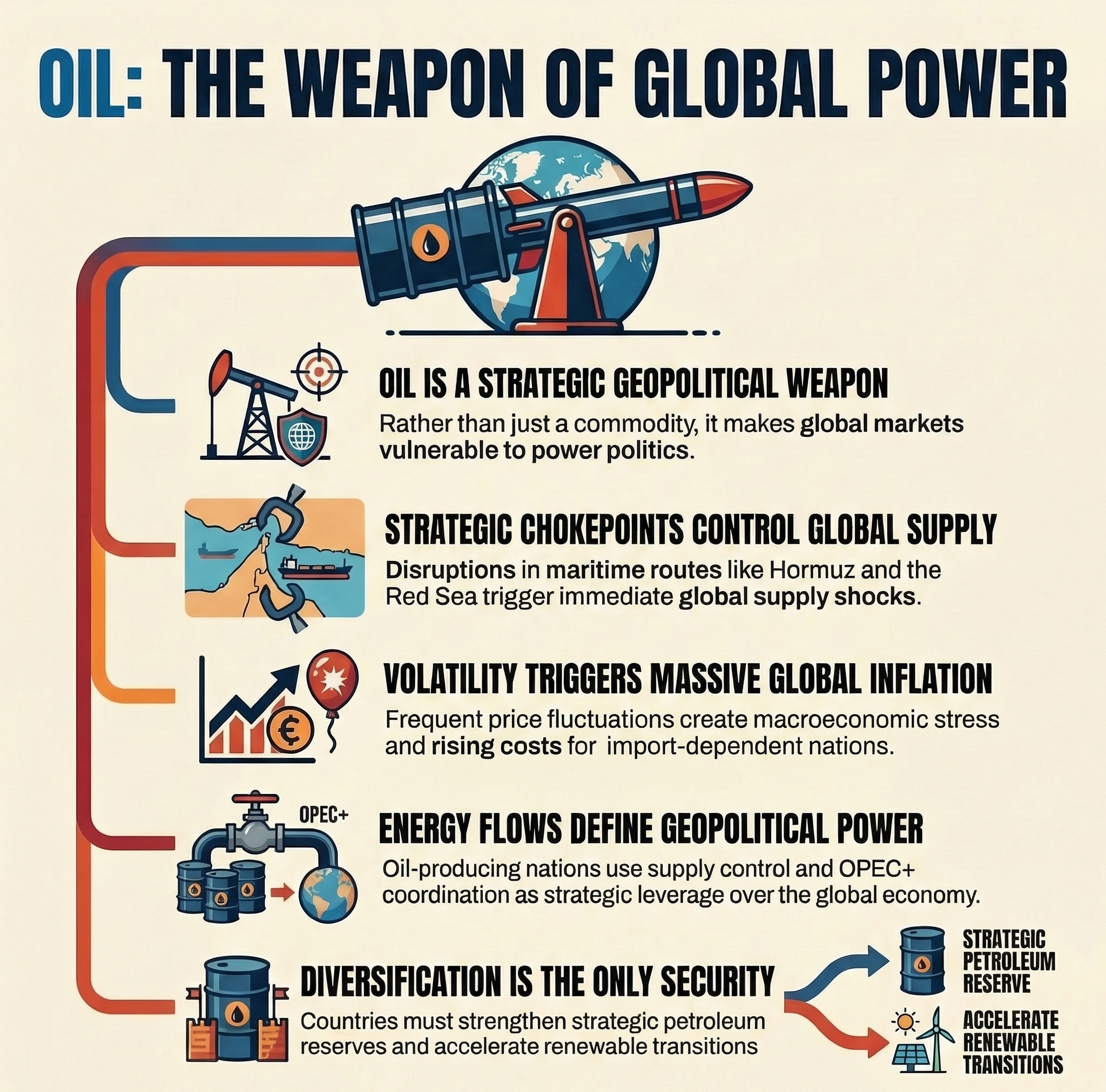
1. Key Arguments
A. Geopolitics Drives Oil Market Instability
Conflicts and tensions disrupt supply routes and production.
Events in West Asia, Russia-Ukraine, and maritime chokepoints directly influence oil flows and pricing.
B. Strategic Routes as Vulnerability Points
Critical maritime routes (Hormuz, Red Sea, etc.) are chokepoints.
Any disruption leads to supply shocks and increased transportation costs.
C. OPEC+ and Energy Politics
Oil-producing nations exercise strategic control over supply.
Production cuts and coordination influence global prices and political leverage.
D. Price Volatility and Economic Impact
Frequent fluctuations in oil prices affect global inflation.
Import-dependent countries like India face macroeconomic stress.
E. Energy Transition vs Fossil Fuel Dependence
Despite renewable push, oil remains central to global energy.
Transition is slow, making economies vulnerable to disruptions.
2. Author’s Stance
Realist and geopolitically aware
Focus on power politics in energy
The author views oil as a strategic tool rather than just a commodity.
Implicit concern for energy security
Highlights vulnerabilities of import-dependent economies.
3. Biases and Limitations
Geopolitical emphasis over economic fundamentals
Market forces like demand cycles and technological changes are underplayed.
Limited focus on renewable transition
Does not deeply analyse how renewables may reduce such vulnerabilities.
State-centric analysis
Less attention to private sector, innovation, and market adaptation.
4. Strengths (Pros)
Strong linkage between geopolitics and energy
Explains real-world disruptions effectively.
Relevance to current global conflicts
Timely analysis of ongoing geopolitical tensions.
Clear implications for energy-importing countries
Particularly relevant for India’s policy planning.
5. Weaknesses (Cons)
Insufficient economic depth
Limited discussion on pricing mechanisms, demand elasticity.
Lack of long-term transition analysis
Energy transition pathways are not explored in detail.
Overemphasis on disruption narrative
May exaggerate instability while ignoring resilience mechanisms.
6. Policy Implications
A. Energy Security Strategy
Diversification of import sources
Reducing dependence on specific regions.
B. Strategic Petroleum Reserves
Buffer against supply shocks
Strengthening storage capacity.
C. Renewable Energy Transition
Reducing fossil fuel dependence
Accelerating solar, wind, and green hydrogen.
D. Maritime Security
Securing sea lanes and trade routes
Naval presence and international cooperation.
E. Diplomatic Engagement
Balancing relations with oil-producing nations
Energy diplomacy as a strategic tool.
7. Real-World Impact
Economic Stability
Inflation and fiscal pressure
Rising oil prices affect subsidies, trade deficit.
Energy Access
Costlier fuel impacts households and industries
Transport and production costs increase.
Geopolitical Alignments
Countries align based on energy interests
Strategic partnerships evolve around oil supply.
Environmental Impact
Continued reliance on fossil fuels
Delays climate goals and sustainability targets.
8. UPSC GS Paper Linkages
GS Paper II (International Relations)
- Geopolitics of energy
- India’s foreign policy and energy diplomacy
GS Paper III (Economy & Environment)
- Energy security
- Inflation and macroeconomics
- Renewable energy transition
GS Paper I (Geography)
- Distribution of oil resources
- Strategic chokepoints
9. Balanced Conclusion
Oil remains both an economic commodity and a geopolitical weapon.
While disruptions highlight vulnerabilities, they also underscore the need for resilient and diversified energy strategies.
10. Future Perspective
Transition to multipolar energy systems
Shift from oil dominance to diversified energy mix.
Strengthening resilience mechanisms
Strategic reserves, alternative routes, and supply chains.
Accelerating clean energy adoption
Reducing long-term dependence on fossil fuels.
Enhanced global cooperation
Stability in energy markets requires coordinated international efforts.
Final Insight
In the modern world, control over energy flows is as significant as control over territory—making oil a central axis of global power politics.
