

On climate change, India has a good story to tell
Indian Express
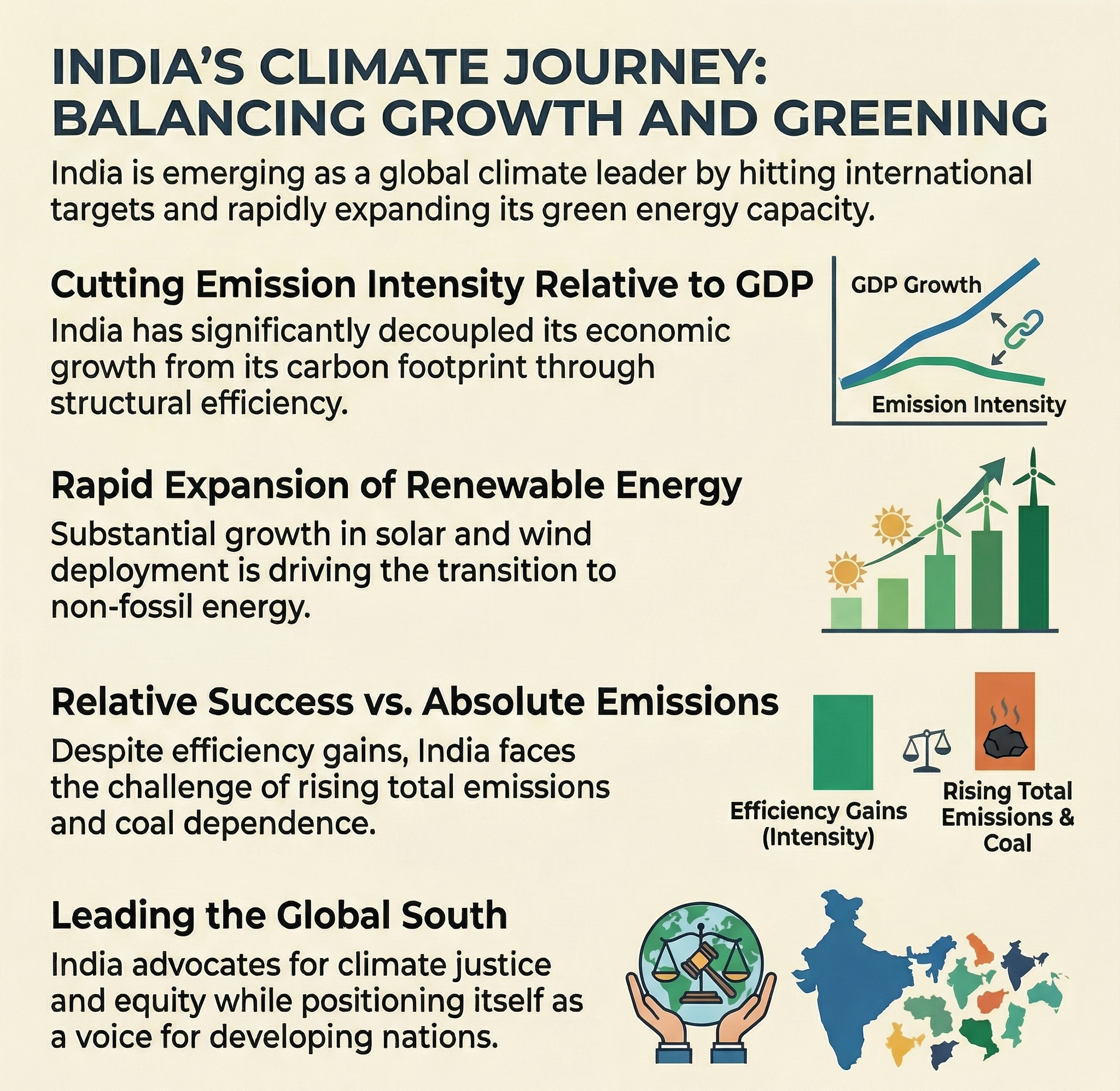
1. Key Arguments
A. Strong Performance in Emission Intensity Reduction
India has reduced emissions intensity significantly relative to GDP.
This reflects efficiency improvements and structural economic shifts.
B. Rapid Expansion of Renewable Energy
Non-fossil energy capacity has grown substantially.
Solar and wind deployment indicate a transition towards cleaner energy.
C. Alignment with Global Climate Commitments
India is meeting or exceeding its Paris Agreement targets.
Demonstrates credibility in international climate negotiations.
D. Development-Climate Balance
India prioritises economic growth alongside sustainability.
Recognises the need for energy access and poverty reduction.
E. Leadership in Global South
India positions itself as a voice for developing countries.
Advocates climate justice and equity in global forums.
2. Author’s Stance
Positive and defensive
Highlights achievements
Presents India’s climate record in favourable light.
Counters criticism from developed nations
Emphasises equity and differentiated responsibilities.
3. Biases and Limitations
National performance bias
Focuses on achievements while underplaying gaps.
Limited discussion of absolute emissions
India’s total emissions continue to rise.
Underexplored sectoral challenges
Coal dependence and industrial emissions are not deeply analysed.
4. Strengths (Pros)
Data-backed optimism
Highlights measurable progress.
Contextual understanding of development needs
Balances climate action with socio-economic realities.
Strong global positioning narrative
Enhances India’s diplomatic stance.
5. Weaknesses (Cons)
Selective emphasis
Downplays ongoing environmental challenges.
Limited forward-looking strategy
Focuses more on past achievements than future roadmap.
Insufficient critique of domestic policies
Implementation gaps not deeply analysed.
6. Policy Implications
A. Sustaining Renewable Growth
Scaling solar, wind, and storage technologies
Maintaining momentum in energy transition.
B. Addressing Coal Dependence
Gradual transition from fossil fuels
Ensuring just transition for affected regions.
C. Enhancing Climate Finance
Mobilising domestic and international resources
Supporting large-scale investments.
D. Strengthening Adaptation Measures
Building resilience to climate impacts
Agriculture, water, and infrastructure.
E. Global Climate Diplomacy
Advocating equity and differentiated responsibilities
Strengthening India’s leadership role.
7. Real-World Impact
Environmental Impact
Improved emission efficiency
Reduced carbon intensity.
Economic Impact
Growth of green industries
Investment and employment opportunities.
Global Standing
Enhanced credibility in climate negotiations
Leadership among developing nations.
Challenges
Rising absolute emissions and energy demand
Balancing growth with sustainability.
8. UPSC GS Paper Linkages
GS Paper III (Environment & Economy)
- Climate change
- Energy transition
- Sustainable development
GS Paper II (International Relations)
- Climate diplomacy
- Paris Agreement
GS Paper I (Geography)
- Environmental challenges
- Resource management
9. Balanced Conclusion
India’s climate story is indeed positive in relative terms, but not without significant challenges.
Achievements in emission intensity and renewables must be complemented by deeper structural changes.
10. Future Perspective
From relative success to absolute reduction
Addressing total emissions.
Accelerating clean energy transition
Reducing coal dependency.
Strengthening adaptation and resilience
Preparing for climate impacts.
Enhancing global leadership
Driving equitable climate action.
Final Insight
India’s climate narrative is credible, but its true success will depend on sustaining momentum while addressing emerging challenges in a rapidly changing world.
