

One Nation, One Election: Constitutional Reform or Misplaced Priority?
One Nation, One Election: Constitutional Reform or Misplaced Priority?
Relevance: GS Paper II (Indian Constitution, Polity, Federalism, Election-related Issues)
Context
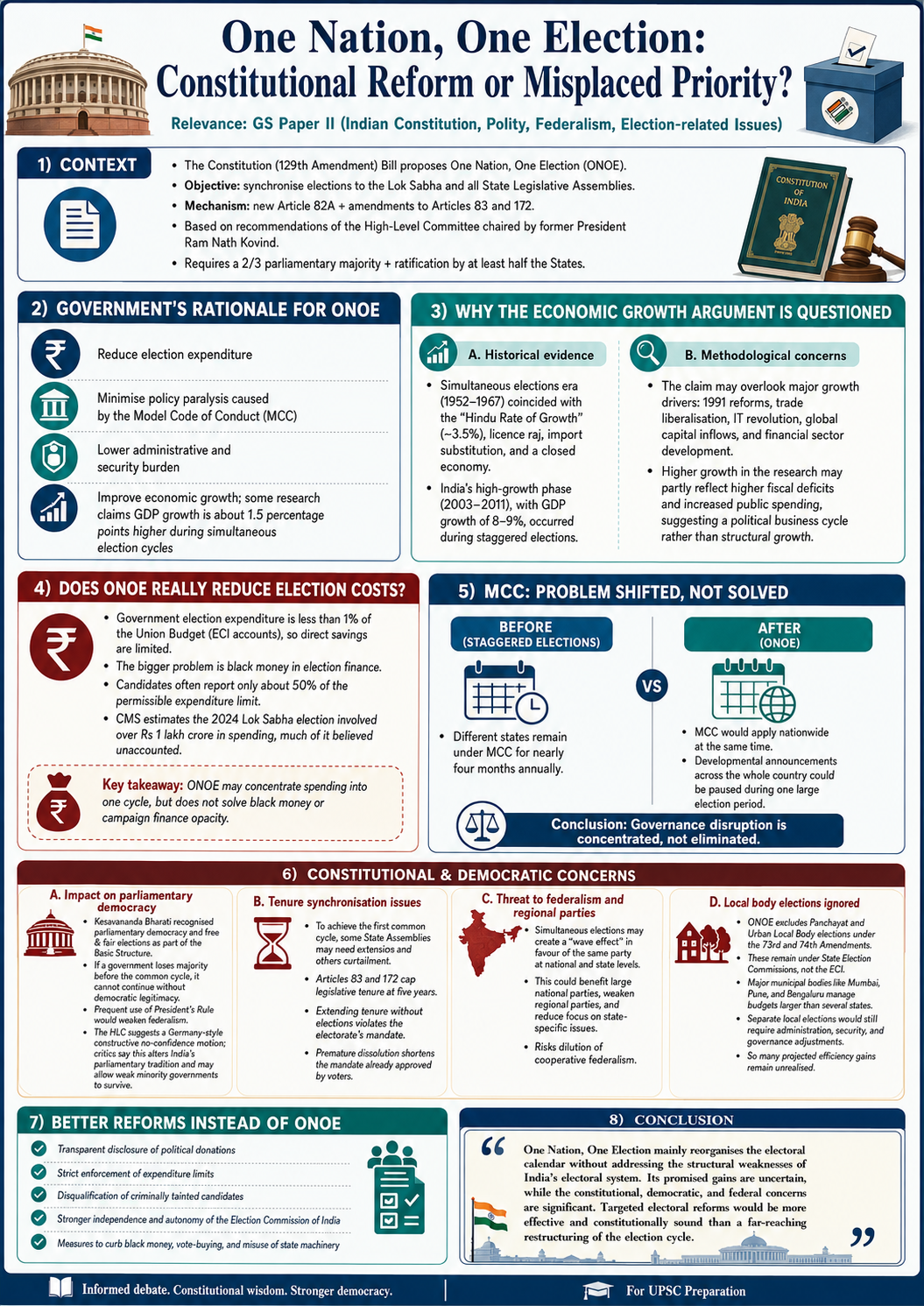
- The Constitution (129th Amendment) Bill seeks to implement One Nation, One Election (ONOE) by synchronising elections to the Lok Sabha and all State Legislative Assemblies.
- This will be achieved through insertion of a new Article 82A and amendments to Articles 83 and 172.
- The proposal is based on recommendations of the High-Level Committee (HLC) chaired by former President Ram Nath Kovind, and requires a two-thirds parliamentary majority plus ratification by at least half the States.
- This warrants critical evaluation of the government's rationale alongside constitutional, political, and economic concerns.
Government's Rationale for ONOE
- Reduction in election expenditure.
- Minimising policy paralysis caused by the Model Code of Conduct (MCC).
- Lower administrative and security burden.
- Higher economic growth — citing research claiming GDP growth is around 1.5 percentage points higher during simultaneous election cycles.
Questioning the Economic Growth Argument
- Historical evidence contradicts the claim:
- India's period of simultaneous elections (1952-1967) coincided with the "Hindu Rate of Growth" (~3.5% annually), marked by the licence raj, import substitution, and a closed economy.
- India's highest growth phase (2003-2011), with GDP growth of 8-9%, occurred during staggered elections.
- Methodological concerns with the cited research:
- It may not adequately account for major growth drivers such as the 1991 economic reforms, trade liberalisation, the IT revolution, global capital inflows, and financial sector development.
- The reported growth appears partly driven by higher fiscal deficits and increased government expenditure, raising the possibility of a political business cycle rather than sustainable structural growth.
Does ONOE Actually Reduce Election Costs?
- Government election expenditure constitutes less than 1% of the Union Budget, per Election Commission of India (ECI) accounts — so the scope for savings here is limited.
- The real issue is black money in election financing: candidates officially report spending only about 50% of the permissible expenditure limit, suggesting substantial unaccounted financing.
- The Centre for Media Studies (CMS) estimates the 2024 Lok Sabha election involved over Rs 1 lakh crore in expenditure, much of it believed unaccounted.
- Conclusion: ONOE merely concentrates election expenditure into one cycle rather than reducing the role of black money or campaign financing.
MCC: Problem Shifted, Not Solved
- Currently, different states remain under the Model Code of Conduct (MCC) for nearly four months annually due to staggered elections.
- Under ONOE, the MCC would apply simultaneously nationwide, suspending developmental announcements across the entire country during one large election period.
- This concentrates governance disruption rather than eliminating it, making the claim of ending "policy paralysis" questionable.
Constitutional and Democratic Concerns
Impact on Parliamentary Democracy
- The Kesavananda Bharati judgment recognised parliamentary democracy and free and fair elections as part of the Basic Structure of the Constitution.
- If a government loses its majority before the common election cycle, it cannot continue without democratic legitimacy — frequent recourse to President's Rule would undermine federalism.
- The HLC proposes adopting Germany's constructive no-confidence motion model, where a no-confidence motion must simultaneously elect an alternative government. Critics argue this alters India's parliamentary tradition and could enable weak minority governments to remain in office.
Tenure Synchronisation Issues
- Achieving the first synchronised election cycle would require extending some State Assemblies' tenure while curtailing others.
- Articles 83 and 172 limit legislative tenure to five years — extending tenure without elections violates the electorate's mandate, while premature dissolution shortens the tenure voters actually approved.
- Both options, therefore, compromise democratic legitimacy in different ways.
Threat to Federalism and Regional Parties
- Research points to a "wave effect" — simultaneous elections encourage voters to support the same party at both national and state levels.
- Potential consequences: electoral advantage for large national parties, weakening of regional parties, and reduced attention to state-specific issues like agrarian distress, coastal livelihoods, flood management, and regional development priorities.
- This risks diluting India's cooperative federal structure.
Ignoring Local Government Elections
- The proposal excludes elections to Panchayats and Urban Local Bodies, which are constitutionally protected under the 73rd and 74th Constitutional Amendments.
- Local body elections remain under State Election Commissions, not the ECI.
- Municipal corporations such as Mumbai, Pune, and Bengaluru manage budgets exceeding those of several states — underscoring their significance.
- Since separate local elections would still require administrative deployment, security arrangements, and cause governance disruptions, many of ONOE's projected efficiency gains remain unrealised.
Reforms Needed Instead of ONOE
- Transparent disclosure of political donations.
- Strict enforcement of expenditure limits.
- Disqualification of criminally tainted candidates.
- Strengthening the independence and autonomy of the Election Commission of India.
- Measures to curb black money, vote-buying, and misuse of state machinery.
Conclusion
The proposed One Nation, One Election framework primarily reorganises India's electoral calendar without addressing the structural weaknesses of the electoral system. The anticipated gains remain uncertain, while the proposal raises significant constitutional and federal concerns. Strengthening electoral integrity through targeted reforms would be a more effective and constitutionally sound approach than undertaking a far-reaching constitutional restructuring.
