

One Rath Yatra, Two Traditions: The Puri-ISKCON Dispute

One Rath Yatra, Two Traditions: The Puri-ISKCON Dispute
Relevance: GS Paper I (Indian Culture, Religious Traditions) | GS Paper II (Governance, Institutions, Centre-State/Religious Body Relations)
Why in the News?
1. A long-running dispute over the celebration dates of Lord Jagannath's Rath Yatra has escalated into a major religious controversy.
2. The Shree Jagannath Temple Managing Committee (SJTMC) has accused the International Society for Krishna Consciousness (ISKCON) of violating sacred scriptures by holding the chariot festival on dates outside the prescribed calendar.
3. The row intensified after ISKCON ended discussions with the SJTMC and the Shree Jagannath Temple Administration (SJTA), indicating it would continue its worldwide Rath Yatra under its existing model.
4. Gajapati Maharaja Dibyasingha Deb, chairman of SJTMC, wrote to President Droupadi Murmu and PM Narendra Modi, seeking intervention to stop what he called "untimely" Rath Yatras.
The Puri Temple's Position: A Scripturally Fixed Calendar
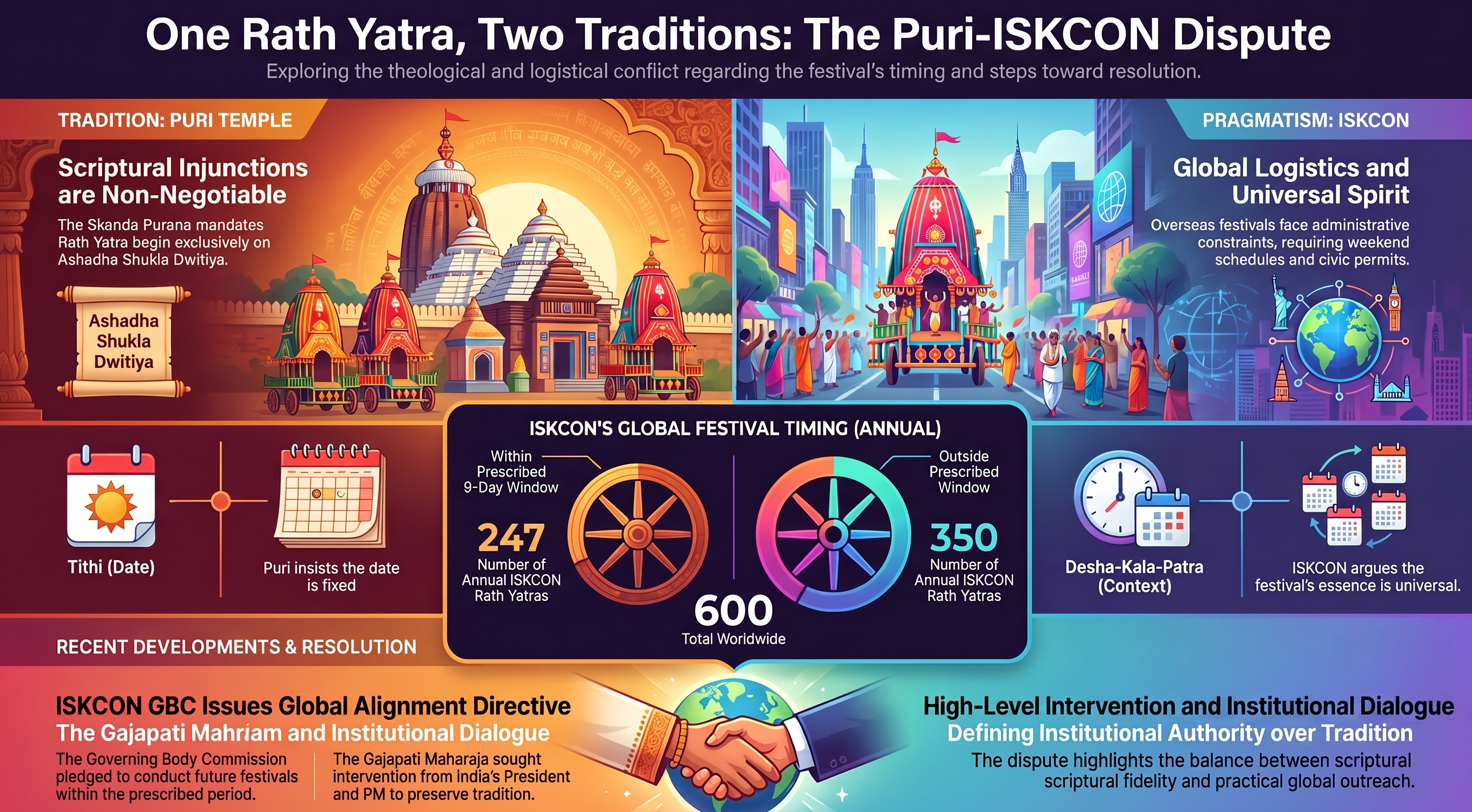
1. According to Deb, Lord Jagannath himself prescribed the timing of the annual festivals in the Purushottama Kshetra Mahatmya section of the Skanda Purana.
2. As per scripture: Snana Yatra must be observed only on Jyeshtha Purnima, while the nine-day Rath Yatra must begin exclusively on Ashadha Shukla Dwitiya.
3. Similar references in the Narada Purana are cited to reinforce that the prescribed tithi (lunar date) is an integral, non-negotiable part of the ritual.
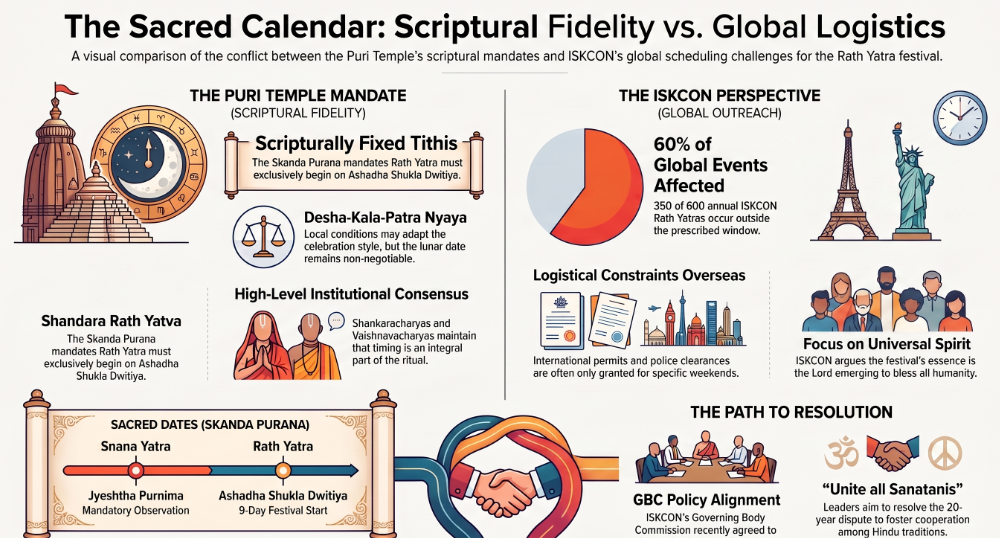
4. Deb notes that while the manner of celebration can be adapted per local conditions (desha-kala-patra nyaya), the tithi itself cannot be altered under any circumstances.
5. Temple scholars, after examining ISKCON's theological arguments in a high-level meeting last year, rejected the organisation's interpretation and reaffirmed that Rath Yatra anywhere in the world must begin only on Ashadha Shukla Dwitiya.
6. Deb also cited the views of leading Shankaracharyas, Vaishnavacharyas, and the Mukti Mandap Pandita Sabha (presided over by the Shankaracharya of Govardhan Peeth, Puri) — all of whom maintain that Snana Yatra and Rath Yatra must be observed only on the scripturally prescribed tithis.
7. Deb's core argument: this is not merely a timing issue but a question of preserving the authentic identity of a centuries-old tradition, questioning how an organisation following the Bhagavad Gita could disregard Lord Jagannath's own scriptural injunction.
ISKCON's Position: Logistics vs. Sacred Schedule
1. ISKCON rejects the allegation that it has violated scriptures, arguing that staging chariot festivals across continents involves legal, logistical, and administrative constraints.
2. Permissions from civic authorities, police, and other agencies overseas are often available only on weekends or dates fixed months in advance, making strict adherence to the nine-day Ashadha window impractical.
3. ISKCON organises nearly 600 Rath Yatras worldwide annually; of these, about 247 are held within the prescribed nine-day period, while around 350 take place outside that window due to local constraints.
4. ISKCON maintains it has agreed to follow Puri traditions strictly for Rath Yatras held within India.
5. Banamali Dasa, regional secretary of ISKCON, told Business Standard that the organisation holds the SJTA in the "highest regard" and has aligned its India dates with Puri, while it works to convince overseas leaders and has urged government involvement in the matter.
6. ISKCON's broader argument: the essence of Rath Yatra lies not in a fixed date but in the moment Lord Jagannath emerges from the temple to bless all humanity without discrimination — a universal spirit it says it has faithfully spread globally for years.
Recent Development: A Step Toward Resolution
1. The Governing Body Commission (GBC) of ISKCON clarified that Rath Yatra will be conducted across the centres of the Global Hare Krishna Movement during the prescribed nine-day period, as advised by the Shree Jagannath Temple at Puri.
2. This was framed as a gesture toward unity and cooperation among traditions and institutions.
3. Madhu Pandit Dasa, GBC chairman, expressed hope in a letter to Deb that the decision would "unite all Sanatanis" in service to Lord Jagannath and his devotees.
Broader Context
1. The Shree Jagannath Temple Administration has attempted to resolve the issue through dialogue with ISKCON for nearly two decades, including scholars' meetings, correspondence, and repeated interventions by the Odisha government.
2. Despite this sustained engagement, Deb alleges ISKCON continued organising Snana Yatras and Rath Yatras on "random dates" globally, hurting devotees' religious sentiments.
3. The dispute highlights broader questions about institutional authority over religious tradition, the balance between scriptural fidelity and practical global outreach, and the role of civil administration in matters of religious practice.
