

Opening the floodgates
The Statesman
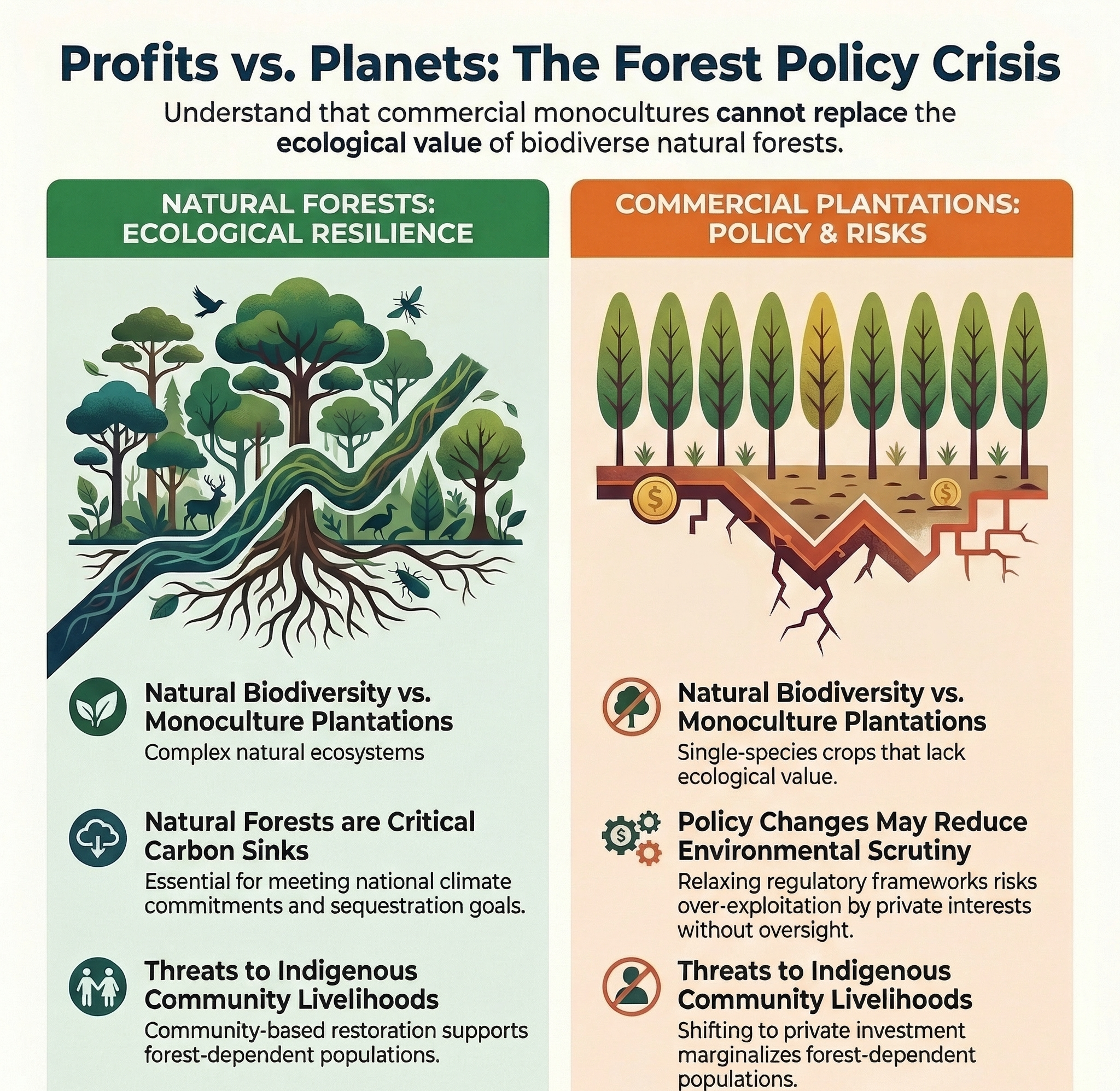
Key Arguments of the Article
Forest Policy Shift Toward Commercialisation
The article claims that amendments to forest laws and policies have opened avenues for private sector involvement in forest land management. Historically, forest corporations engaged in plantation-based forestry to supply timber and industrial raw materials.
However, the author suggests that such models often replaced biodiverse natural forests with monoculture plantations.
Ecological Value of Natural Forests
A central argument of the article is that natural forests possess significantly higher ecological value than commercial plantations. Natural forests support biodiversity, ecological resilience, and long-term carbon sequestration.
Monoculture plantations, by contrast, may provide economic returns but cannot replicate ecosystem services provided by natural forests.
Rehabilitation of Degraded Forests
The article highlights that degraded forest lands were previously targeted for rehabilitation through community-based restoration and conservation programmes.
However, new policy changes may prioritise commercial forestry or private investment instead of ecological restoration.
Risk of Reduced Environmental Oversight
The author argues that relaxing regulatory frameworks could reduce scrutiny and environmental safeguards.
Increased private participation without strong monitoring mechanisms may lead to over-exploitation of forest resources.
Climate and Biodiversity Concerns
The article connects forest conservation with climate change mitigation. Natural forests act as major carbon sinks and play a critical role in maintaining ecological balance.
Weakening forest protection could undermine India’s climate commitments and biodiversity conservation goals.
Author’s Stance
The author adopts a strongly conservation-oriented stance. The narrative clearly prioritises ecological protection and expresses scepticism toward commercial forestry initiatives.
The argument reflects an environmentalist perspective that views policy liberalisation as a potential threat to natural ecosystems.
Possible Biases
Environmental Advocacy Bias
The article emphasises ecological risks and may underrepresent potential economic benefits of forestry investments.
Limited Economic Perspective
The discussion focuses largely on environmental implications, with relatively less attention to economic development needs such as timber supply or rural livelihoods.
Policy Skepticism
There is a noticeable scepticism toward regulatory reforms that allow greater private participation.
Advantages of the Environmental Argument
Protection of Biodiversity
Preserving natural forests helps maintain ecosystems, wildlife habitats, and ecological balance.
Climate Change Mitigation
Natural forests act as major carbon sinks and contribute significantly to climate regulation.
Long-Term Sustainability
Conservation-oriented policies support sustainable resource management.
Community Livelihoods
Healthy forests sustain livelihoods of indigenous and forest-dependent communities.
Concerns Regarding Strict Conservation Approach
Economic Opportunity Costs
Restricting commercial forestry may limit industrial supply of timber and forest-based products.
Rural Development Challenges
Some forest regions require economic activities to support local livelihoods.
Administrative Complexity
Balancing conservation with development requires strong institutional capacity.
Policy Implications
Strengthening Ecological Safeguards
Environmental regulations should ensure that natural forests are protected from excessive commercial exploitation.
Community-Based Forest Management
Involving local communities in forest governance can improve conservation outcomes.
Sustainable Forestry Practices
Plantation forestry should complement, not replace, natural forests.
Climate Policy Integration
Forest conservation must align with India’s climate commitments and carbon sequestration goals.
Transparent Environmental Governance
Decision-making related to forest land use should remain transparent and accountable.
Real-World Impact
If conservation safeguards are strengthened:
• Protection of biodiversity and ecosystems
• Improved climate resilience
• Sustained livelihoods for forest communities
If safeguards weaken:
• Accelerated deforestation
• Loss of biodiversity
• Increased ecological vulnerability
• Conflict between development and environmental interests
Alignment with UPSC GS Papers
GS Paper III
Environment and ecology, conservation policies, climate change mitigation, biodiversity protection.
GS Paper II
Governance of natural resources, environmental laws, and policy frameworks.
GS Paper I
Distribution and importance of natural resources, environmental geography.
GS Paper IV
Ethical responsibility in environmental governance and sustainable development.
Balanced Assessment
The article raises important concerns about the ecological consequences of forest policy changes. Natural forests provide irreplaceable ecological services and must remain central to conservation strategies.
At the same time, policy frameworks must balance environmental protection with legitimate economic and developmental needs.
Future Perspective
India’s environmental governance must increasingly focus on sustainable forest management models that integrate ecological conservation, community participation, and economic viability.
For policymakers and civil services aspirants, the debate illustrates the broader challenge of balancing development imperatives with environmental sustainability in a rapidly growing economy.
