

Pakistan-Saudi Arabia-Turkey Mutual Defence Pact

Pakistan-Saudi Arabia-Turkey Mutual Defence Pact (Mecca Agreement) —
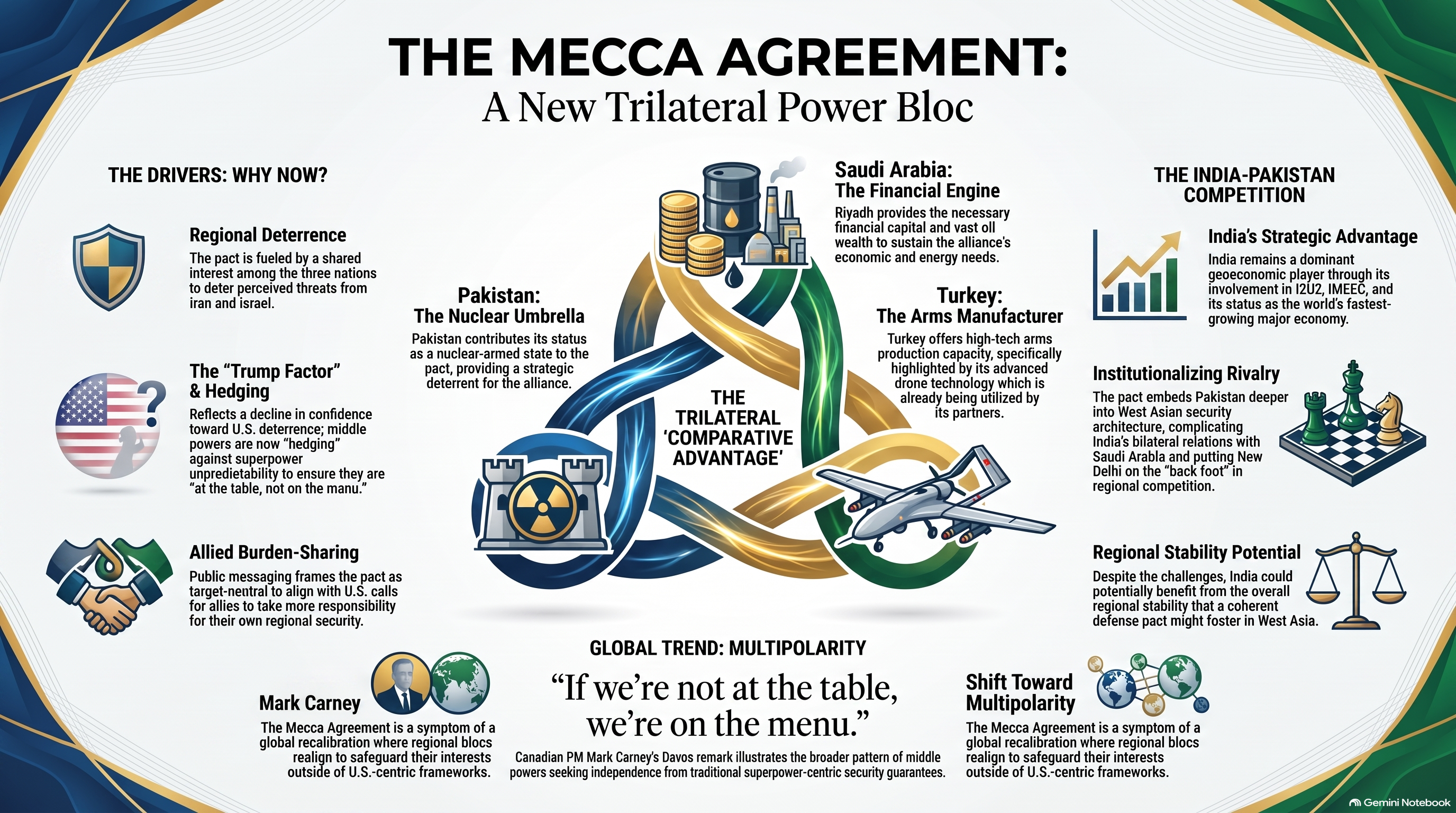
1. Context / Background
- New trilateral mutual defence agreement signed between Pakistan, Saudi Arabia, and Turkey.
- Builds on existing bilateral ties:
- Pakistan-Saudi Arabia defence pact (signed last year).
- Pakistan-Turkey defence cooperation, including Pakistan's use of Turkish drones in its conflict with India last year.
- Turkey-Saudi Arabia rapprochement, driven by a 2023 Turkish drones deal, following years of tension.
- Cooperation among the three intensified further during the Iran war.
2. Drivers Behind the Pact
A. Regional security imperative
- Shared interest in deterring Iran and Israel.
- Complementary strengths ("comparative advantage"):
- Pakistan → nuclear capability
- Saudi Arabia → financial capital/oil wealth
- Turkey → arms production capacity
B. The "Trump factor" (US unpredictability)
- Reflects declining confidence in US deterrence capacity in West Asia — Washington seen as unable to deter Iran and unwilling to restrain Israel.
- A hedge against unpredictability in US policy toward Israel, Iran, and the wider region.
- Simultaneously crafted to be acceptable to Washington — public messaging stresses the pact targets no specific country (pre-empting US concern it could be used against Israel), aligning with Trump's push for allied burden-sharing.
3. Wider Global Trend Reflected
- Illustrates a broader pattern of middle powers hedging against superpowers — echoing Canadian PM Mark Carney's Davos remark: "if we're not at the table, we're on the menu."
- Seen as reinforcing multilateralism and multipolarity.
4. Implications for India
Potential positives
- India could benefit from regional stability the pact may foster.
- India's independent strengths in West Asia's geoeconomic architecture:
- Participation in I2U2 and IMEEC
- Strong bilateral ties with Israel
- Status as the world's fastest-growing major economy and attractive investment destination
- Note: India has itself pursued similar hedging strategies — e.g., managing rapprochement with China, pursuing an India-EU FTA — amid US unpredictability.
Challenges for India
- Institutionalises a security partnership linking:
- Pakistan (India's rival)
- Turkey (strained ties with India)
- Saudi Arabia (one of India's closest West Asian partners)
→ Complicates India's bilateral calculus with Riyadh. - Embeds Pakistan deeper into West Asia's security architecture, a region India also views as strategically vital (energy imports, expatriate population, key partnerships).
- West Asia has become a battleground for India-Pakistan strategic competition; the pact, for now, puts India on the back foot there.
5. Key Takeaway
- The Mecca pact is less about targeting India directly and more a symptom of global recalibration away from US-centric security guarantees.
- For India, it signals the need to actively safeguard its West Asia partnerships (especially with Saudi Arabia) even as regional blocs realign.
