

PERILS OF PROMOTING ANCIENT REMEDIES

PERILS OF PROMOTING ANCIENT REMEDIES
Subject: Science & Technology | Health | Ethics
Source: The Hindu
Why in News?
Recent controversy over claims regarding the medicinal properties of cow urine and the use of such claims to demonstrate the scientific validity of traditional practices has renewed the debate over scientific temper, research integrity and evidence-based validation of traditional knowledge.
Core Issue
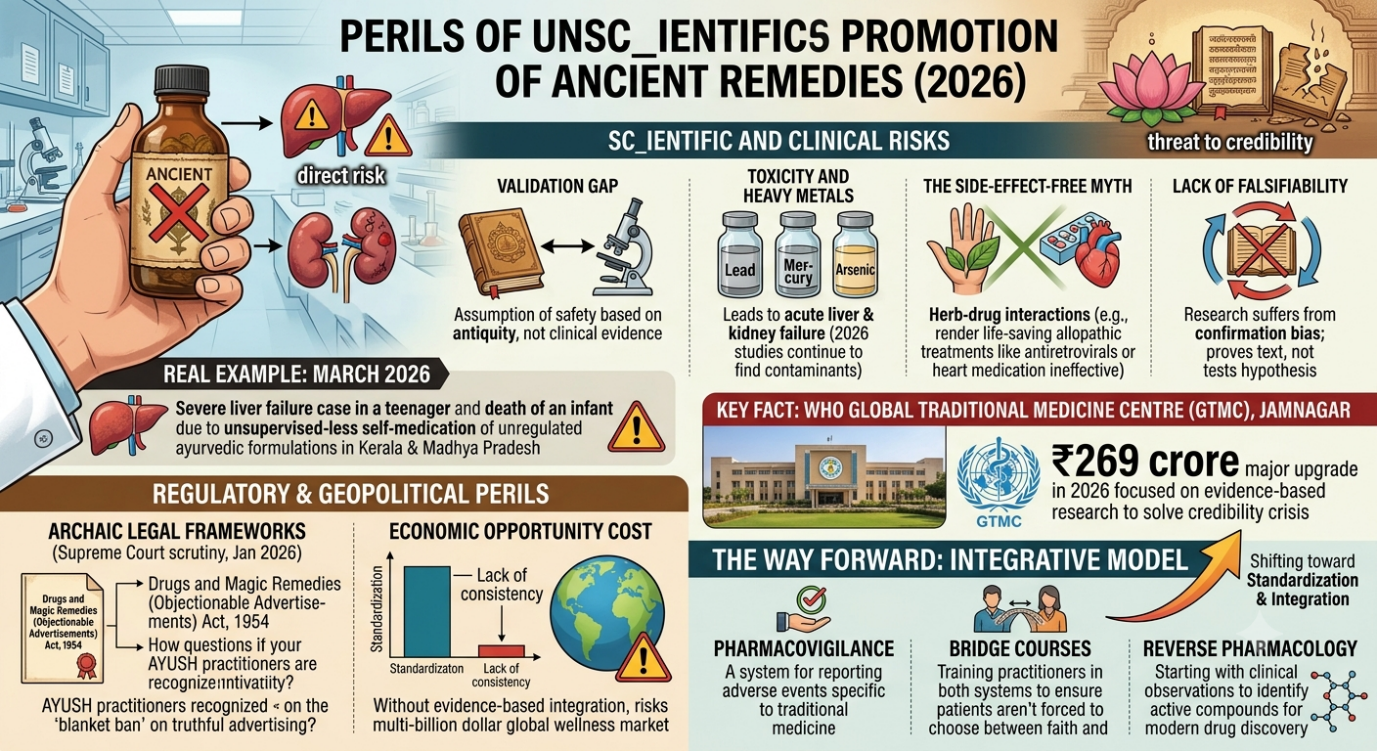
Traditional knowledge can provide valuable leads for scientific research, but ancient origin does not establish scientific validity. The concern arises when research begins with a preconceived belief and selectively searches for evidence to confirm it.
Major Concerns
1. Confirmation Bias
- Research may begin with the assumption that an ancient remedy must be effective.
- Positive findings are highlighted while contradictory evidence is ignored.
2. Weak Scientific Evidence
- Finding bioactive compounds or trace minerals in a substance does not establish therapeutic efficacy.
- Petri-dish/laboratory evidence ≠ proven clinical benefit.
3. Safety Risks
- “Natural” does not automatically mean safe.
- Traditional remedies may contain heavy metals, microbes, contaminants or toxic compounds.
- Dosage and bioavailability can vary depending on cultivation and processing.
4. Research Misconduct
- Selective reporting, manipulated data and fabricated results can make ineffective remedies appear successful.
- Examples include controversies surrounding papaya leaf extract and curcumin research.
5. Politicisation of Science
- State-supported attempts to validate cultural or religious beliefs through science can undermine institutional autonomy and scientific credibility.
Scientific Temper
Article 51A(h) requires citizens to develop:
Scientific temper + Humanism + Spirit of inquiry and reform
Scientific temper does not mean rejecting traditional knowledge. It means testing every claim through evidence, irrespective of its cultural or religious origin.
Traditional Knowledge: The Correct Approach
Traditional knowledge → Research hypothesis → Laboratory testing → Toxicity assessment → Clinical trials → Independent replication → Evidence-based adoption
Example: Artemisinin
Traditional Chinese medicine provided clues for investigating anti-malarial plants. Researchers subsequently conducted rigorous experiments before developing artemisinin, which later received global recognition through the 2015 Nobel Prize in Physiology or Medicine.
Way Forward
- Establish stronger research integrity mechanisms for detecting fabrication, falsification and selective reporting.
- Create an independent Research Integrity Office/Ombudsman.
- Make public research funding dependent on methodological rigour, reproducibility and scientific merit.
- Subject traditional remedies to modern toxicological, pharmacological and clinical testing.
- Ensure transparency through access to clinical-trial data and research methodology.
- Distinguish clearly between traditional belief, hypothesis, preliminary evidence and clinically established fact.
