

Personal Insolvency and Bankruptcy under the IBC, 2016

Personal Insolvency and Bankruptcy under the IBC, 2016
Why in News?
The National Company Law Tribunal (NCLT) recently declared Venugopal Dhoot, former promoter of Videocon Industries, bankrupt for failing to meet his personal guarantee obligations on loans worth ₹12,668 crore extended by the State Bank of India (SBI).
Understanding Personal Insolvency and Bankruptcy
- Personal Insolvency: A financial situation in which an individual is unable to repay their debts when they become due.
- Personal Bankruptcy: A legal process through which an individual is formally declared bankrupt, and their assets are administered and distributed among creditors to repay outstanding debts.
|
About Insolvency and Bankruptcy Code (IBC)
|
Difference between Corporate and Personal Insolvency
|
Basis |
Corporate Insolvency |
Personal Insolvency |
|
Debtor |
Company or corporate entity |
Individual |
|
Objective |
Rescue the company or liquidate its assets |
Resolve an individual's debts or distribute their assets |
|
Assets involved |
Company assets |
Personal estate and eligible assets of the individual |
|
Legal framework |
IBC, 2016 |
IBC, 2016 |
Personal Guarantor: Why Can Banks Recover a Company's Debt from an Individual?
A personal guarantor is an individual who legally promises to repay a loan if the primary borrower (usually a company) fails to do so.
- Promoters and directors often provide personal guarantees to banks while securing loans for their companies.
- If the company defaults, the lender can invoke the personal guarantee and initiate proceedings against the guarantor.
- This creates a separate legal basis for holding the individual liable for the guaranteed debt.
Example: Suppose a company borrows ₹100 crore from a bank, and its promoter provides a personal guarantee.
- If the company fails to repay the loan, the bank can initiate insolvency proceedings against the company.
- The bank can also pursue the promoter under the personal guarantee.
- Thus, the promoter's personal assets may become subject to legal recovery proceedings.
How Does Personal Insolvency Work under the IBC?
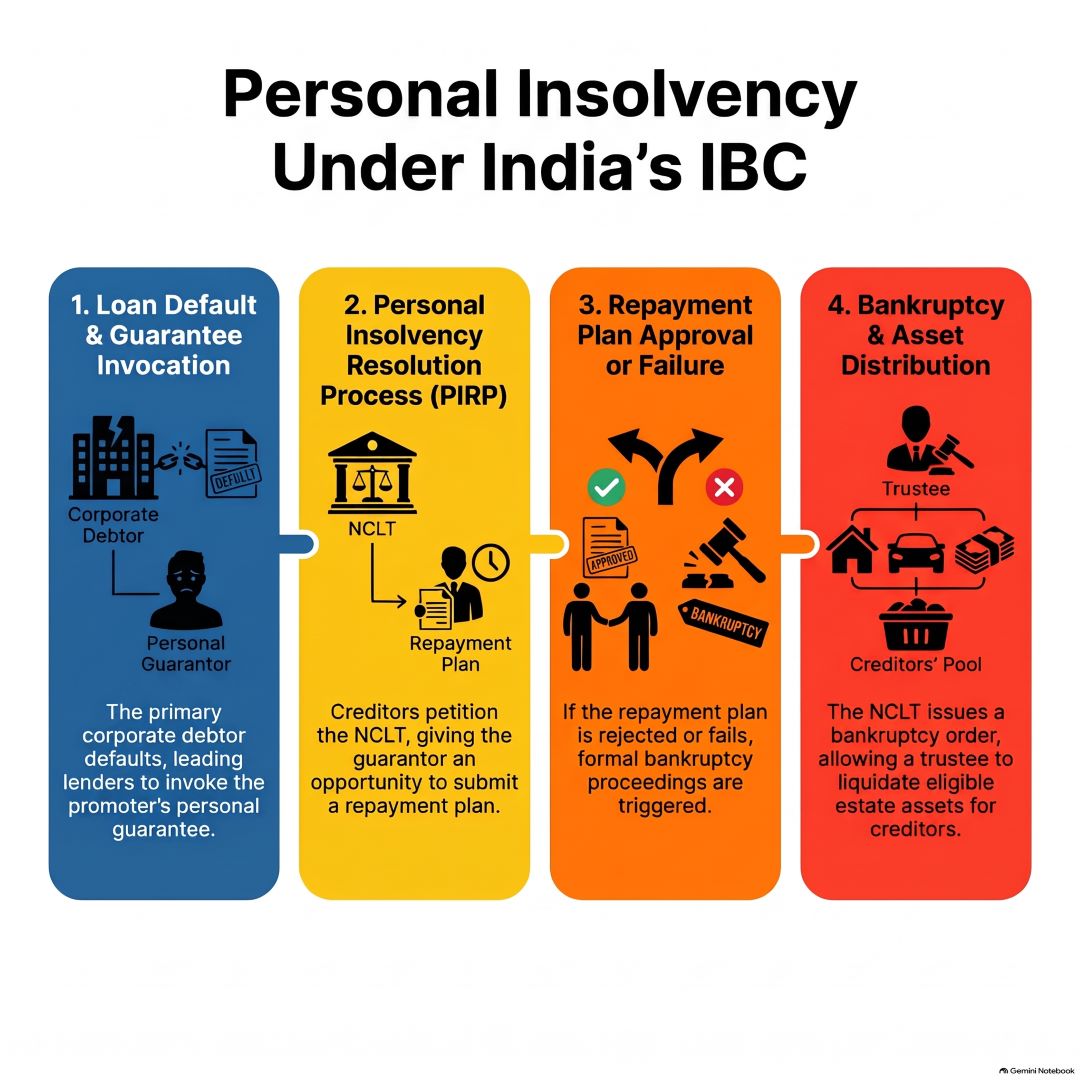
The IBC provides a legal mechanism for dealing with the financial failure of personal guarantors to corporate debtors.
- Default: The company fails to repay its loan, and the bank invokes the personal guarantee.
- Personal Insolvency Resolution Process (PIRP): The creditor approaches the NCLT to initiate insolvency proceedings against the personal guarantor. The individual gets an opportunity to submit a repayment plan.
- Approval or failure of resolution: If an acceptable repayment plan is approved, the individual must fulfil its terms. If the process fails, bankruptcy proceedings may follow.
- Bankruptcy: NCLT may pass a bankruptcy order, following which a bankruptcy trustee administers the individual's estate and distributes the proceeds among creditors according to the legal priority.
What Happens After an Individual Is Declared Bankrupt?
- The individual's estate vests in a bankruptcy trustee.
- The individual must disclose relevant details of assets, liabilities, income and financial affairs.
- The trustee takes control of the bankruptcy estate, realises eligible assets and distributes proceeds among creditors.
- Certain assets and property are protected or excluded under applicable legal provisions.
- A person adjudged bankrupt is subject to statutory restrictions, including restrictions on acting as a company director.
Important Legal Provisions under the IBC, 2016
|
Provision |
Significance |
|
Part III |
Deals with insolvency resolution and bankruptcy of individuals and partnership firms. |
|
Section 94 |
Allows a debtor to initiate their own insolvency resolution process. |
|
Section 95 |
Allows creditors to apply for initiation of an individual's insolvency resolution process. |
|
Section 100 |
Deals with admission or rejection of an insolvency resolution application. |
|
Section 121 |
Provides for an application for bankruptcy. |
|
Section 126 |
Deals with restrictions imposed on a bankrupt individual. |