

PFAS CONTAMINATION IN INDIA: FOREVER CHEMICALS AND EMERGING ENVIRONMENTAL RISKS

PFAS CONTAMINATION IN INDIA: FOREVER CHEMICALS AND EMERGING ENVIRONMENTAL RISKS
Context
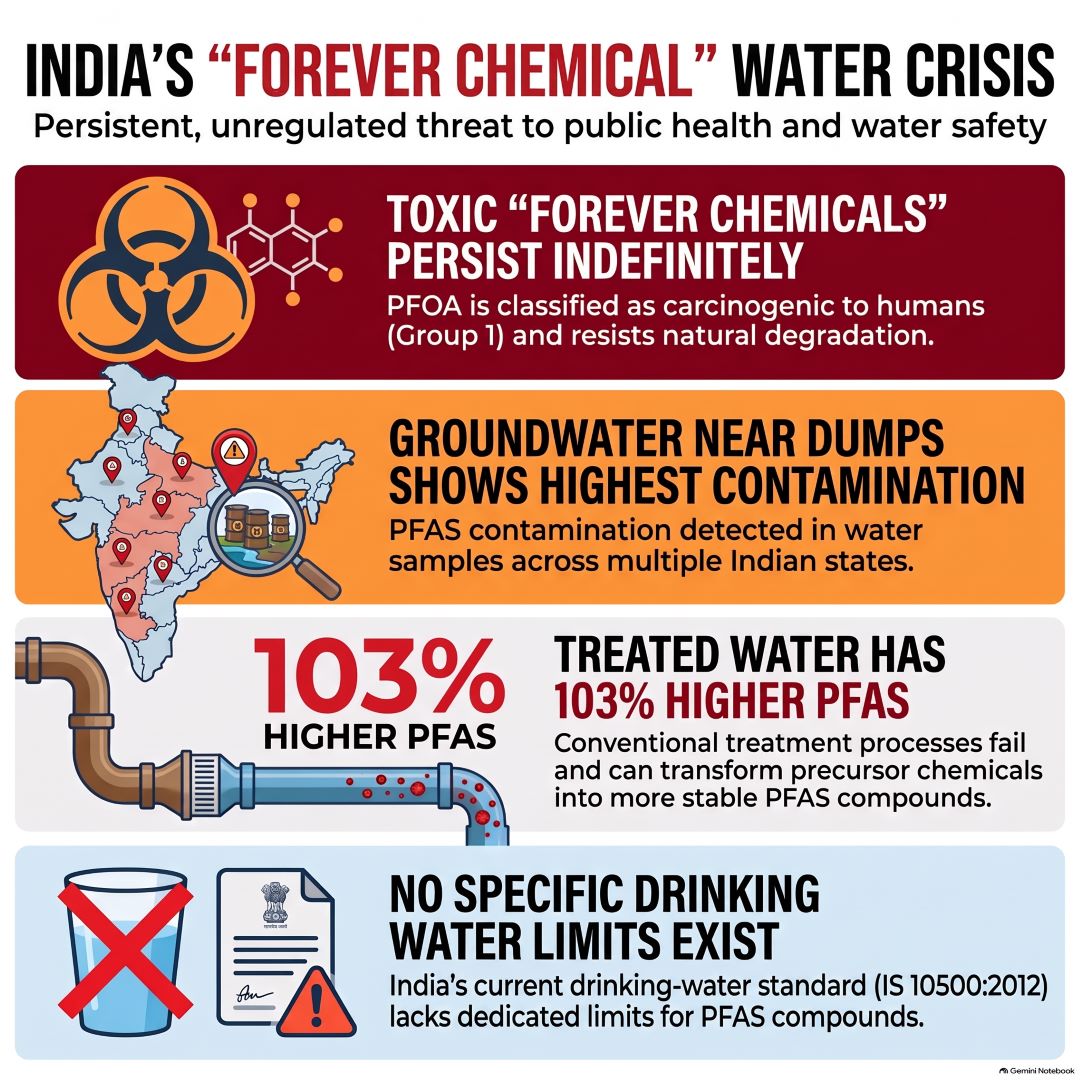
- PFAS contamination has been detected in water samples across multiple Indian states, raising concerns about public health, ecological impacts and the adequacy of existing water-treatment systems.
- India does not currently have a dedicated PFAS-specific drinking-water limit under the IS 10500:2012 standard, while the regulatory framework for these emerging contaminants is under consideration.
What Are PFAS?
- Definition: Per- and polyfluoroalkyl substances (PFAS) are a large group of synthetic chemicals containing strong carbon–fluorine bonds.
- Applications: Used in textiles, non-stick coatings, food packaging, firefighting foams and various industrial products.
- Persistence: Their resistance to environmental degradation has earned them the name “forever chemicals”.
- Environmental Concern: PFAS can persist in soil and water, travel through aquatic systems and accumulate in living organisms, depending on the compound.
Health and Ecological Concerns
- Carcinogenicity: In 2025, the International Agency for Research on Cancer (IARC) classifications identified:
- Perfluorooctanoic acid (PFOA) as carcinogenic to humans (Group 1).
- Perfluorooctanesulfonic acid (PFOS) as possibly carcinogenic to humans (Group 2B).
- Potential Health Effects: Depending on the compound and exposure level, studies have associated certain PFAS with immune-system effects, altered cholesterol levels, liver effects and developmental concerns.
- Ecological Impacts: A February 2026 study reported that exposure to a mixture of 24 PFAS compounds affected zebrafish development, delayed egg hatching, reduced offspring growth and heart rates, and resulted in accumulation in blood.
- Risk Assessment: Detecting PFAS in water does not automatically establish a health risk. Risk depends on the specific chemical, concentration, exposure duration and route of exposure.
Evidence of PFAS Contamination in India
- 2025 Research Review: A review published in Journal of Hazardous Materials Advances examined PFAS monitoring studies from Gujarat, Maharashtra, Tamil Nadu and West Bengal. It identified contamination as a concern while highlighting the lack of comprehensive national data.
- IIT Madras Study (2024):
- Analysed 14 water samples collected during 2022–23 from groundwater, surface water and different stages of a water-treatment plant.
- Groundwater near garbage dumps showed the highest PFAS concentrations among the sampled locations.
- PFAS concentrations in treated water were reported to be 5%–103% higher than in raw water in some samples.
- The findings suggest that treatment processes may transform unidentified PFAS precursors into more stable compounds, although the small sample size limits broader conclusions.
- Monitoring Limitations: Testing only a fixed list of eight PFAS compounds may overlook a much wider range of fluorinated chemicals and transformation products.
Why Are Existing Treatment Systems Struggling?
- Limitations of Conventional Treatment: Conventional biological wastewater-treatment processes are generally ineffective at removing many PFAS compounds.
- Adsorption Technologies: Activated carbon and other adsorption materials can capture certain PFAS, but performance varies by compound, water chemistry and treatment design.
- Precursor Transformation: Some PFAS precursors may transform into more persistent compounds during treatment or in the environment.
- Analytical Challenges: High-resolution mass spectrometry can help identify previously unrecognised PFAS, but requires specialised equipment and careful quality control to prevent sample contamination.
- Cost and Technical Capacity: Advanced treatment and monitoring require trained personnel, laboratory infrastructure and sustained investment.
India’s Regulatory Response
- Drinking-Water Standards: The existing IS 10500:2012 drinking-water standard does not establish dedicated limits for PFAS, according to the supplied report.
- Manufacturing Regulation: The Union Environment Ministry has reportedly confirmed that India does not have a blanket PFAS-specific prohibition on manufacturing.
- BIS Working Group: The Bureau of Indian Standards (BIS) has established a working group to examine emerging contaminants and PFAS-related standards.
- Scientific Capacity: CSIR–Indian Institute of Toxicology Research (IITR), Lucknow, is participating in a UNEP-funded National Implementation Plan to develop baseline data and has developed capabilities to detect 50 PFAS molecules across multiple classes.
- Remaining Gaps: Specific compounds to be regulated, testing methodologies and enforceable concentration limits remain important areas for policy development.
Conclusion
PFAS contamination presents an emerging environmental governance challenge because these persistent chemicals can remain in water systems while conventional treatment methods may not remove them effectively. India needs stronger monitoring, standardised testing, science-based drinking-water limits and improved treatment technologies. A precautionary and accountable regulatory framework can protect public health and ecosystems while scientific evidence continues to develop.