

Policy Moment: Case for Social Media Age Limit
Morning Standard
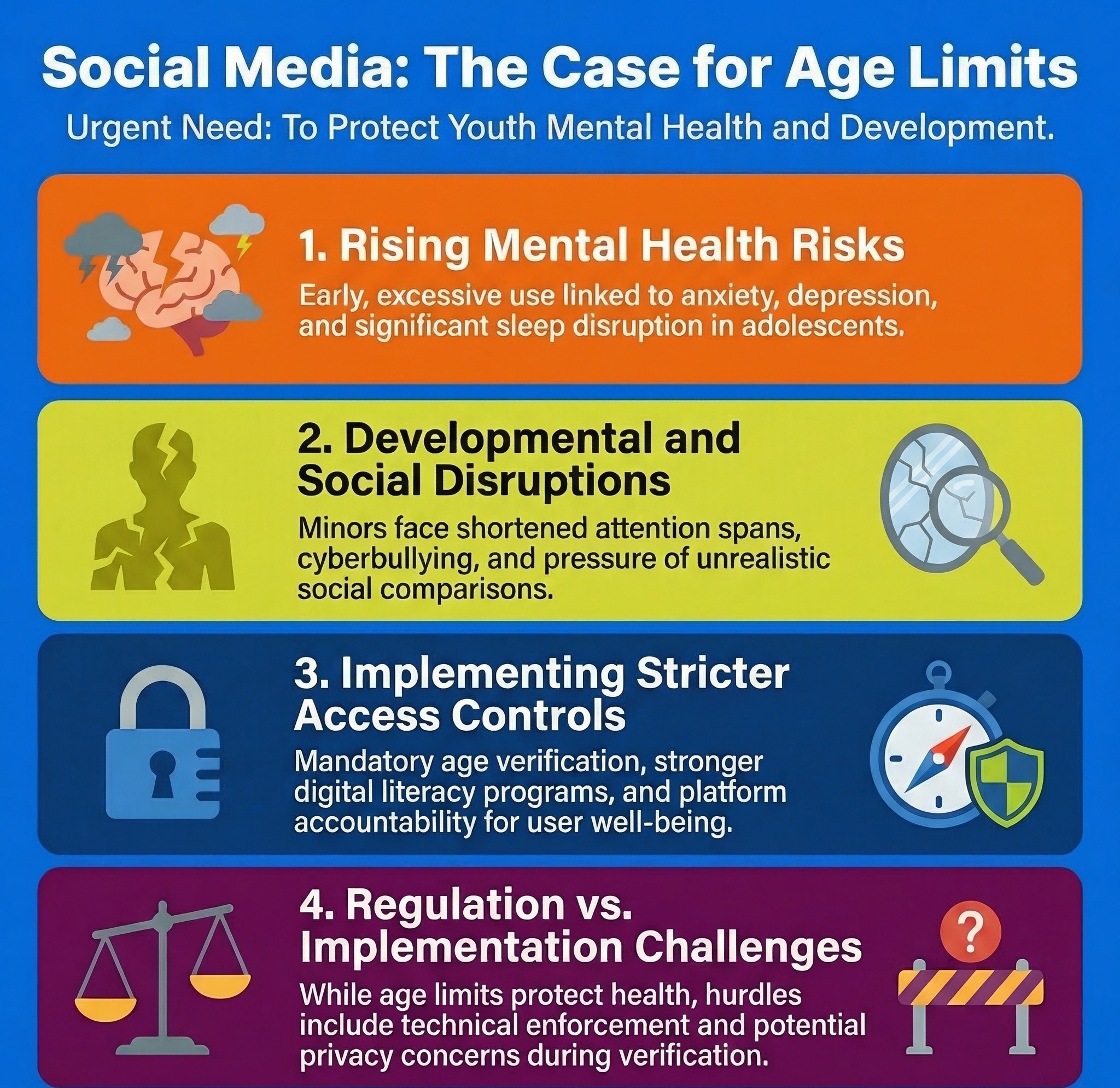
Key Arguments of the Article
Rising Concerns Over Digital Exposure
The article argues that children today are exposed to social media platforms at increasingly younger ages. Smartphones and internet access have expanded rapidly, allowing minors to spend large amounts of time online.
This early exposure raises concerns about mental health, attention span, and social behaviour.
Psychological and Developmental Impacts
The author highlights research linking excessive social media usage with anxiety, depression, sleep disruption, and reduced concentration among adolescents.
Children may also face cyberbullying, peer pressure, and unrealistic social comparisons.
Parental and Institutional Challenges
Parents and schools often struggle to regulate children’s digital habits. Social media platforms are designed to maximise engagement, making it difficult for young users to control their screen time.
This creates a governance gap between technological innovation and social regulation.
Global Policy Developments
The article refers to international examples where governments are debating stricter regulations on youth access to social media platforms.
These discussions reflect broader global concerns about the impact of digital technologies on young populations.
Need for Responsible Technology Governance
The article argues that governments, technology companies, parents, and educators must collaborate to create safer digital environments for children.
Age restrictions, stronger verification mechanisms, and digital literacy programmes are presented as possible policy responses.
Author’s Stance
The author adopts a precautionary and child-protection oriented stance. The article supports the idea that social media platforms should be subject to regulatory oversight when it comes to youth usage.
The tone reflects concern about the long-term social and psychological consequences of unregulated digital exposure.
Possible Biases
Protective Perspective
The article emphasises potential harms of social media while giving less attention to positive aspects such as educational opportunities and digital connectivity.
Regulatory Bias
The argument leans toward policy intervention and may underestimate the role of parental responsibility and individual choice.
Limited Technological Perspective
The article focuses on social consequences but does not fully explore technological solutions such as algorithmic moderation or parental control tools.
Advantages of Age-Based Regulation
Protection of Mental Health
Limiting exposure to social media may reduce anxiety, cyberbullying, and psychological stress among adolescents.
Encouragement of Balanced Development
Children may engage more in physical activities, education, and face-to-face social interaction.
Accountability for Technology Companies
Regulation may encourage platforms to design safer digital environments for younger users.
Increased Public Awareness
Policy debates can raise awareness about responsible digital consumption.
Concerns and Limitations
Enforcement Challenges
Verifying user age online can be technically difficult and may raise privacy concerns.
Digital Exclusion
Strict restrictions may limit beneficial uses of social media for education, communication, and skill development.
Risk of Overregulation
Excessive regulation may restrict digital freedoms or innovation.
Implementation Complexity
Coordinating regulatory frameworks across multiple platforms and jurisdictions can be difficult.
Policy Implications
Development of Digital Safety Regulations
Governments may consider frameworks that regulate social media access for minors.
Age Verification Mechanisms
Technology companies may need to implement more reliable age verification systems.
Digital Literacy Programmes
Education systems should include digital literacy and responsible internet usage training.
Parental Guidance and Awareness
Parents must play a proactive role in monitoring children’s online activities.
Platform Accountability
Social media companies should design algorithms and features that prioritise user well-being.
Real-World Impact
If balanced regulations are implemented:
• Improved mental well-being among young users
• Safer online environments for children
• Greater accountability of technology companies
If poorly implemented:
• Difficult enforcement of age restrictions
• Privacy concerns related to verification systems
• Reduced access to beneficial digital resources
Alignment with UPSC GS Papers
GS Paper II
Governance challenges related to digital regulation, child protection policies, and technology governance.
GS Paper III
Role of technology in society, digital economy, and emerging challenges of cyber governance.
GS Paper I
Social changes related to digitalisation and youth behaviour.
GS Paper IV
Ethical issues concerning technology use, responsibility toward children’s well-being, and digital ethics.
Balanced Assessment
The article raises important concerns about the psychological and developmental impacts of social media on young users. As digital technologies become deeply embedded in everyday life, societies must address the risks associated with early and excessive exposure.
At the same time, policy interventions must strike a balance between protecting children and preserving the benefits of digital connectivity.
Future Perspective
The debate over social media regulation is likely to intensify as digital technologies continue to evolve. Policymakers will need to develop nuanced frameworks that combine regulation, education, and technological safeguards.
For policymakers and civil services aspirants, the issue illustrates the emerging governance challenges at the intersection of technology, society, and public policy.
