

Pradhan Mantri Bhartiya Janaushadhi Pariyojana (Jan Aushadhi): The Case for Expansion

Pradhan Mantri Bhartiya Janaushadhi Pariyojana (Jan Aushadhi): The Case for Expansion
Source: The Hindu
Why in News?
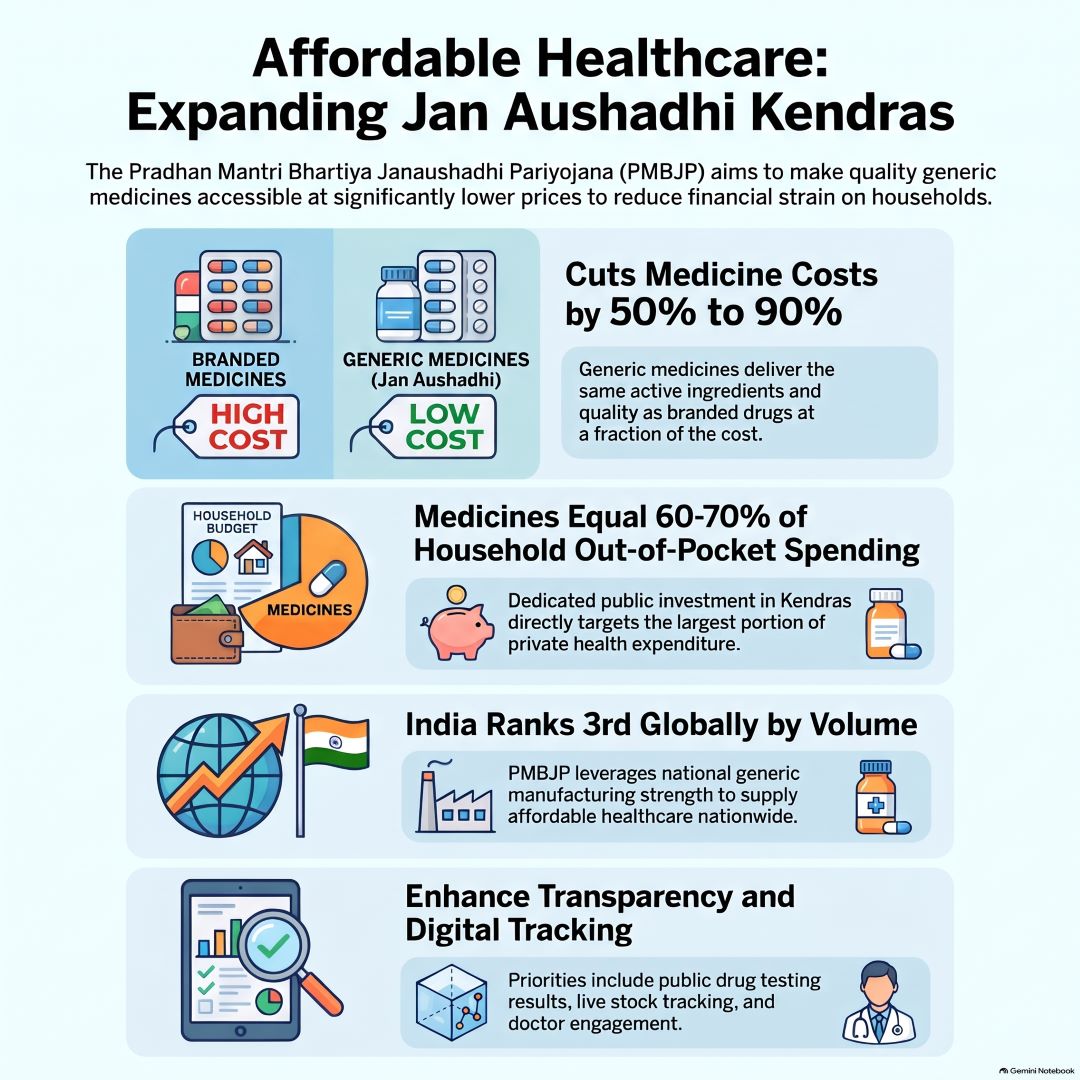
The need to expand the Pradhan Mantri Bhartiya Janaushadhi Pariyojana (PMBJP) has drawn attention amid low public awareness, inconsistent availability of medicines, and the high share of medicines in household out-of-pocket healthcare spending.
Background
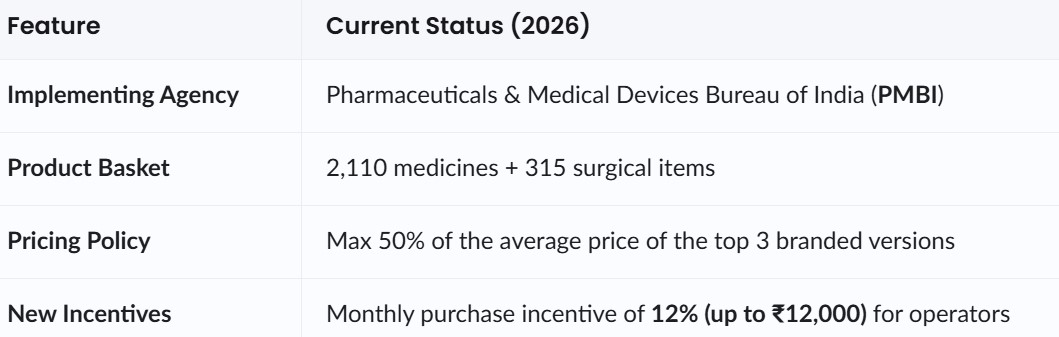
- PMBJP is a Central Government initiative that makes quality generic medicines available at affordable prices through dedicated outlets called Jan Aushadhi Kendras. It was launched in 2008, revamped in 2015, and is implemented through the Pharmaceuticals and Medical Devices Bureau of India (PMBI).
- It uses India's pharmaceutical manufacturing strength to supply medicines at much lower prices than comparable branded ones, easing the financial burden on households.
- A generic medicine has the same active ingredient, strength and dosage form as the branded drug but costs less. Bioequivalence means it acts in the body in the same way as the original.
- PMBI works under the Department of Pharmaceuticals. The Indian Pharmacopoeia Commission sets drug quality standards.
History:
· Jan Aushadhi Scheme was launched by the Department of Pharmaceuticals in 2008 across the country.
· In 2015, the Jan Aushadhi Scheme was revamped as Pradhan Mantri Jan Aushadhi Yojana (PMJAY).
· In 2016, it was again renamed as Pradhan Mantri Bhartiya Janaushadhi Pariyojana (PMBJP).
|
Concept and Equivalence A generic medicine is a medication created to be the same as an already marketed brand-name drug in dosage form, safety, strength, route of administration, quality, performance characteristics, and intended use.
Current Status in India (as of late 2026) India has consolidated its position as a global leader in generic manufacturing, but the landscape is shifting from "cost-focus" to "compliance-focus."
🇮🇳 Governance and Schemes: PMBJP The Pradhan Mantri Bhartiya Janaushadhi Pariyojana (PMBJP) is the flagship mission to make quality generics accessible.
|
Analysis and Way Forward
- National survey: The Department of Pharmaceuticals and the Health Ministry should commission an independent, nationally representative survey on awareness, reasons for using or avoiding Kendras, doctors' prescribing and stock availability.
- Quality transparency: The Indian Pharmacopoeia Commission has agreed to test random batches. Results should be published regularly with the period, method and laboratories.
- Online stock tracking: Real-time inventory and automated reordering to cut stock-outs.
- Doctors' confidence: Once quality is shown, engage doctors' associations on generic prescribing, and show bioequivalence status on labels.
- Positioning: Present Kendras as affordable stores for everyone, not charity outlets, using social media and the Jan Aushadhi Sugam app (store locator, navigation, price lists), with live stock availability added.
- Public investment: Medicines are about 60-70% of household out-of-pocket health spending, and government health expenditure was 1.43% of GDP in 2023-24 against the National Health Policy target of 2.5% by 2025. A dedicated allocation to expand and promote Kendras could directly reduce household spending.