

Preparing India for a true innovation-led economy
The Hindu
Key Arguments of the Article
India’s Growing Innovation Ecosystem
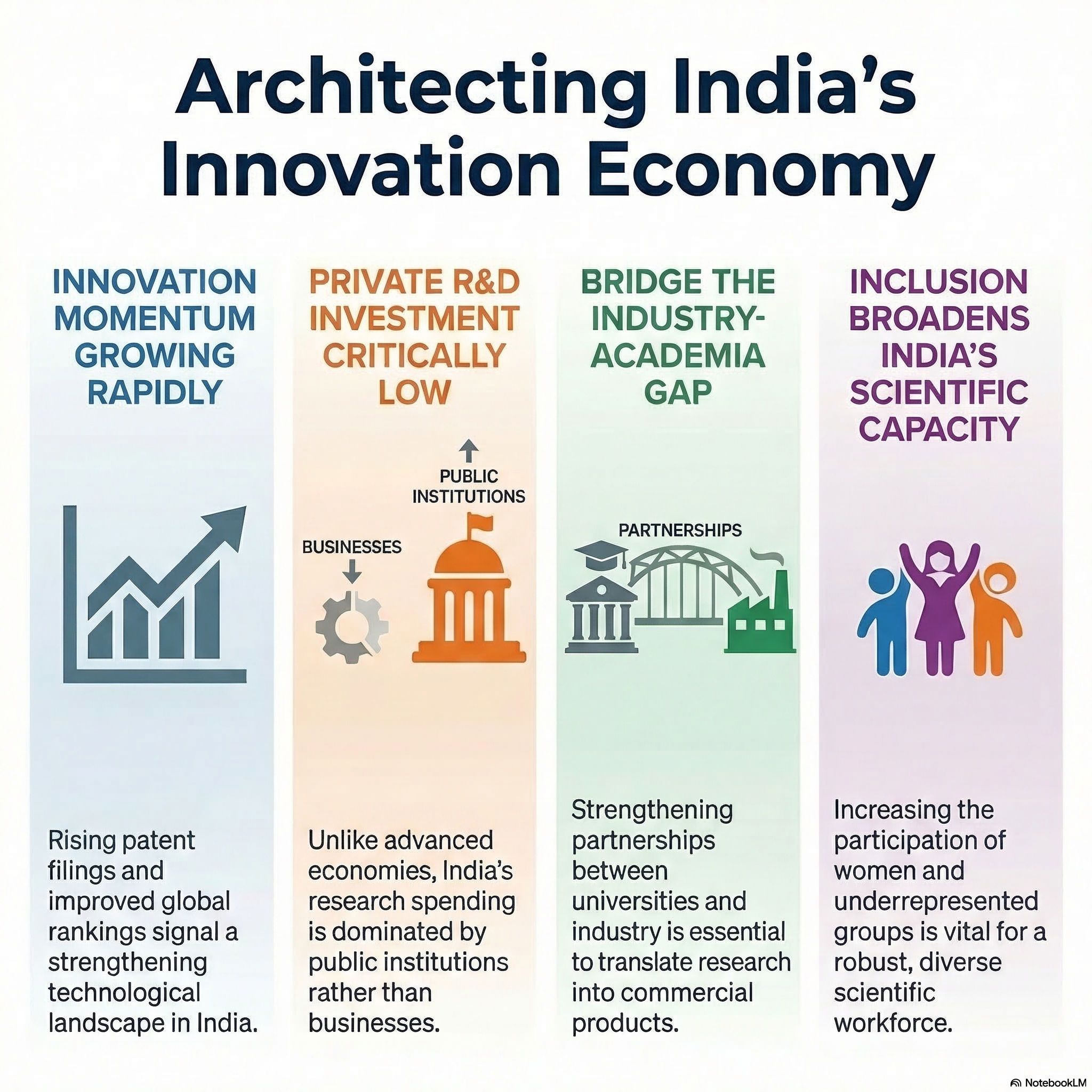
The article notes that India has made significant progress in improving its innovation ecosystem. Rising patent filings, improved global innovation rankings, and increasing start-up activity indicate a strengthening technological landscape.
Government initiatives supporting research and development have contributed to this momentum.
Role of Public Investment in R&D
Public funding has played a critical role in supporting research institutions, universities, and government laboratories. Budget allocations for research infrastructure and innovation initiatives demonstrate a commitment to strengthening India’s scientific capabilities.
However, public investment alone cannot sustain long-term innovation-led growth.
Weak Private Sector Participation
A key argument in the article is that private sector participation in research and development remains relatively low. In advanced economies, businesses contribute the majority of R&D investment, while in India public institutions still dominate research spending.
This imbalance limits the commercialisation of innovation and the translation of research into industrial applications.
Importance of Patent Activity and Intellectual Property
Patent filings are highlighted as an important indicator of technological progress. India has seen an increase in patent applications, suggesting growing research output.
Nevertheless, the article argues that patent numbers must translate into real technological and industrial innovation to create economic value.
Need for Inclusive Innovation
The article also emphasises the importance of diversity and inclusion in the innovation ecosystem. Participation of women and underrepresented groups in science, technology, engineering, and research fields remains essential for broadening the country’s innovation capacity.
Inclusive innovation strengthens the overall scientific workforce.
Author’s Stance
The author adopts a cautiously optimistic stance regarding India’s innovation trajectory. While acknowledging improvements in the innovation ecosystem, the article emphasises the need for structural reforms to ensure sustained technological progress.
The author particularly stresses the importance of increasing private sector participation in research and development.
Possible Biases
Innovation Optimism
The article generally supports India’s innovation strategy and highlights progress in innovation indicators.
Institutional Perspective
The discussion focuses largely on institutional reforms and policy frameworks, with limited attention to grassroots innovation.
Technology-Centric Approach
The analysis prioritises technological innovation and may give less emphasis to social innovation or traditional knowledge systems.
Advantages of an Innovation-Led Economy
Economic Growth
Technological innovation enhances productivity and supports high-value economic activities.
Global Competitiveness
Countries with strong innovation ecosystems gain advantages in international markets.
Industrial Transformation
Innovation supports the development of advanced manufacturing, digital technologies, and knowledge-based industries.
Employment Generation
New technologies and start-up ecosystems create opportunities for skilled employment.
Challenges and Limitations
Low R&D Expenditure
India’s total research spending remains lower than that of major innovation-driven economies.
Weak Industry–Academia Linkages
Limited collaboration between universities and industry reduces the commercialisation of research.
Infrastructure Gaps
Research infrastructure and funding mechanisms require continuous improvement.
Talent Retention
Many highly skilled researchers migrate abroad due to better research opportunities.
Policy Implications
Increasing Private Sector R&D Investment
Encouraging industry participation in research through incentives and collaborative frameworks is essential.
Strengthening Research Institutions
Universities and laboratories need improved funding, autonomy, and research infrastructure.
Promoting Industry–Academia Collaboration
Partnerships between research institutions and industry can accelerate innovation and commercialisation.
Supporting Start-up Ecosystems
Policies promoting entrepreneurship, venture capital investment, and technology incubation can stimulate innovation.
Real-World Impact
If innovation policies succeed:
• Growth in high-technology industries
• Increased global competitiveness
• Expansion of knowledge-based employment
If challenges remain unresolved:
• Continued dependence on foreign technologies
• Limited technological self-reliance
• Slower industrial transformation
Alignment with UPSC GS Papers
GS Paper III
Science and technology, research and development, innovation ecosystems, economic development.
GS Paper II
Government policies for technological advancement and industrial development.
GS Paper IV
Ethics in scientific progress, responsible innovation, and inclusive development.
Balanced Assessment
India’s aspiration to build an innovation-led economy reflects a strategic shift toward knowledge-driven development. While significant progress has been made through policy initiatives and institutional investments, sustained success requires stronger industry participation, better research infrastructure, and greater integration between academia and industry.
Innovation must also remain inclusive and accessible across sectors and regions.
Future Perspective
As global competition increasingly revolves around technological capabilities, countries that invest in research, innovation, and human capital will shape the future global economy. India’s ability to strengthen its innovation ecosystem will play a decisive role in determining its economic and technological leadership.
For civil services aspirants and policymakers, the issue underscores the importance of aligning science policy, industrial strategy, and education systems to create a robust innovation-driven development model.
