

Private R&D Spending Crosses Government's for the First Time

Private R&D Spending Crosses Government's for the First Time
Relevance: GS Paper III (Science & Technology, Indian Economy, Innovation Policy)
Why in the News?
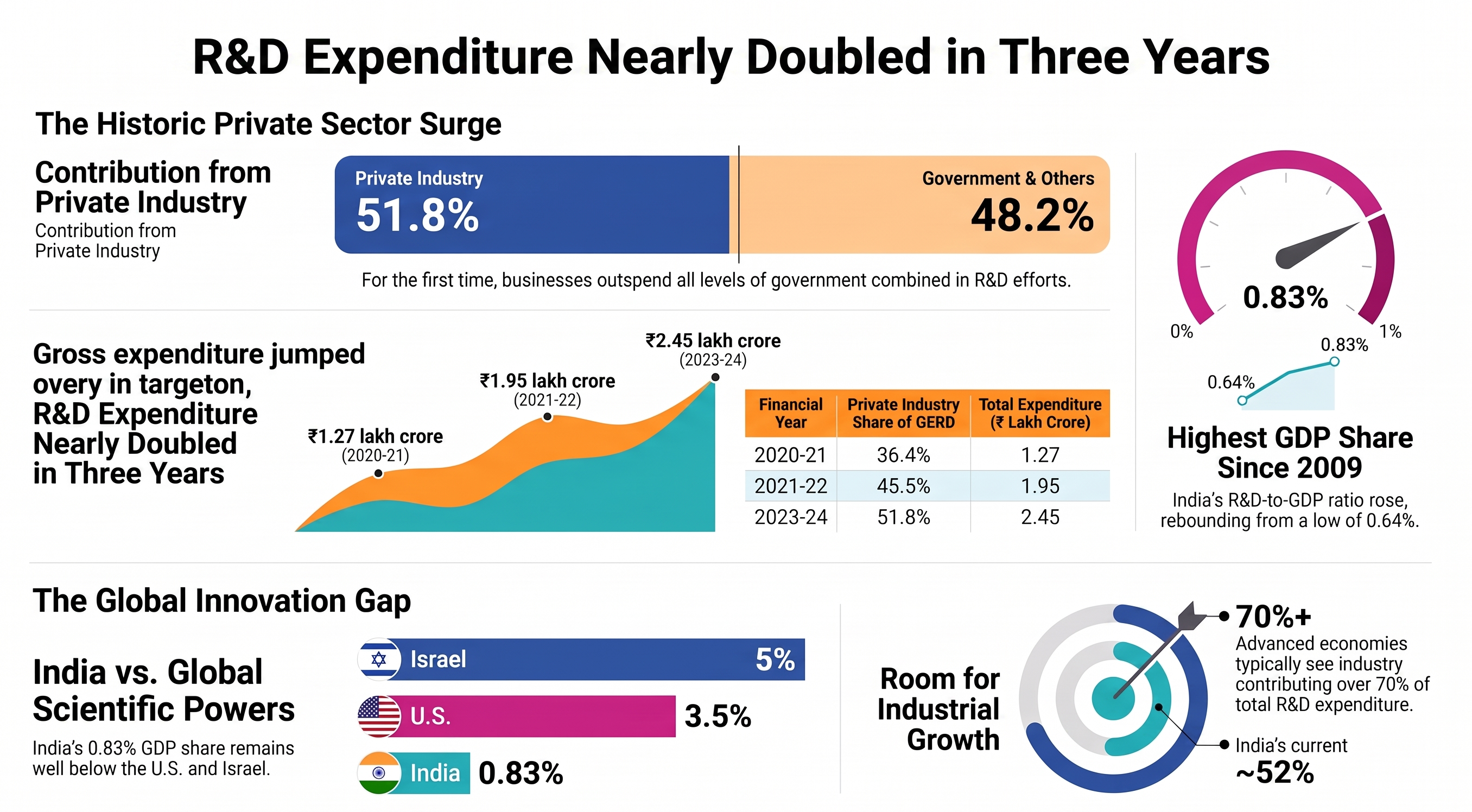
- India's R&D spending surged to 0.83% of GDP in 2021-22 — the first time it crossed the 0.8% threshold since 2009-10, per newly disclosed government data.
- Private industry accounted for 45.5% of national R&D spending in 2021-22, rising further to 51.8% in 2023-24 — the first time businesses have contributed more to India's research effort than all levels of government combined.
- This data was disclosed by the Department of Science and Technology (DST) in a Lok Sabha reply, forming part of the yet-to-be-released Research & Development Statistics 2025-26 report.
Why This Matters?
- Despite having one of the world's largest scientific workforces and ranking among the top countries for scientific publications, India has long spent a much smaller GDP share on research than major scientific powers.
- India's R&D-to-GDP ratio had steadily fallen every year, reaching a nadir of 0.64% in 2020-21.
- Comparative figures for that year: China 2.4%, Japan 3.3%, South Korea 4.8%, US 3.5%, Israel ~5%.
- Successive governments have argued India's innovation ecosystem is constrained because industry contributes a much smaller share of national R&D than in advanced economies, where business typically accounts for over 70% of research expenditure.
About India's R&D Data Collection
- DST compiles official R&D statistics through its National Science and Technology Management Information System (NSTMIS), conducting national science surveys since 1973 using UNESCO/OECD definitions.
- These surveys gather expenditure data from central/state government agencies, universities, public sector enterprises, and private industry.
- The 2022-23 edition expanded coverage to include multinational companies and enterprises outside the Department of Scientific and Industrial Research's (DSIR) recognition scheme; there were 2,397 DSIR-recognised in-house R&D centres as of December 2022.
- Until this parliamentary reply, the latest publicly available DST publication (the 2022-23 edition, released 2023) contained data only up to 2020-21 — making this Lok Sabha reply the first official disclosure of R&D expenditure for 2021-22, 2022-23, and 2023-24.
Gross Expenditure on R&D (GERD) Trend
- GERD fell from Rs 1.33 lakh crore (2019-20) to Rs 1.27 lakh crore (2020-21) — a COVID-year slump.
- It then jumped 53% to Rs 1.95 lakh crore in 2021-22.
- It rose further to Rs 2.13 lakh crore in 2022-23 and Rs 2.45 lakh crore in 2023-24.
- Notably, budget documents from this period do not show a commensurate surge in government science spending — allocations to DST, Department of Biotechnology, Department of Atomic Energy, ISRO, and other major science agencies rose only incrementally, making it unlikely that public expenditure alone drove this increase.
The Private Sector Surge
- Private industry's share of GERD: 38.5% (2017-18) → 37.7% (2018-19) → 33.8% (2019-20) → 36.4% (2020-21) → 45.5% (2021-22) → 48.0% (2022-23) → 51.8% (2023-24).
- This marks the first time private industry has contributed more than half of India's total R&D expenditure.
- In absolute terms, industry R&D spending rose from about Rs 43,800 crore (2017-18) and Rs 46,700 crore (2018-19), to Rs 44,800 crore (2019-20) and Rs 46,400 crore (2020-21), before almost doubling to Rs 88,600 crore in 2021-22, and rising further to Rs 1,26,800 crore in 2023-24.
Significance
- This represents a structural shift in India's innovation landscape, with private industry now the dominant driver of national R&D spending, rather than government.
- It partially addresses a long-standing critique (also raised in the earlier "Tech Self-Reliance" editorial context) that India's private sector under-invests in R&D relative to peers like China, South Korea, and the US.
- However, India's overall R&D-to-GDP ratio, even after this rise, remains well below levels seen in China, Japan, South Korea, the US, and Israel — indicating substantial room for further growth on both public and private fronts.
