

Proof of Citizenship
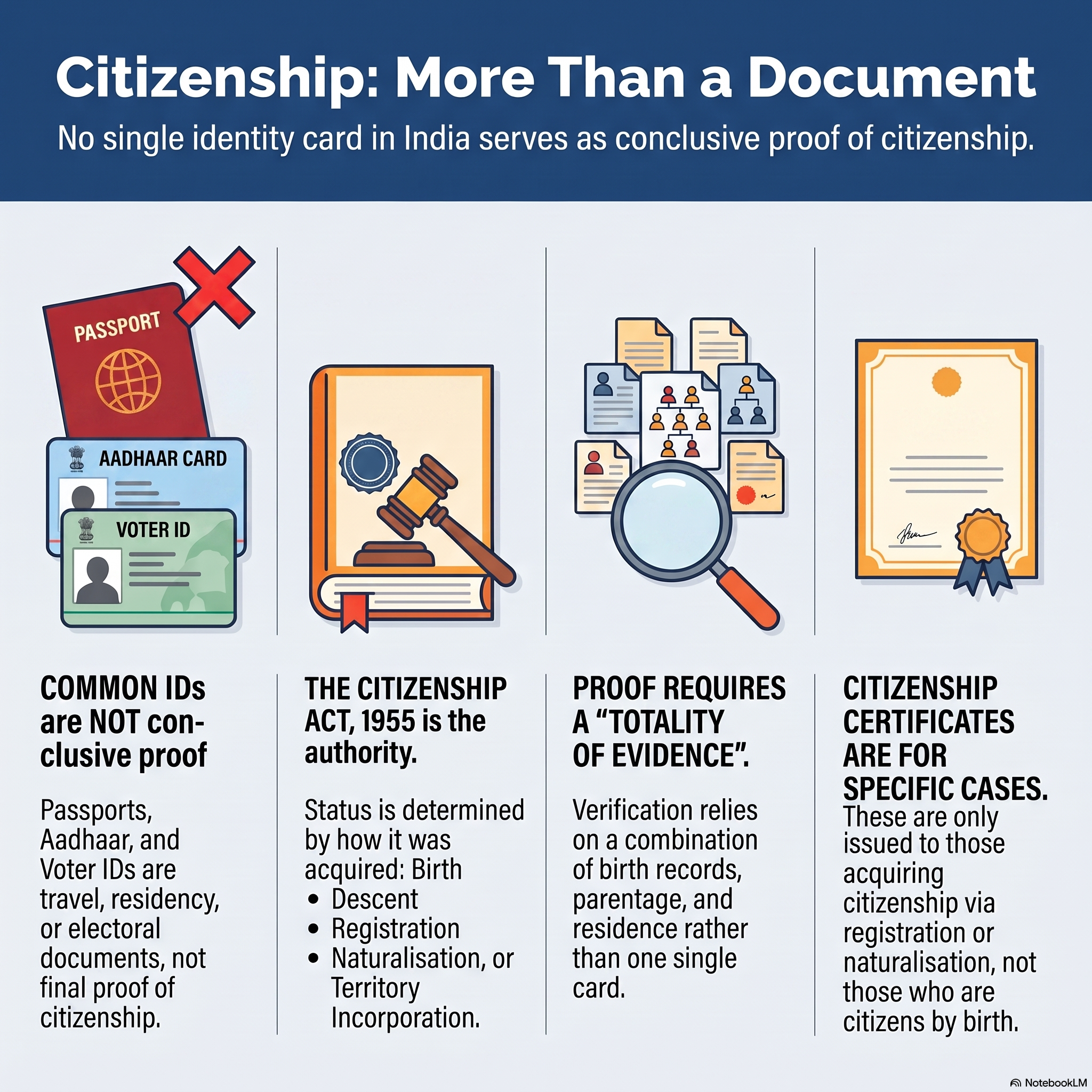
What Constitutes Proof of Citizenship in India?
Source: Hindustan Times (25 June 2026)
Core Thesis
The Ministry of External Affairs (MEA) clarified that a passport is not conclusive proof of Indian citizenship, highlighting a long-standing feature of Indian law: India does not have a single universally accepted document proving citizenship. Citizenship is determined under the Citizenship Act, 1955, based on the totality of evidence and the mode of acquiring citizenship.
Background
- The issue gained prominence following:
- MEA's clarification that a passport is a travel document and not conclusive proof of citizenship.
- Debates surrounding electoral roll revision and citizenship verification exercises.
- India follows a document-based and statutory approach rather than a single national citizenship identity card.
Legal Framework
Constitutional Basis
- Articles 5–11 of the Constitution deal with citizenship at the commencement of the Constitution.
- Parliament enacted the Citizenship Act, 1955 to regulate acquisition and termination of citizenship.
Modes of Acquiring Citizenship (Citizenship Act, 1955)
- By Birth.
- By Descent.
- By Registration.
- By Naturalisation.
- By Incorporation of Territory.
Why a Passport is Not Conclusive Proof
- Under the Passports Act, 1967, passports are issued only after verifying that the applicant is an Indian citizen.
- However, a passport is strong evidence, not conclusive proof, because:
- It can be revoked if obtained through fraud or misrepresentation.
- Citizenship can still be questioned under the Citizenship Act.
Status of Common Documents
|
Document |
Whether it is Proof of Citizenship? |
|
Passport |
No. Strong evidence of citizenship but not conclusive proof. |
|
Aadhaar |
No. Proof of identity/residency; enrolment is based on residence, not citizenship. |
|
Voter ID (EPIC) |
No. Indicates electoral registration; does not independently establish citizenship. |
|
PAN Card |
No. Tax identification document only. |
|
Birth Certificate |
No. Establishes birth; citizenship depends on statutory conditions under the Citizenship Act. |
|
Ration Card |
No. Welfare entitlement document only. |
|
Citizenship Certificate |
Yes, but only for persons acquiring citizenship through registration or naturalisation, not for citizens by birth. |
Why No Single Citizenship Document Exists
- India has never adopted a National Citizenship Card.
- Most Indians become citizens by birth, without receiving a separate citizenship certificate.
- Courts determine citizenship by examining the totality of evidence, including:
- Birth records.
- Parentage.
- Residence.
- Government records.
- Other supporting documents.
Significance
- Highlights the distinction between identity, residency and citizenship.
- Important for electoral roll verification, migration issues and citizenship-related disputes.
- Reinforces that citizenship determination is governed by the Citizenship Act, 1955, not by possession of any single government-issued document.
Challenges
- Absence of a universally accepted proof of citizenship creates legal uncertainty.
- Different authorities may require different combinations of documents.
- Verification exercises can impose documentation burdens on ordinary citizens.
- Multiple identity documents often fail to conclusively resolve citizenship disputes.
Way Forward
- Establish clear and uniform guidelines on acceptable evidence for citizenship determination.
- Improve digitisation and integration of birth and civil registration records.
- Strengthen awareness regarding the distinction between identity, residency and citizenship documents.
- Ensure that citizenship verification processes remain transparent, legally sound and consistent with constitutional safeguards.
Conclusion
India follows a legal and evidentiary approach to citizenship rather than relying on a single identity document. While passports, voter IDs and Aadhaar serve different legal purposes, citizenship is ultimately determined under the Citizenship Act, 1955, based on the applicable statutory provisions and the overall evidence available.
Final Takeaway
In India, citizenship is a legal status—not a document. No single identity card conclusively proves citizenship; instead, it is established through the Citizenship Act, 1955 and the cumulative evidence relating to an individual's entitlement.
