

Public Servants Must Act in Favour of the Weak, and in Fear of Their Conscience

Public Servants Must Act in Favour of the Weak, and in Fear of Their Conscience
1. Conscience and Moral Courage
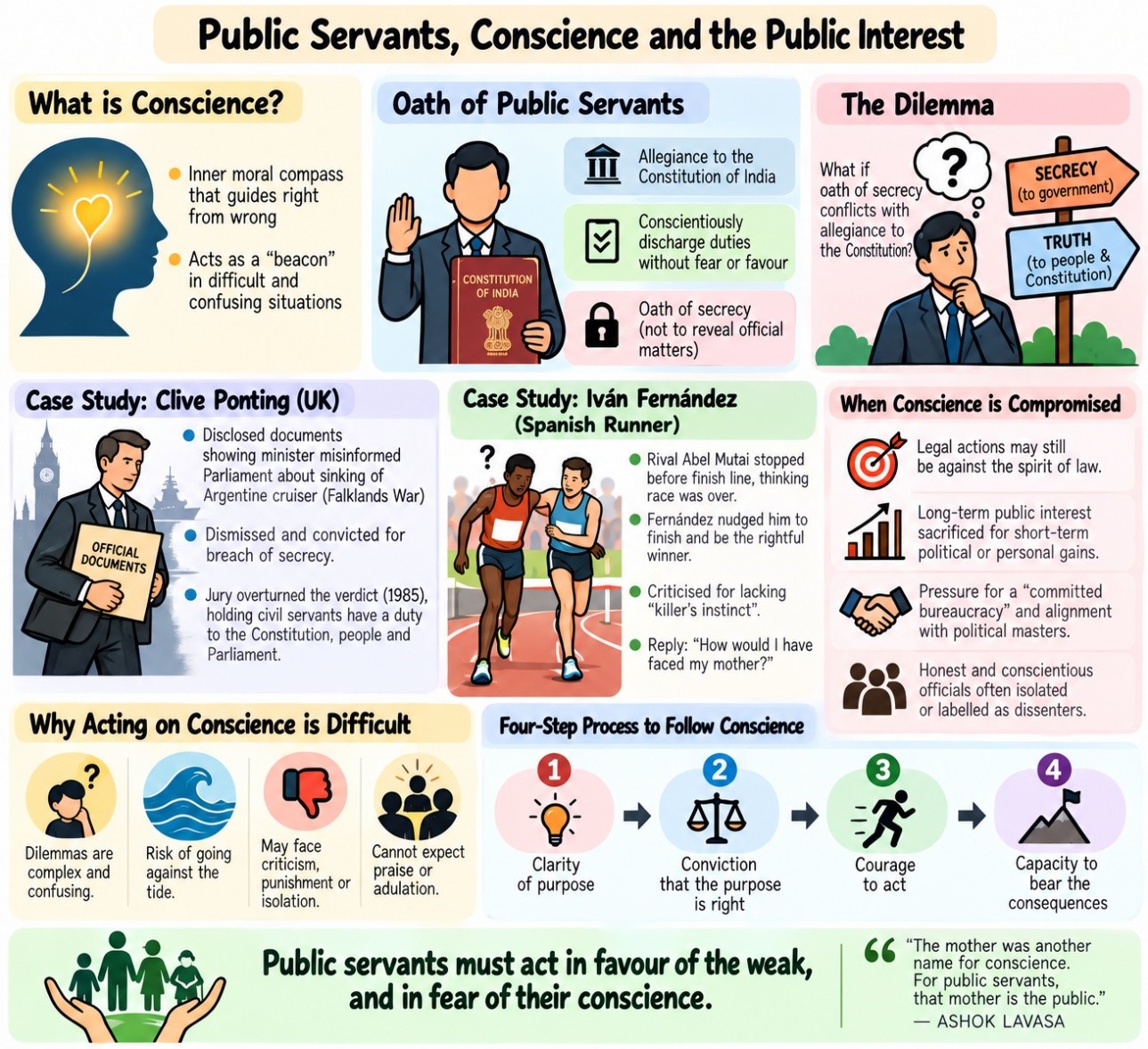
- Public servants take an oath to uphold the Constitution and perform their duties without fear or favour, affection or ill-will.
- Conscience becomes important when there is a conflict between official orders, political pressure, law and public interest.
- Ethical action requires four things: clarity of purpose, conviction, courage to act and willingness to face consequences.
- Moral courage means doing what is right even when it may bring professional or personal costs.
- The key ethical question is not only “Is it legal?” but also “Is it in the larger public interest?”
2. Constitutional Morality and Public Interest
- Public servants are ultimately accountable to the Constitution and citizens, not merely to the government of the day.
- Article 14 → equality before law and protection against arbitrary state action.
- Article 38 → promotion of people's welfare and reduction of inequalities.
- Article 39 → protection of weaker sections and equitable distribution of resources.
- Article 311 → safeguards civil servants against arbitrary dismissal, removal or reduction in rank.
- Article 51A(h) → scientific temper, humanism and spirit of inquiry.
- Thus, constitutional morality requires public authorities to uphold justice, equality, dignity and welfare, even while implementing lawful government policies.
3. Political Pressure, Dissent and Bureaucratic Integrity
- Political neutrality means implementing the lawful decisions of an elected government while retaining professional integrity and constitutional commitment.
- A bureaucracy that merely follows instructions without questioning their consequences can weaken accountability and good governance.
- Constructive dissent is important when an official identifies legal, ethical or administrative risks.
- File noting, written opinions and reasoned recommendations provide institutional space for disagreement and accountability.
- Performance appraisal should reward integrity and effectiveness, rather than merely making an officer a “trouble-free” official.
- The All India Services (Conduct) Rules, 1968 emphasise integrity, political neutrality and devotion to duty.
- The Second Administrative Reforms Commission recognised ethics, integrity and accountability as important for good governance.
4. Ethical Dilemmas: Secrecy, Law and Conscience
- Public servants may face a conflict between their duty of secrecy and responsibility towards public accountability.
- Clive Ponting case: The British civil servant disclosed documents after believing that Parliament had been misinformed during the Falklands War. Though initially convicted, he was acquitted by the jury. The case illustrates the difficult balance between official secrecy, accountability and public interest.
- Whistle Blowers Protection Act, 2014 provides a framework for disclosures relating to corruption, misuse of power and certain offences.
- Ethical dilemmas often arise when an action is legally permissible but contrary to the spirit of law or long-term public welfare.
5. Lessons for Civil Services Ethics
- Sardar Vallabhbhai Patel called civil servants the “steel frame” of India, highlighting their role in maintaining administrative stability.
- The example of Iván Fernández—who helped an opponent finish a race instead of exploiting his mistake—shows that integrity means choosing fairness even when there is no obligation to do so.
- For public servants, the ultimate test of integrity is whether decisions protect public interest, especially the interests of the weak and vulnerable.
- GS-II: Constitutional morality, civil services, political neutrality, accountability and governance.
- GS-IV: Integrity, conscience, moral courage, empathy, objectivity and ethical dilemmas.
Conclusion:
A public servant must not become merely an instrument of power. Law provides the minimum standard; conscience, constitutional morality and public interest provide the ethical direction. The real test of public service is the courage to protect the vulnerable and uphold constitutional values even when doing so is inconvenient or personally costly.
