

Rare-Disease Drugs: Making India the Next Frontier in Affordable Healthcare

Rare-Disease Drugs: Making India the Next Frontier in Affordable Healthcare
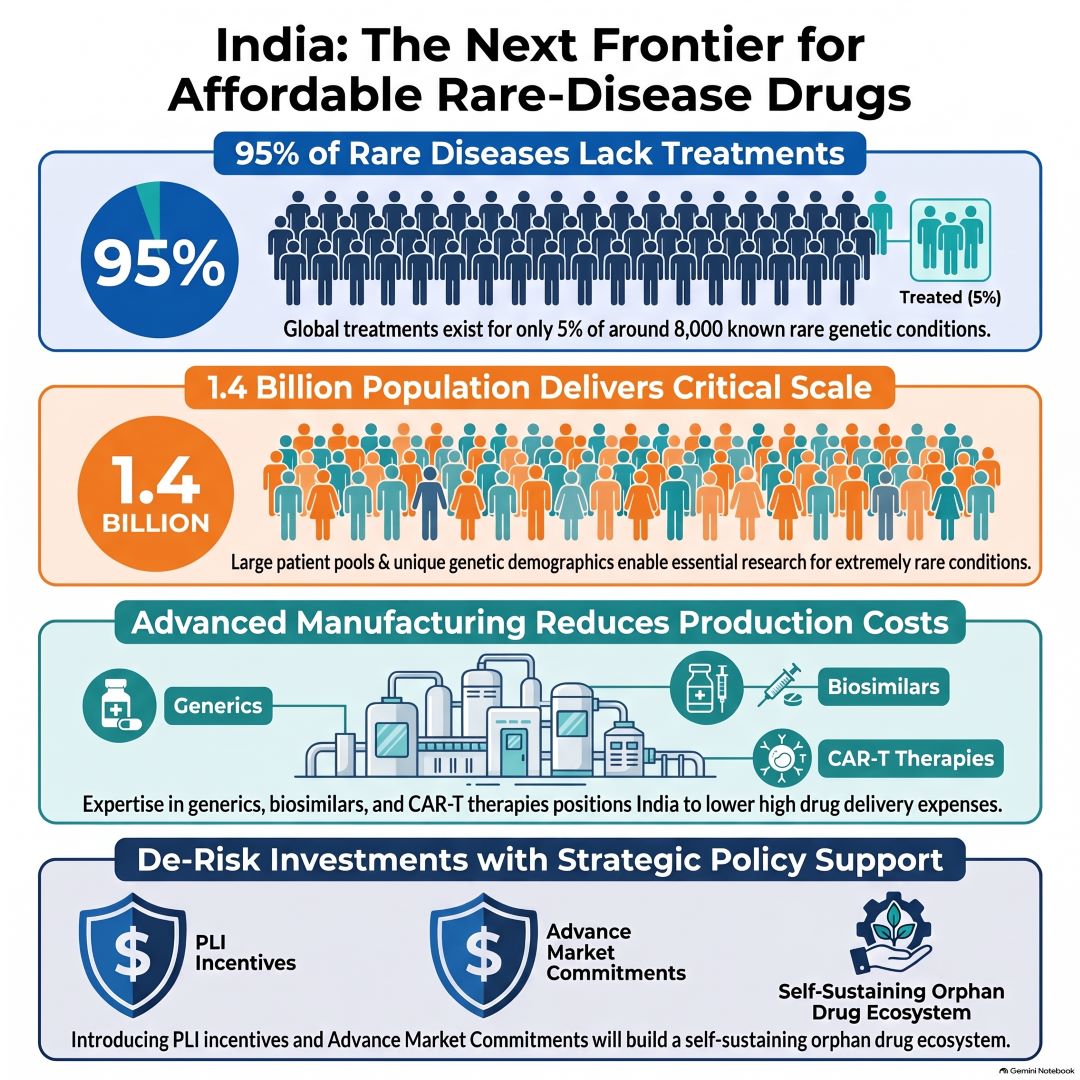
1. Scale of the Problem
- Around 8,000 rare diseases are known globally, collectively affecting hundreds of millions of people.
- India has reported 1,004 rare genetic disorders so far.
- Since individual patient populations are very small, such medicines are called “orphan drugs”, as conventional markets provide limited commercial incentives.
- Existing medicines address only around 5% of rare diseases, leaving most patients without effective treatment.
- India provides financial assistance of up to ₹50 lakh per patient under its rare-disease support framework, but this can be inadequate because some therapies cost several crores.
2. Why Rare-Disease Drugs Remain Expensive
- Pharmaceutical companies face two major challenges:
- Finding sufficient patients for clinical trials.
- Establishing reliable clinical endpoints for extremely rare conditions.
- Small patient populations make recovery of R&D costs difficult.
- Advanced treatments such as gene therapy and personalised therapies can involve very high upfront costs.
- Even after approval, manufacturing medicines in small quantities and maintaining specialised distribution networks can increase costs.
- The US Orphan Drug Act, 1983 addressed the problem through tax incentives, grants, fee waivers and market exclusivity, contributing to a substantial increase in orphan-drug approvals.
3. India's Potential Advantage
- India's population of over 1.4 billion provides a large absolute patient pool for studying even very rare conditions.
- Certain communities with higher levels of endogamy can have greater prevalence of particular genetic disorders, creating opportunities for genetic research.
- India's pharmaceutical ecosystem provides:
- Large-scale manufacturing capacity.
- Skilled scientific manpower.
- Lower production costs.
- Experience in generics and biosimilars.
- India supplies a significant share of global generic medicines and has extensive manufacturing facilities approved by international regulators.
- Indian facilities have also developed advanced therapies such as CAR-T cell therapy, demonstrating growing capabilities beyond conventional generics.
4. Regulatory and Policy Opportunity
- Rule 101 of the New Drugs and Clinical Trials Rules, 2019 provides a regulatory pathway for certain drugs already approved in specified countries, allowing them to avoid repeating an Indian clinical trial in eligible cases.
- Greater clarity and transparency in the approval process could encourage companies to conduct rare-disease research and manufacturing in India.
- India can promote collaboration between multinational pharmaceutical companies, Indian firms, hospitals, research institutions and patient groups.
- Government procurement can reduce market uncertainty and make investment in orphan drugs more commercially viable.
5. Way Forward: From Subsidy to Sustainable Access
- Introduce PLI-type incentives for orphan-drug manufacturing.
- Provide tax incentives and support for technology transfer from national laboratories and global companies.
- Use Advance Market Commitments (AMCs), where the government commits to purchasing a specified quantity at an agreed price.
- Strengthen distribution through Centres of Excellence for Rare Diseases, CGHS and Jan Aushadhi Kendras.
- Encourage exports of affordable rare-disease medicines to low- and middle-income countries.
- Develop a benefit-sharing model so that Indian patients who contribute data and participate in trials can obtain affordable access to the resulting therapies.
- The broader objective should be to de-risk initial investment rather than permanently subsidise companies, allowing a competitive rare-disease pharmaceutical ecosystem to emerge.