

RBI's In-Principle Approval for Paytm Wallet Services

RBI's In-Principle Approval for Paytm Wallet Services
Source: IE
Syllabus: GS III – Indian Economy, Banking and Financial Sector; Digital Payments; Regulatory Institutions.
Why in News?
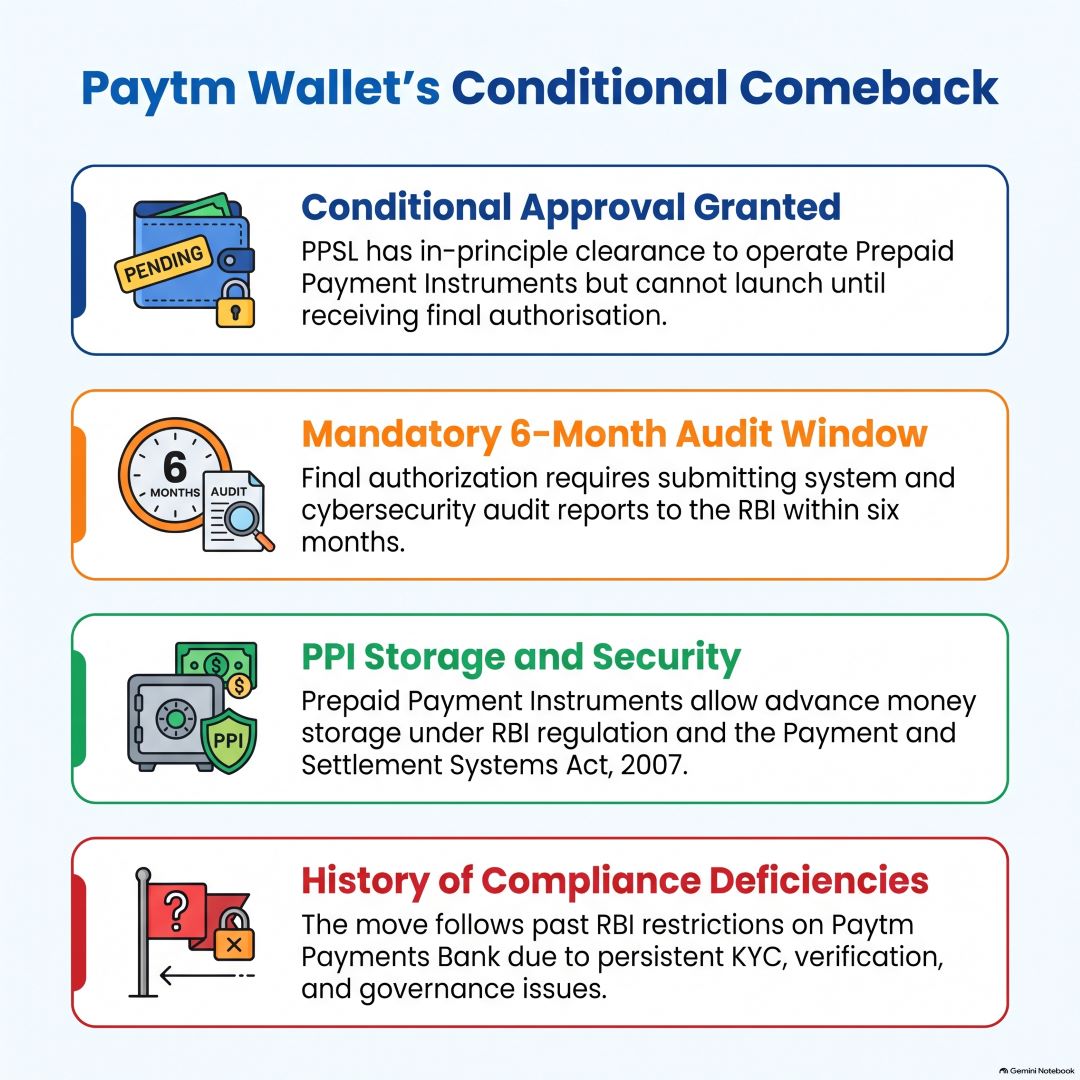
The Reserve Bank of India (RBI) has granted in-principle authorisation to Paytm Payments Services Ltd (PPSL), a wholly owned subsidiary of One 97 Communications, to issue and operate Prepaid Payment Instruments (PPIs), including digital wallets.
This could facilitate the return of Paytm Wallet services after restrictions imposed on Paytm Payments Bank in 2024. However, PPSL cannot begin operations until it receives final authorisation from the RBI.
What are Prepaid Payment Instruments (PPIs)?
PPIs are payment instruments that allow users to store money in advance and use it for purchases, transactions or transfers, subject to applicable RBI regulations.
Examples: Digital wallets, prepaid cards and gift cards.
Types of PPIs:
- Small PPIs: Issued with minimum customer details and subject to restrictions on usage and loading.
- Full-KYC PPIs: Issued after completing full Know Your Customer (KYC) verification and offering wider transaction facilities under RBI norms.
Regulatory framework: PPIs are regulated by the RBI under the Payment and Settlement Systems Act, 2007 and its Master Directions on PPIs.
What Does In-Principle Authorisation Mean?
In-principle approval is a conditional clearance, not permission to start operations.
Before receiving a final Certificate of Authorisation, PPSL must:
- Conduct system and cybersecurity audits through a qualified auditor.
- Comply with RBI's prescribed cybersecurity and digital payment security requirements.
- Ensure compliance with RBI's directions on storage of payment system data.
- Submit the system audit report within six months of the RBI's approval letter.
Failure to meet the conditions within the prescribed period will result in the lapse of the in-principle authorisation.
Key distinction: In-principle authorisation allows an applicant to proceed towards final regulatory approval; actual operations can begin only after the required final authorisation.
Background: Why Did RBI Restrict Paytm Payments Bank?
Paytm's wallet business was transferred to Paytm Payments Bank in 2017.
RBI subsequently identified persistent regulatory and compliance deficiencies, particularly relating to KYC, customer verification and governance.
Important regulatory timeline:
|
Year |
RBI action |
|
2018 |
Regulatory scrutiny over KYC and customer onboarding deficiencies; restrictions on new customer onboarding. |
|
March 2022 |
RBI barred the bank from onboarding new customers. |
|
October 2023 |
RBI imposed a penalty of ₹5.39 crore. |
|
January 2024 |
RBI restricted fresh deposits, top-ups and other credit transactions in wallets, FASTags and related instruments. |
|
April 2026 |
RBI cancelled Paytm Payments Bank's banking licence under Section 22 of the Banking Regulation Act, 1949. |
Why did RBI intervene?
Persistent non-compliance, weaknesses in customer verification and concerns regarding governance and the separation of the bank's operations from its group companies.
4. Key Regulatory Institutions and Laws
- RBI: Regulates banks and non-bank payment system operators and oversees payment system authorisation.
- Payment and Settlement Systems Act, 2007: Provides the legal framework for regulation and supervision of payment systems in India. Section 4 requires RBI authorisation to operate a payment system.
- Banking Regulation Act, 1949: Governs banking operations. Section 22 deals with licensing of banking companies.
- CERT-In: India's national agency for responding to cybersecurity incidents. It also empanels auditors for information security audits.
Conclusion
RBI's in-principle approval creates an opportunity for Paytm's wallet business to return through a separate regulated entity. However, the development highlights a larger principle of India's fintech ecosystem: digital payment innovation must be supported by regulatory compliance, cybersecurity, sound governance and consumer protection.