

Reinforcing the case for a One Health approach
The Hindu
1. Key Arguments
A. Interconnected Nature of Health Risks
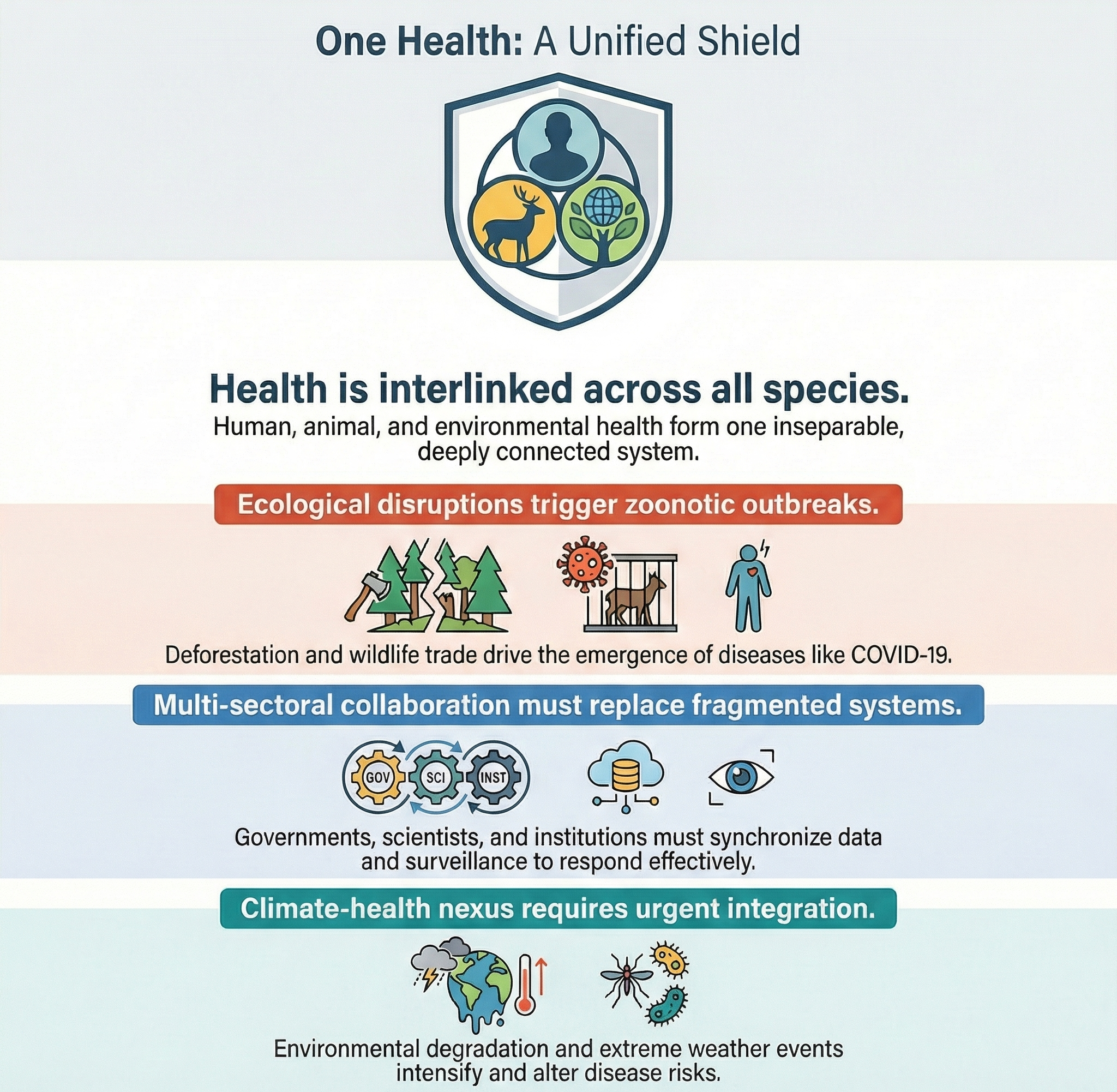
Human, animal, and environmental health are deeply interlinked.
Zoonotic diseases (e.g., COVID-like outbreaks) emerge from ecological disruptions, deforestation, and wildlife trade.
B. Scientific and Institutional Collaboration
Effective response requires multi-sectoral coordination.
Governments, scientists, and international institutions must work in synchrony.
C. Evolution of One Health Concept
From theoretical framework to policy necessity.
Gained prominence post-SARS, avian influenza, and COVID-19.
D. Pandemic as a Turning Point
COVID-19 demonstrated the cost of fragmented systems.
Accelerated global acceptance of integrated health governance.
E. Global Institutional Framework
WHO-led pandemic treaty and Quadripartite collaboration (WHO, FAO, UNEP, WOAH).
Focus on surveillance, data sharing, and equitable access.
F. Climate Change Linkages
Environmental degradation and climate change intensify disease risks.
Extreme events alter disease vectors and ecosystems.
G. India’s Policy Response
National One Health Mission and post-COVID institutional reforms.
Emphasis on surveillance, zoonotic disease control, and inter-sectoral coordination.
2. Author’s Stance
Strongly supportive and advocacy-driven
Promotes One Health as indispensable
Positions it as a scientific and policy consensus.
Normative tone
Calls for urgent adoption and scaling.
3. Biases and Limitations
Idealistic bias
Assumes seamless coordination across sectors and nations
Institutional optimism
Overestimates effectiveness of global governance frameworks
Limited discussion of constraints
Neglects funding gaps, bureaucratic silos, and political resistance
4. Strengths (Pros)
Holistic framing
Integrates health, environment, and economy
Contemporary relevance
Strong linkage with COVID-19 and climate change
Policy-oriented
References global treaties and national missions
Scientific grounding
Emphasises evidence-based policymaking
5. Weaknesses (Cons)
Implementation challenges underplayed
Inter-ministerial coordination and federal complexities ignored
Resource constraints overlooked
Developing countries’ capacity limitations not deeply analysed
Equity concerns insufficiently explored
Access disparities in vaccines, surveillance infrastructure
6. Policy Implications
A. Institutional Integration
Create unified platforms across health, agriculture, and environment ministries
B. Surveillance Systems
Strengthen zoonotic disease surveillance and early warning systems
C. Climate-Health Nexus
Integrate climate adaptation strategies with public health planning
D. Global Cooperation
Enhance data sharing and equitable access frameworks
E. Capacity Building
Invest in research, workforce training, and infrastructure
7. Real-World Impact
Pandemic Preparedness
Early detection and prevention of outbreaks
Public Health Outcomes
Reduced disease burden and mortality
Economic Stability
Avoidance of large-scale disruptions like COVID-19
Environmental Benefits
Promotes sustainable ecosystem management
8. UPSC GS Paper Linkages
GS Paper II (Governance & Health)
- Public health systems
- International organisations (WHO)
- Policy coordination
GS Paper III (Environment & Science)
- Climate change
- Biodiversity and zoonotic diseases
- Disaster preparedness
GS Paper I (Society)
- Health vulnerabilities and social impact
9. Balanced Conclusion
The article convincingly establishes the urgency and relevance of the One Health approach in an era of interconnected global risks. However, it leans toward a normative ideal without sufficiently addressing ground-level implementation barriers, particularly in developing countries.
10. Future Perspective
Operationalisation over rhetoric
Shift from conceptual advocacy to actionable frameworks
Decentralised governance
Strengthen state and local-level coordination
Technology integration
Use AI, big data, and genomic surveillance
Equity-focused approach
Ensure inclusive access to healthcare and resources
Final Insight
One Health is not merely a policy choice—it is an inevitability in a world where ecological imbalance, globalisation, and public health are inseparably linked. The real challenge lies not in recognising this truth, but in governing it effectively.
