

Religion is One
The Statesman
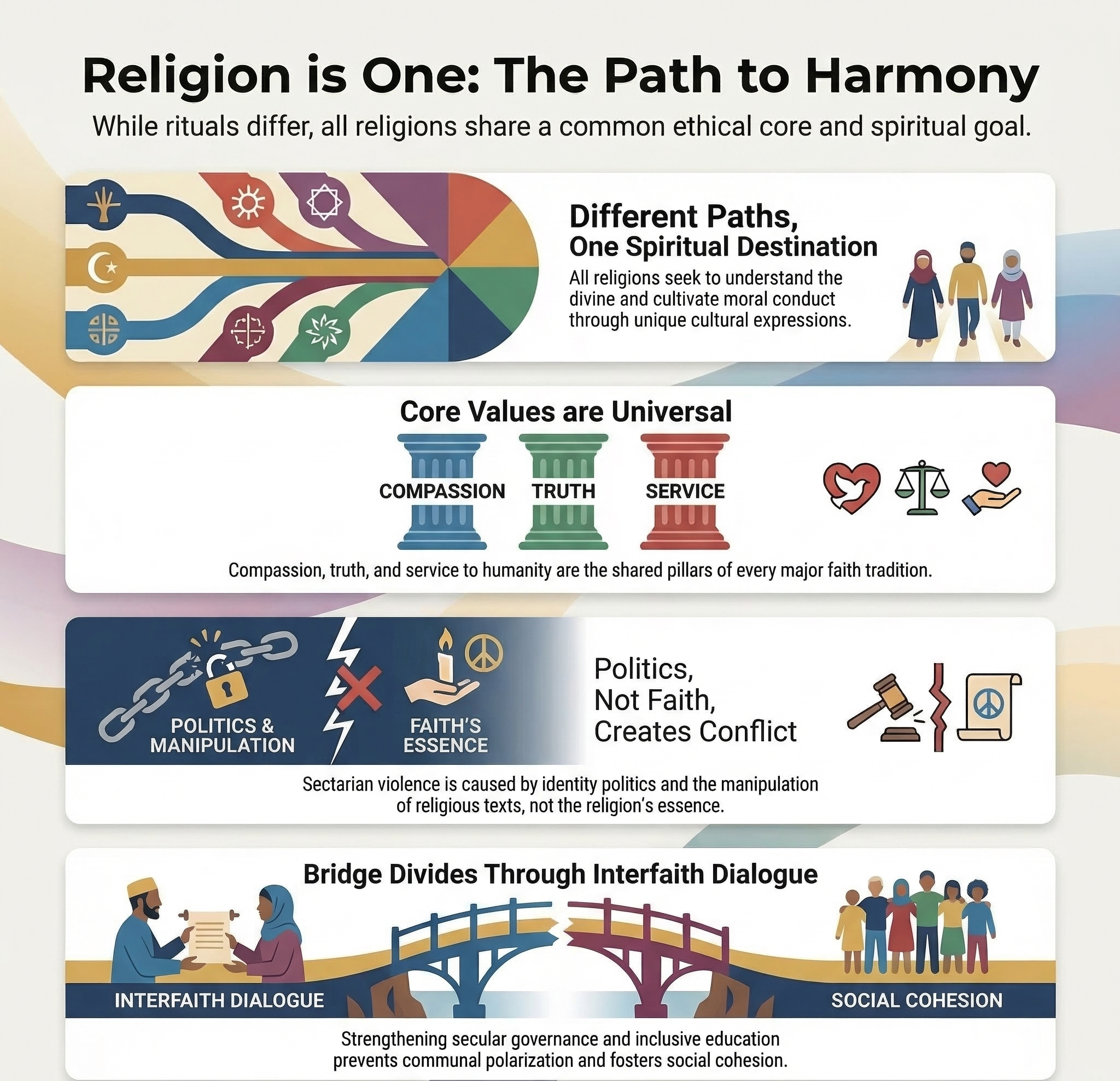
Key Arguments of the Article
Unity of Spiritual Truth
The article argues that all religions ultimately seek the same spiritual goal: understanding the divine and cultivating moral conduct. While rituals, doctrines, and cultural expressions differ, the ethical core of religions remains similar.
This perspective suggests that religious diversity should not lead to division but should instead be understood as different paths to the same truth.
Historical Examples of Religious Harmony
The article draws inspiration from spiritual thinkers and leaders who emphasised the unity of religions. Their teachings promoted respect for different faith traditions and highlighted the universal principles of compassion, truth, and service.
Such perspectives helped create frameworks for interfaith understanding.
Religion as a Moral Framework
Religion is presented not merely as a set of rituals but as a moral system guiding human behaviour. The article emphasises values such as compassion, tolerance, truthfulness, and service to humanity.
These values are portrayed as common across all major religious traditions.
Misinterpretation and Sectarianism
The article argues that conflicts arise not because of religion itself but due to misinterpretation, political manipulation, and sectarian interests.
When religion becomes tied to identity politics, its ethical foundations are often overshadowed by power struggles.
Role of Spiritual Leaders
Spiritual leaders are described as figures who emphasised universal brotherhood and human unity. Their teachings aimed to transcend narrow sectarian divisions and encourage people to focus on shared spiritual ideals.
Author’s Stance
The author clearly advocates the philosophical view that religions share a common moral and spiritual foundation. The tone is reflective and idealistic, encouraging readers to move beyond religious differences and focus on shared human values.
The article promotes harmony and interfaith dialogue.
Possible Biases
Idealistic Interpretation of Religion
The article emphasises harmony among religions and may understate historical conflicts rooted in religious differences.
Philosophical Orientation
The narrative draws heavily from spiritual philosophy rather than empirical social analysis.
Limited Discussion of Political Context
The article focuses on spiritual unity but gives less attention to how religion interacts with politics, identity, and power structures.
Advantages of Promoting Religious Unity
Social Harmony
Recognising common moral values across religions can reduce communal tensions and strengthen social cohesion.
Cultural Pluralism
Interfaith understanding supports the coexistence of diverse cultural and religious traditions.
Ethical Development
Shared moral principles such as compassion and justice contribute to ethical social systems.
National Integration
Promoting religious harmony strengthens unity in multicultural societies.
Challenges and Concerns
Identity-Based Conflicts
Religion is often closely tied to identity, which can lead to political mobilisation and conflict.
Misinterpretation of Religious Texts
Selective interpretations may reinforce exclusivist or extremist ideologies.
Institutional Rivalries
Competition among religious institutions can undermine the idea of unity.
Political Instrumentalisation
Religion may be used for political mobilisation, which complicates interfaith harmony.
Policy Implications
Strengthening Secular Governance
A secular constitutional framework ensures equal respect for all religions.
Promoting Interfaith Dialogue
Institutional platforms for dialogue among religious communities can strengthen mutual understanding.
Inclusive Education
Educational curricula should emphasise ethical values and cultural pluralism.
Preventing Communal Polarisation
Governments must address hate speech, misinformation, and sectarian mobilisation.
Real-World Impact
If the idea of religious unity is embraced:
• Greater social cohesion
• Reduced communal tensions
• Strengthened pluralistic values
If religious divisions intensify:
• Increased communal conflicts
• Social fragmentation
• Politicisation of religious identities
Alignment with UPSC GS Papers
GS Paper I
Indian culture, religious diversity, and social harmony.
GS Paper II
Secularism, constitutional values, and governance.
GS Paper IV
Ethics, morality, and universal human values.
Balanced Assessment
The article provides a philosophical perspective that emphasises the unity of religious values and the importance of interfaith harmony. While this view encourages tolerance and ethical living, it may simplify the complex historical and political dimensions of religion.
A balanced approach must recognise both the shared moral values of religions and the socio-political realities that shape religious interactions.
Future Perspective
In an increasingly diverse and interconnected world, fostering interfaith understanding will remain crucial for maintaining social harmony. Education, dialogue, and constitutional values will play a central role in ensuring that religious diversity becomes a source of strength rather than division.
For civil services aspirants, the discussion highlights the importance of secular governance, cultural pluralism, and ethical leadership in managing religious diversity within democratic societies.
