

Responsible Microfinance: RBI's Stand on Over-Indebtedness

Responsible Microfinance: RBI's Stand on Over-Indebtedness
Source: IE
Why in the news?
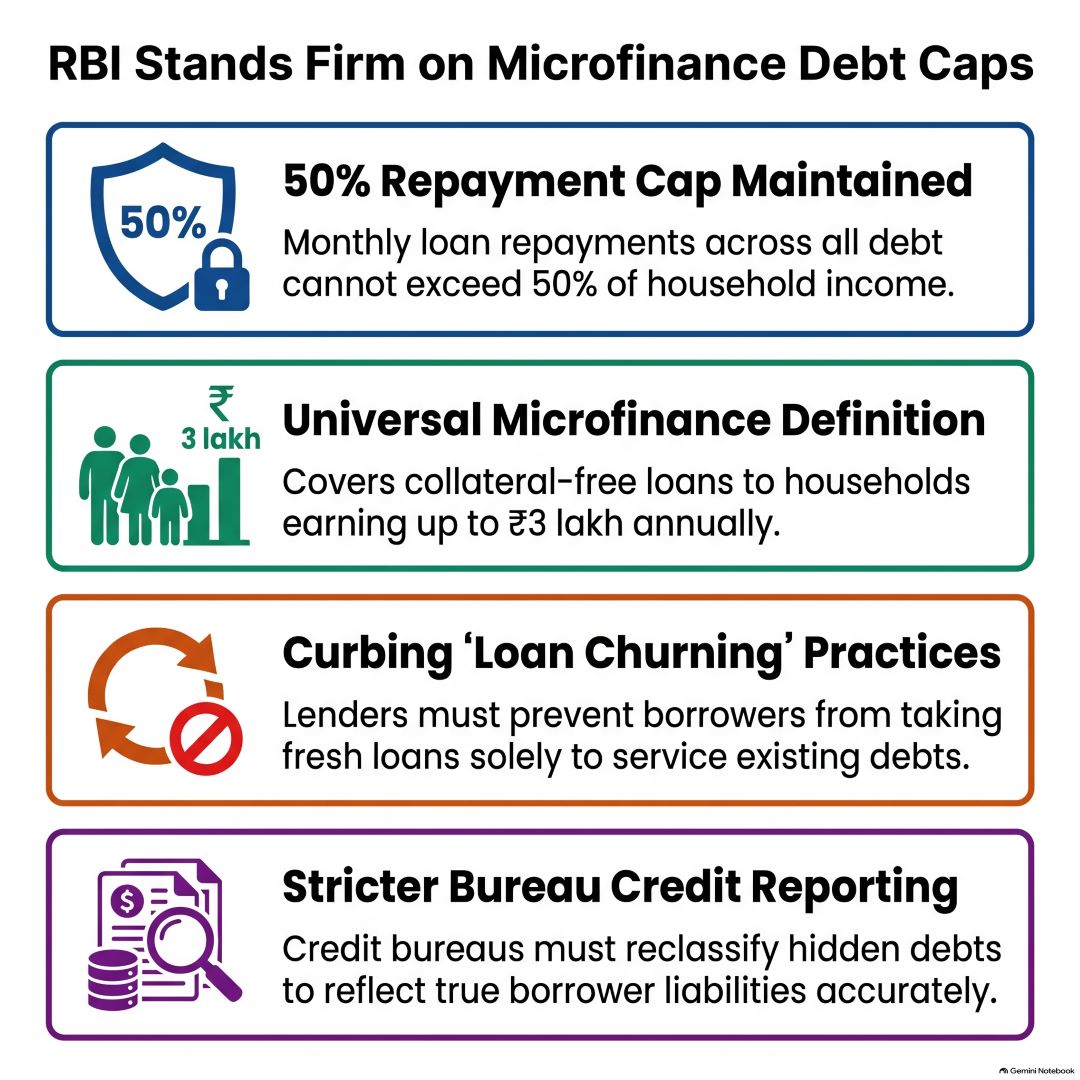
In a 13 November 2026 address to the Microfinance Institutions Network (MFIN), an RBI Deputy Governor (Shirish Chandra Murmu) opposed an industry proposal to ease the 50% household repayment ceiling. He said that excluding the principal component of certain loans from the affordability calculation would understate a household's actual debt burden. He also signalled that the ₹3 lakh household-income threshold may be reviewed, but only depending on the RBI's assessment of need and developments in the industry. The speech signals regulatory priorities and does not itself change the rules.
Context: the sector and its stress
- Microfinance means collateral-free loans to low-income households, delivered through NBFC-MFIs, banks, small finance banks, and others, often to women borrowers.
- The sector had about 6.6 crore live borrowers (June 2026), per credit-bureau data cited in the speech.
- In June 2025, another RBI Deputy Governor (M. Rajeshwar Rao) described a "vicious cycle" of over-indebtedness, high interest rates and harsh recovery practices. The RBI's Financial Stability Report later noted borrower indebtedness edging up in September 2025 after a two-year decline.
What is over-indebtedness?
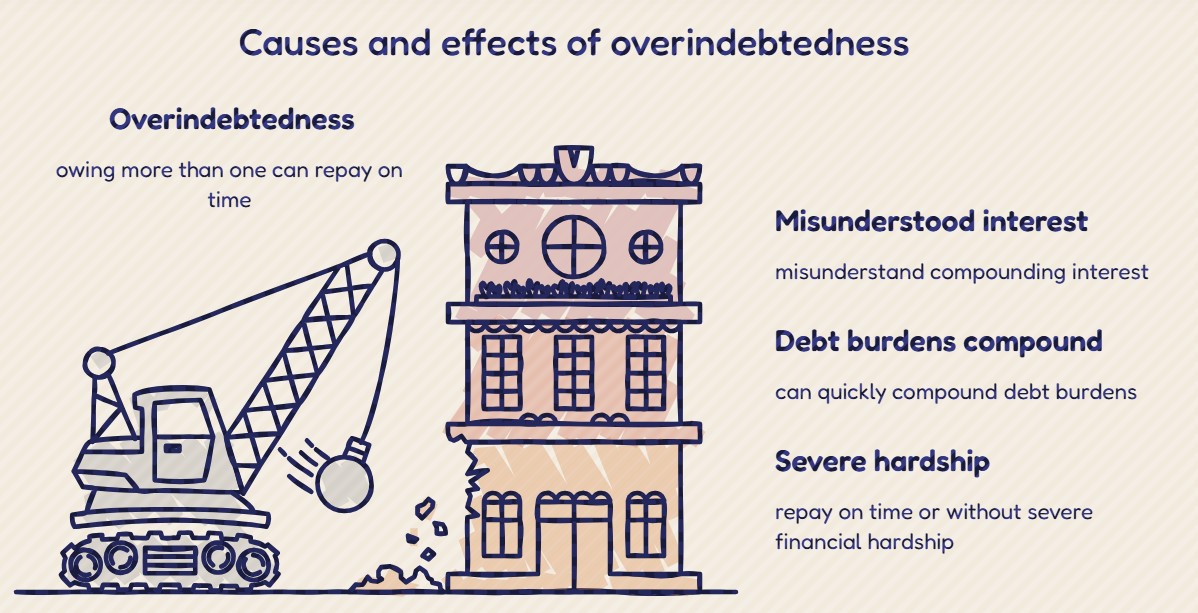
A borrower holds more debt than household income can service without cutting essential consumption or borrowing afresh to repay old loans ("loan churning"). Typical drivers: multiple lenders to one household, lending to the same borrower by several entities with no shared view of total debt, income overstated or not verified, and aggressive growth targets by lenders.
RBI's regulatory framework
Harmonised framework for microfinance loans (effective 2022)
- Uniform definition: all collateral-free loans to households with annual income up to ₹3 lakh, applicable across regulated entities (REs).
- FOIR cap: each RE must have a board-approved policy capping monthly loan repayment (principal plus interest, on all existing loans plus the new one) at a maximum of 50% of monthly household income. Existing loans above the limit are allowed to mature, but no new loan is given in such cases.
- Household income assessment: a board-approved policy is mandatory; household income must be reported to Credit Information Companies (CICs), with reasons recorded where assessed income differs from reported income.
- Pricing: interest-rate and margin caps were removed in favour of board-approved pricing policies, but usurious rates are barred and lenders must disclose minimum, maximum and average rates.
- Borrower protection: Key Facts Statement (KFS) before contract, loan terms explained in a language the borrower understands, no prepayment penalty, flexible repayment periodicity, grievance redress, and recovery guidelines.
- Dropped: the earlier requirement that 50% of loans be for income generation, so credit can also meet medical, education and income-smoothing needs.
Self-regulation: MFIN's "guardrails" (revised in 2024) added a three-lender cap and a ₹2 lakh total-indebtedness cap counting microfinance plus unsecured retail loans. These curbed over-lending but, per ratings agencies, also raised borrower rejection rates and slowed disbursements.
RBI's current position (November 2026)
|
Issue |
RBI's stand |
|
Relaxing FOIR / excluding principal |
Rejected. The 50% ceiling is a maximum, not a target; it leaves room for essential spending in households with thin savings |
|
Actual burden |
Studies show the average borrower spends about 18.7% of monthly household income on repayments, so the ceiling is already liberal |
|
Loan sizes |
Ticket sizes are rising; risk that lenders favour existing borrowers and first-time borrowers find credit harder to get |
|
Churning |
Lenders must avoid borrowers taking larger loans just to service older ones |
|
Income threshold (₹3 lakh) |
May be reviewed, linked to improvements in income assessment, credit reporting and responsible lending |
|
Credit reporting |
More frequent reporting; bureaus advised to move misclassified microfinance loans from the Consumer to the Microfinance segment, giving lenders a true picture of indebtedness |
|
Conduct concerns |
Over-indebtedness, high interest and harsh recovery |
Concerns and trade-offs
- Tight affordability limits can reduce credit access for first-time and genuinely creditworthy borrowers.
- Household income in informal, seasonal economies is hard to verify; self-reported figures can be inflated.
- Data gaps: misclassification, delayed reporting and coverage differences across lenders (NBFC-MFIs, banks, SFBs, fintech partners) weaken the FOIR check.
- Rising loan sizes reflect inflation and larger enterprise needs, but also raise risk if not tied to cash flows.
- Pricing freedom after 2022 depends on supervision of "usurious" rates, which is hard to define.Conclusion