

Retrospective Green Nod: Supreme Court's Final Word on Post-Facto Environmental Clearance
Relevance: GS Paper II (Judiciary, Constitutional Provisions) | GS Paper III (Environment, Environmental Governance)
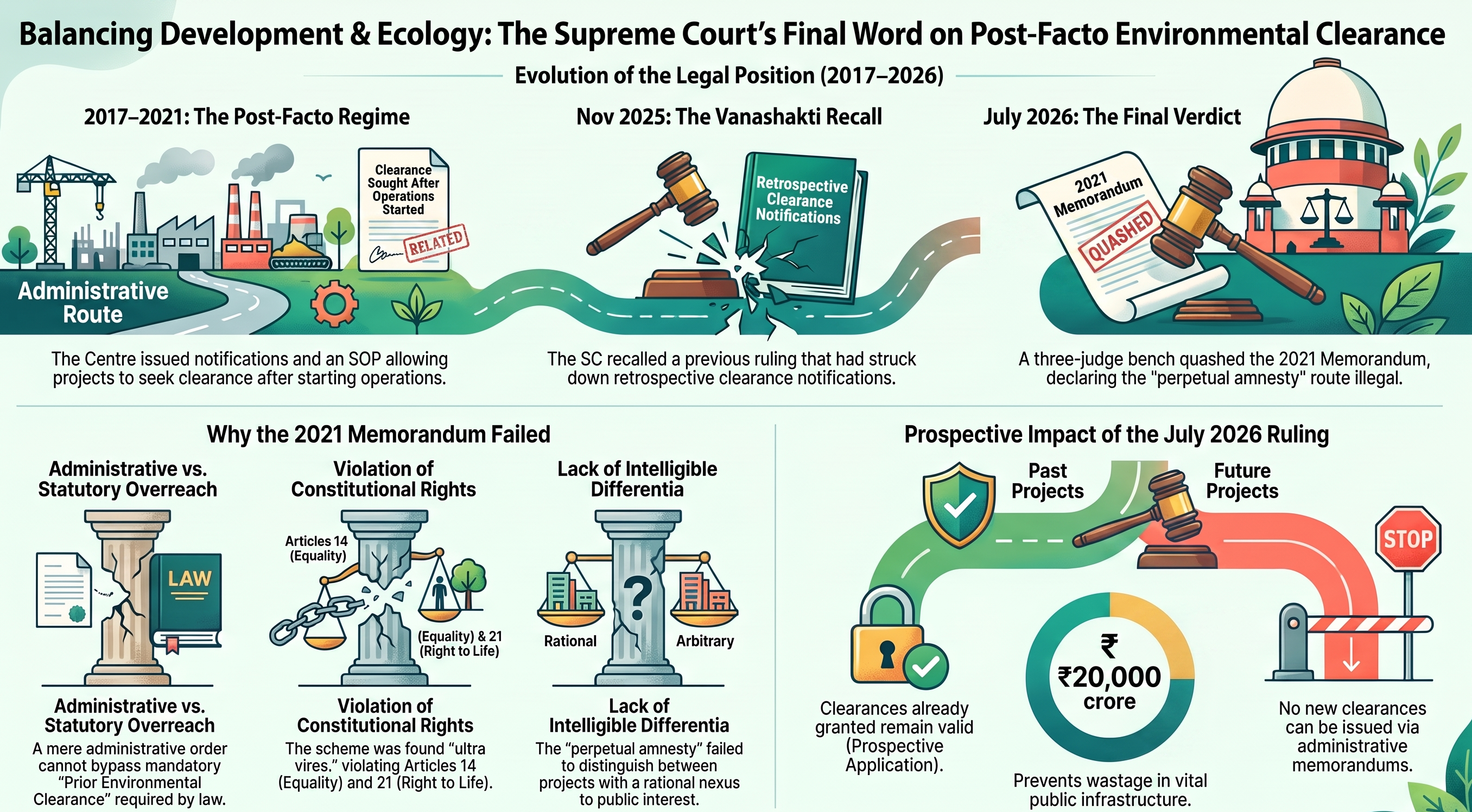
Background: The Vanashakti Ruling
- Justice Ujjal Bhuyan, in Vanashakti v. Union of India, had struck down a 2017 notification enabling retrospective environmental clearance, along with the subsequent 2021 office memorandum laying down the Standard Operating Procedure (SOP) for such clearances.
- On November 18, 2025, the Supreme Court — citing public interest and legal flaws — recalled this ruling in a 2-1 verdict.
- Then-CJI B R Gavai and Justice K Vinod Chandran backed the recall, while Justice Bhuyan dissented, arguing the majority decision "overlooks the very fundamentals of environmental jurisprudence" and represents "a step in retrogression."
The Latest Supreme Court Ruling (July 2026)In a major verdict, a three-judge bench led by Chief Justice Surya Kant quashed the Centre's 2021 Office Memorandum (OM) that allowed for a "perpetual" and administrative route for regularizing environmental violations.
|


On the 2021 Office Memorandum: Struck Down
- The bench struck down the 2021 office memorandum, holding it to be a mere administrative order that envisaged a "perpetual regime" for granting environmental clearances to projects undertaken without prior clearance.
- It found the memorandum substantially altered the nature of enquiry and the criteria for environmental clearance under the 2006 notification — effectively supplanting earlier delegated legislation through an administrative instruction, which is impermissible in law.
- The bench further held that, being a perpetual amnesty scheme applicable to all permissible projects, the memorandum failed to lay down an intelligible differentia for selecting projects for post-facto clearance with a rational nexus to supervening public interest.
- This made it ultra vires the object of the 1986 Act — namely, preserving the environment through a balanced approach between the precautionary principle and sustainable development.
- Consequently, the Court held the 2021 memorandum failed the test of proportionality and reasonableness, and was violative of Articles 14 and 21 of the Constitution.
📜 Evolution of the Legal Position
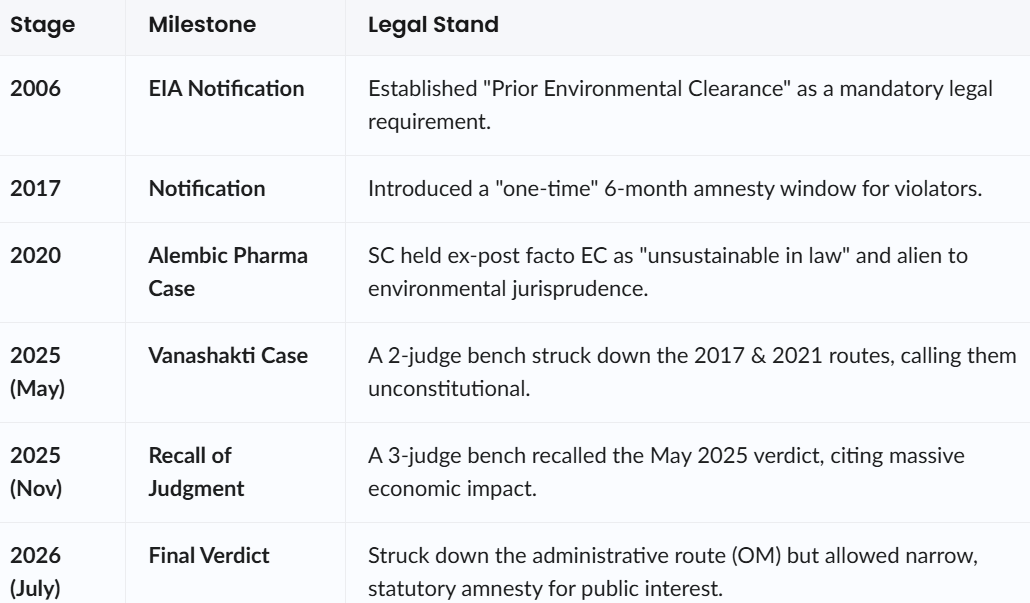
Key Legal Concepts Involved
- Delegated legislation vs. administrative instruction: the ruling distinguishes between a validly framed, time-bound notification (permissible) and an administrative memorandum that effectively creates an open-ended, perpetual policy shift (impermissible), since the latter cannot supplant the former.
- Intelligible differentia: a classification/scheme must have a reasonable basis connected to the law's objective; a blanket, perpetual amnesty for all projects fails this test.
- Precautionary principle and sustainable development: core environmental law doctrines the Court used to assess whether the memorandum aligned with the Environment (Protection) Act's core purpose.
- Articles 14 and 21: the right to equality and the right to life (interpreted to include the right to a healthy environment) formed the constitutional basis for striking down the memorandum.
Significance
- The ruling draws a clear line between a legitimate, narrowly tailored regulatory mechanism (the 2017 notification) and an administrative overreach that effectively normalises ex-post-facto environmental clearances indefinitely (the 2021 memorandum).
- It reinforces that environmental clearance processes must maintain a principled link to the precautionary principle and sustainable development, rather than becoming a routine mechanism for regularising unauthorised projects.
- It highlights the judiciary's continued role in checking administrative instruments that attempt to bypass or dilute statutory/delegated legislative frameworks in environmental governance.
