

Revisiting “The Wealth of Nations” and its abiding suspicion of concentrated power
Indian Express
Key Arguments of the Article
Misinterpretation of Adam Smith
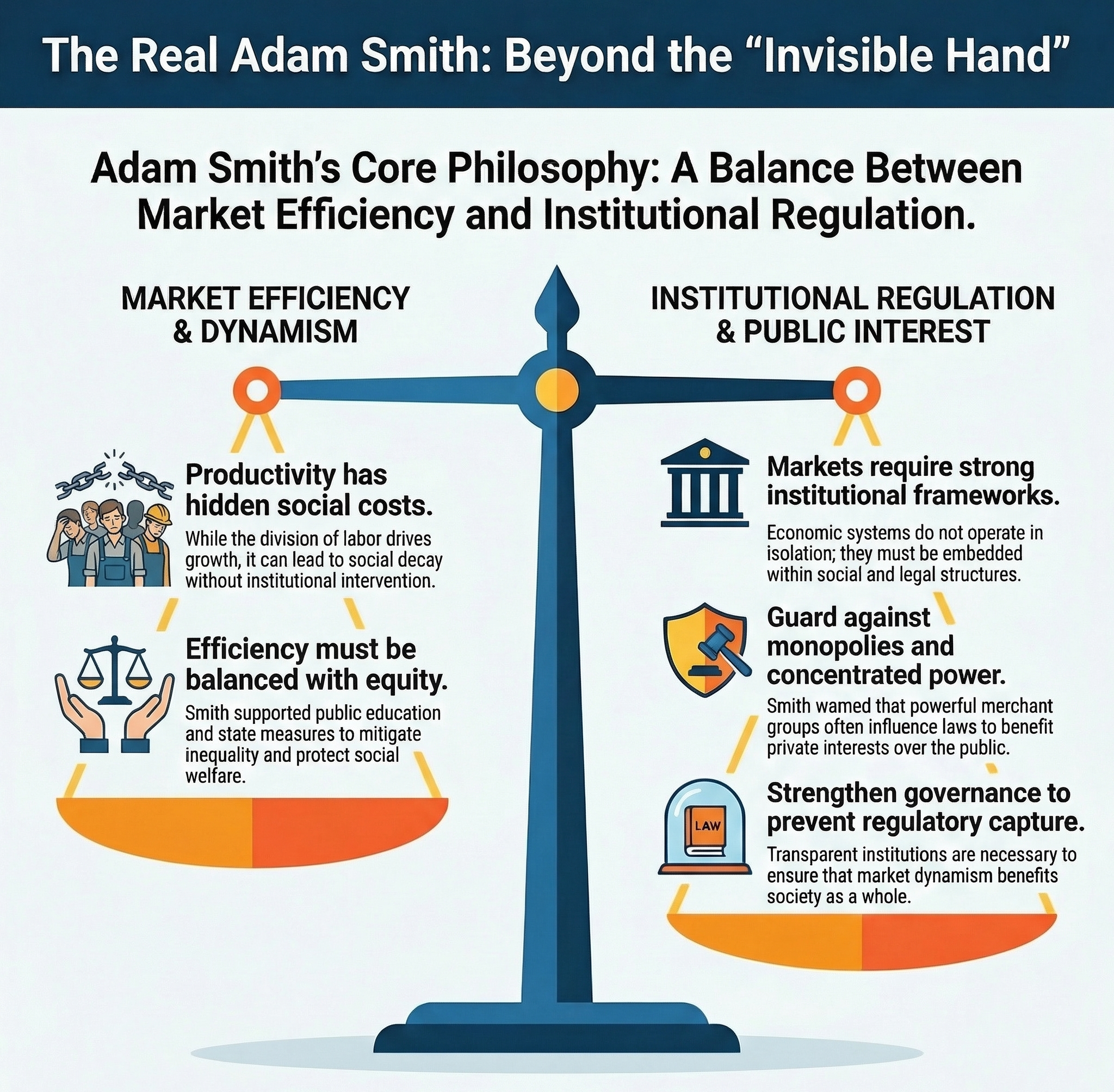
The article challenges the common caricature that Adam Smith blindly supported unregulated markets. While Smith recognised the benefits of market exchange and self-interest, he was also cautious about the dangers of monopolies and concentrated economic power.
The author emphasises that Smith’s thinking was more nuanced than the simplified version often associated with free-market ideology.
Critique of Mercantilism
A major theme in The Wealth of Nations was Smith’s critique of mercantilism, a system in which governments imposed trade restrictions and protected monopolies to benefit specific economic interests.
Smith argued that such policies often served powerful merchant groups rather than the broader public interest.
Institutions and Political Economy
The article highlights Smith’s insight that economic systems are shaped by institutions and political arrangements. Markets do not operate in isolation but are embedded within social and legal structures.
According to Smith, political systems can be captured by powerful economic actors who influence laws and policies for private gain.
Division of Labour and Productivity
Smith’s famous concept of division of labour is discussed as a key driver of productivity and economic growth. Specialisation allows workers to improve efficiency and expand production capacity.
However, Smith also recognised the potential social costs of excessive specialisation.
Moral Concerns and Public Welfare
The article points out that Smith was concerned about the moral consequences of economic systems. While markets generate prosperity, they may also create inequalities and social divisions.
Smith supported public education and other institutional measures to mitigate the negative social effects of industrialisation.
Author’s Stance
The author adopts an interpretive and corrective stance, seeking to restore the complexity of Adam Smith’s economic philosophy. The article argues that Smith was neither an advocate of unrestricted capitalism nor an opponent of government intervention.
Instead, Smith supported markets while warning against concentrations of economic and political power.
Possible Biases
Intellectual Reinterpretation
The article attempts to reinterpret Smith’s ideas in a modern context, which may reflect contemporary debates about inequality and corporate power.
Critical View of Economic Concentration
The narrative strongly emphasises the dangers of concentrated economic power, which may understate the role of large firms in innovation and economic development.
Historical Perspective
The analysis relies heavily on historical interpretation and may not fully account for structural changes in modern global economies.
Advantages of the Argument
Nuanced Understanding of Economic Thought
Revisiting Smith’s ideas encourages a more sophisticated understanding of classical political economy.
Warning Against Monopoly Power
The emphasis on concentrated economic power remains highly relevant in the era of large multinational corporations and digital platforms.
Integration of Economics and Ethics
Smith’s concern for moral and institutional dimensions of economic life highlights the importance of balancing efficiency with social welfare.
Limitations and Critiques
Historical Context
Smith wrote in the context of eighteenth-century economic systems, which differ significantly from contemporary global capitalism.
Limited Discussion of Modern Economic Structures
The article does not fully explore how Smith’s ideas translate into modern financialised and digital economies.
Role of the State
The balance between market freedom and state regulation remains contested and complex.
Policy Implications
Regulation of Market Power
Governments must ensure competitive markets and prevent monopolistic practices.
Strengthening Institutions
Transparent governance and strong institutions are necessary to prevent regulatory capture by powerful economic interests.
Inclusive Economic Growth
Economic policies should aim to balance market efficiency with social equity.
Investment in Public Goods
Education, infrastructure, and social welfare systems help mitigate inequalities generated by market systems.
Real-World Impact
If Smith’s warnings are heeded:
• Stronger regulatory frameworks for large corporations
• Greater accountability in economic governance
• More inclusive economic development
If ignored:
• Concentration of wealth and economic power
• Increased inequality
• Greater influence of private interests on public policy
Alignment with UPSC GS Papers
GS Paper III
Indian economy, role of markets and state, competition policy, economic reforms, inclusive growth.
GS Paper II
Governance, institutional integrity, role of public policy in regulating economic activity.
GS Paper I
History of economic thought and intellectual traditions influencing modern economic systems.
GS Paper IV
Ethics in economics, responsibility of institutions, balancing profit with public welfare.
Balanced Assessment
The article successfully revisits Adam Smith’s work to highlight its continued relevance in debates on economic governance. Smith’s insights about markets, institutions, and concentrated power remain highly applicable in the modern global economy.
However, translating eighteenth-century economic philosophy into contemporary policy frameworks requires careful interpretation and contextual adaptation.
Future Perspective
As global economies grapple with rising inequality, corporate concentration, and technological disruption, the ideas explored in The Wealth of Nations continue to offer valuable insights. Policymakers must balance market dynamism with effective regulation to ensure that economic growth benefits society as a whole.
For civil services aspirants, the article demonstrates how classical economic thought continues to shape modern policy debates on governance, markets, and economic justice.
