

Right to Protest: Constitutional Safeguards and Police Powers

Right to Protest: Constitutional Safeguards and Police Powers
Constitutional Basis of the Right to Protest
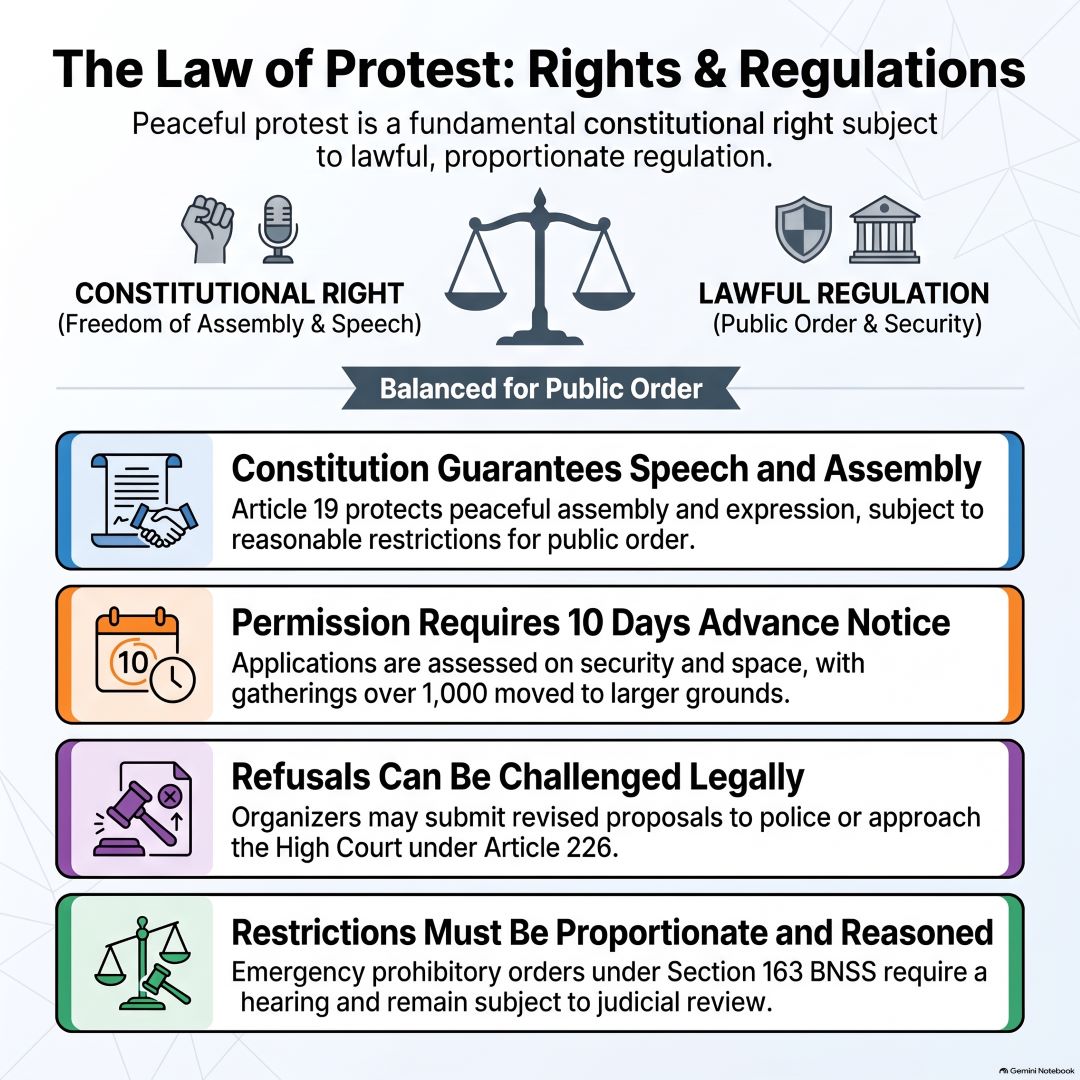
- The right to protest arises primarily from Article 19(1)(a), which guarantees freedom of speech and expression, and Article 19(1)(b), which guarantees the right to assemble peacefully and without arms.
- These rights are not absolute. Article 19(2) permits reasonable restrictions on speech, while Article 19(3) permits reasonable restrictions on peaceful assembly in the interest of public order.
- The constitutional objective is to balance citizens’ right to express dissent with public safety, traffic management and maintenance of public order.
Permission for Public Demonstrations
- Delhi Police guidelines for protests at Jantar Mantar ordinarily require applications to be submitted to the Deputy Commissioner of Police (DCP) at least 10 days before the proposed event.
- Late applications may also be considered depending on space availability and the time needed to make security and administrative arrangements.
- Applications are assessed on a first-come, first-served basis, with inputs from the Special Branch, traffic police and district police.
- Permission may be denied or revoked for legitimate reasons, such as security threats or public-order concerns. Decisions must follow applicable guidelines and should not arbitrarily extinguish the right to peaceful assembly.
- Under the cited guidelines, gatherings at Jantar Mantar are limited to 1,000 people; larger gatherings may be directed to Ramlila Ground.
Supreme Court on the Right to Protest
- In Mazdoor Kisan Shakti Sangathan v. Union of India (2018), the Supreme Court recognised peaceful demonstrations as an important means of expressing grievances but emphasised the need to balance protest rights with the rights of residents and the public.
- In the Ramlila Maidan Incident case (2012), the Court stressed that preventive action affecting fundamental rights must be exercised cautiously and without arbitrariness.
- In Babulal Parate v. State of Maharashtra (1961), the Court considered the legal validity of preventive orders and the ability of affected persons to challenge them.
- The underlying principle is that regulation of protests is permissible, but restrictions should not become a means of preventing all forms of dissent.
Remedies When Permission Is Denied
- Organisers can seek reconsideration from the police by addressing the stated concerns or proposing a smaller gathering, shorter duration or alternative venue.
- If a refusal appears arbitrary or inconsistent with constitutional protections, organisers may approach the High Court under Article 226 for judicial review.
- Delhi Police’s standing order reportedly provides no formal departmental appeal against refusal, although judicial remedies remain available.
- Protesting in defiance of a lawful order may attract Section 223 of the Bharatiya Nyaya Sanhita (BNS), concerning disobedience of an order duly promulgated by a public servant, subject to the facts and legal requirements of the offence.
Prohibitory Orders under BNSS
- Section 163 of the Bharatiya Nagarik Suraksha Sanhita (BNSS), 2023, empowers an Executive Magistrate to issue urgent orders to prevent specified threats to public tranquillity, safety or public order.
- Under Section 163(5), an aggrieved person may apply to the issuing authority to rescind or alter the order.
- Section 163(7) requires the authority to provide an early opportunity of hearing and record reasons in writing when rejecting such an application.
- Such orders are subject to judicial scrutiny; their existence does not automatically remove constitutional protection for peaceful assembly.
Constitutional Balance and Way Forward
- Authorities must assess the actual security and public-order risks, apply restrictions proportionately and consider feasible alternative venues.
- An alternative location should allow protesters to communicate their grievances meaningfully to the relevant authorities; a location that makes the protest ineffective may raise questions of proportionality.
- Transparent permission procedures, reasoned decisions and timely judicial review can reduce arbitrary restrictions while safeguarding public order.
- The broader constitutional principle is that the right to protest is fundamental, but its exercise must remain peaceful and subject to reasonable, lawful and proportionate regulation.