

SC OKs Cutting of 45k Mangroves for Mumbai Coastal Road Project
Hindustan Times
1. Key Arguments
A. Development vs Environmental Conservation (Mangroves Case)
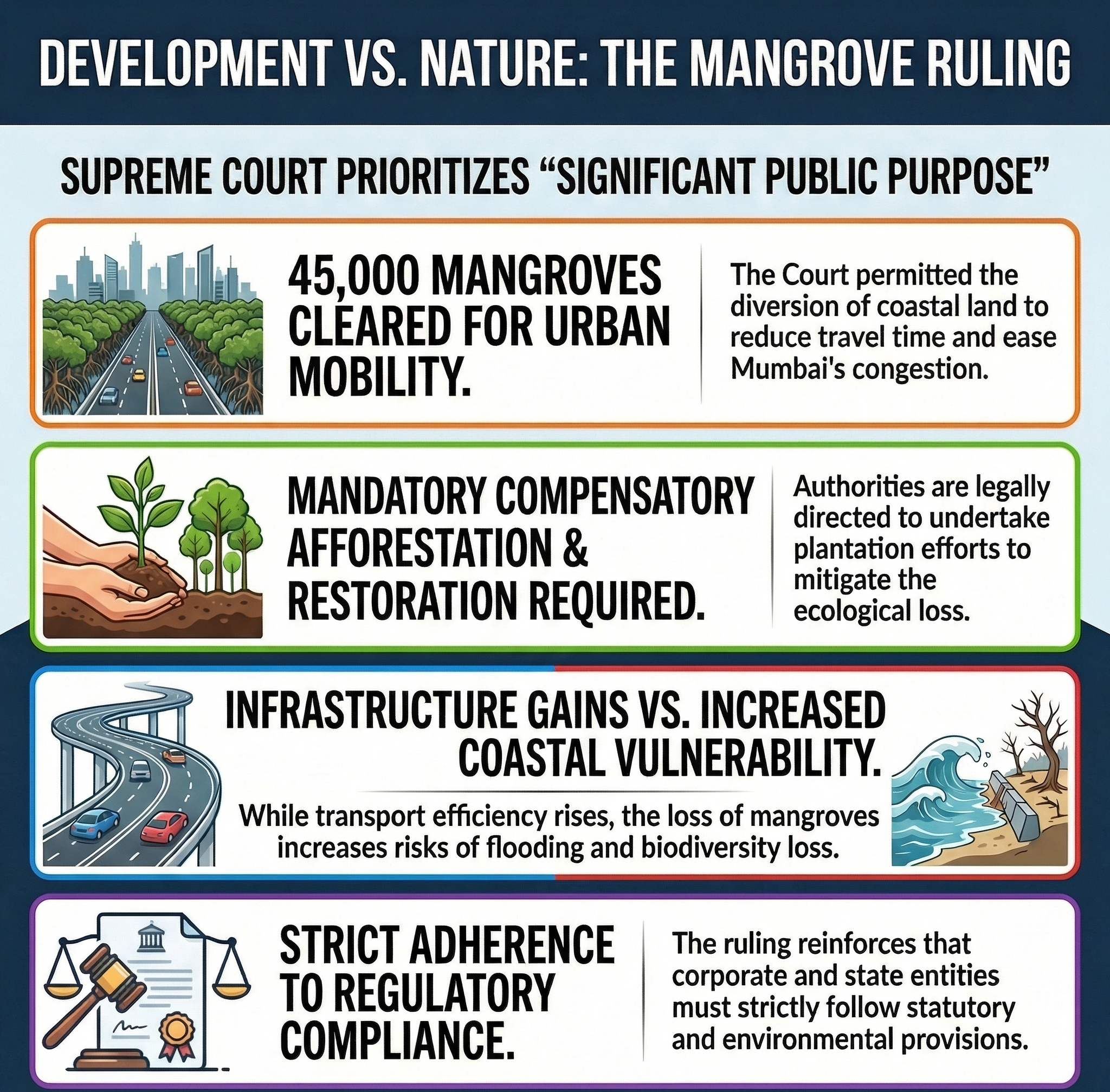
Supreme Court permitted diversion of mangroves citing public infrastructure benefits.
The Mumbai Coastal Road Project is projected to reduce travel time and improve urban mobility.
Compensatory afforestation as mitigation
Authorities have been directed to undertake plantation and restoration efforts.
B. Judicial Endorsement of ‘Larger Public Interest’
Infrastructure gains outweigh ecological costs in this case.
The Court recognises “significant public purpose” in easing congestion and boosting economic activity.
C. Strict Interpretation of Tax Policy (Vedanta Case)
Supreme Court denied concessional diesel benefits.
Held that concessional fuel use is restricted to specified industrial activities, not extendable to mining operations beyond defined scope.
D. Emphasis on Regulatory Compliance
Clear message on adherence to statutory provisions
Corporate entities cannot claim benefits beyond explicit legal provisions.
2. Author’s Stance
Balanced but institutionally aligned
Respect for judicial reasoning
Both pieces largely present the Court’s decisions as justified within legal frameworks.
Subtle concern on environmental trade-offs
In the mangrove case, tone hints at ecological cost but does not strongly oppose the ruling.
3. Biases and Limitations
Judicial deference bias
Limited critical scrutiny of whether “public interest” adequately accounts for long-term ecological damage.
Underrepresentation of environmental risks
Mangrove destruction implications (flooding, biodiversity loss) are not deeply explored.
Limited economic critique in tax case
Does not analyse impact on industrial competitiveness or mining sector costs.
4. Strengths (Pros)
Clear articulation of legal reasoning
Explains how courts balance competing interests.
Highlights governance through rule of law
Reinforces importance of statutory clarity and compliance.
Relevance to urban infrastructure challenges
Addresses real issues of congestion and urban planning.
5. Weaknesses (Cons)
Insufficient ecological depth
Mangroves’ role in coastal protection and climate resilience is underemphasised.
Limited stakeholder perspective
Voices of environmental groups, local communities, and industry are not fully represented.
Short-term vs long-term analysis gap
Focus remains on immediate benefits rather than long-term sustainability.
6. Policy Implications
A. Environmental Governance
Strengthening Coastal Regulation Zone (CRZ) enforcement
Ensure stricter scrutiny before permitting ecological damage.
B. Urban Planning Reform
Integrating sustainability into infrastructure projects
Adopt nature-based solutions alongside development.
C. Judicial Balancing Framework
Refining ‘public interest’ doctrine
Include long-term ecological costs in judicial evaluation.
D. Fiscal and Tax Policy Clarity
Avoid ambiguity in concessional regimes
Clear definitions to prevent litigation.
E. Corporate Accountability
Strict compliance with environmental and tax norms
Promote responsible industrial practices.
7. Real-World Impact
Environmental Impact
Loss of mangroves increases coastal vulnerability
Higher risk of flooding, erosion, and biodiversity loss.
Urban Mobility
Improved transport efficiency
Reduced travel time boosts productivity.
Economic Impact
Higher operational costs for industries (Vedanta case)
No concessional diesel increases cost burden.
Governance
Reinforcement of rule-based administration
Judicial clarity enhances predictability.
8. UPSC GS Paper Linkages
GS Paper II (Polity & Governance)
- Role of judiciary
- Public interest litigation
- Regulatory governance
GS Paper III (Environment & Economy)
- Environmental impact of infrastructure
- Coastal ecosystem protection
- Industrial policy and taxation
GS Paper I (Geography)
- Coastal ecosystems (mangroves)
- Urbanisation challenges
GS Paper IV (Ethics)
- Development vs environment ethics
- Corporate responsibility
9. Balanced Conclusion
The decisions reflect the complexity of modern governance—balancing growth, sustainability, and legal integrity.
While infrastructure development and regulatory clarity are essential, ecological costs and long-term sustainability must not be undervalued.
10. Future Perspective
Towards sustainable infrastructure
Integrate ecological valuation into project planning.
Strengthening environmental jurisprudence
Courts must increasingly factor climate resilience.
Policy clarity and predictability
Reduce litigation through precise legal frameworks.
Holistic governance approach
Align economic growth with environmental sustainability.
Final Insight
True progress lies not in choosing between development and environment, but in designing systems where both can coexist sustainably.
