

SC: Right to life granted under Constitution applies to foreigners too
Morning Standard
1. Key Arguments
A. Universality of Fundamental Rights (Article 21)
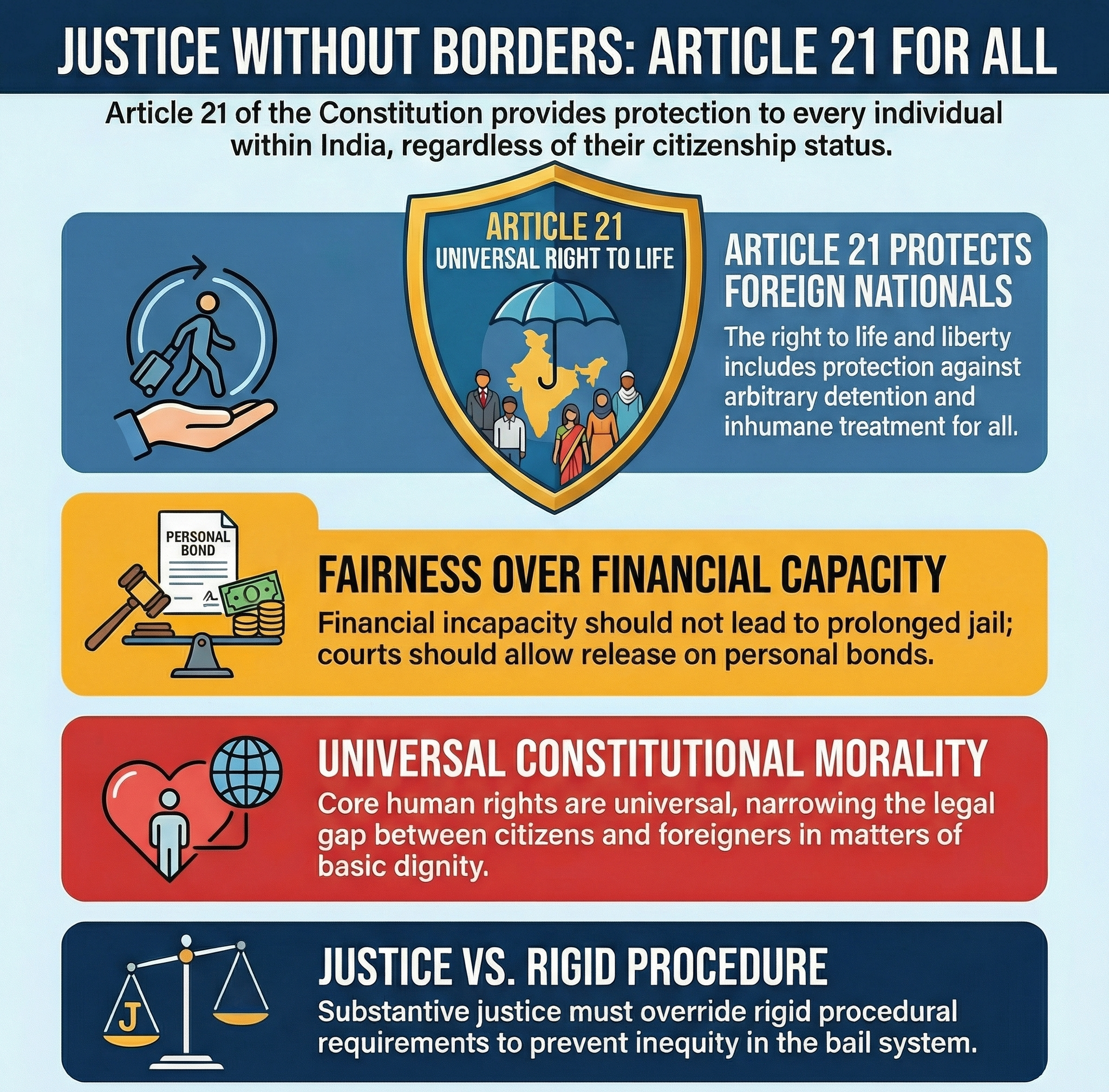
Right to life and liberty is not restricted to citizens.
Foreign nationals are equally entitled to protection against arbitrary detention and inhumane treatment.
B. Humanitarian and Justice-Oriented Interpretation
Courts must consider practical realities such as inability to furnish bail.
Rigid procedural requirements should not override substantive justice.
C. Bail Jurisprudence and Equity
Financial incapacity should not lead to prolonged incarceration.
The Court prioritised fairness by allowing release on personal bond.
D. Distinction Between Citizens and Foreigners Narrowed
While certain rights are citizen-specific, core human rights remain universal.
This reinforces India’s commitment to constitutional morality.
2. Author’s Stance
Supportive of judicial reasoning
Pro-human rights orientation
The article presents the judgment as progressive and aligned with constitutional values.
Implicit endorsement of judicial activism
Highlights the Court’s role in expanding rights through interpretation.
3. Biases and Limitations
Limited security perspective
Concerns related to illegal immigration or national security are not discussed.
Case-specific generalisation
Broader implications may vary depending on context.
Judicial deference
Minimal critique of potential administrative challenges.
4. Strengths (Pros)
Reinforces constitutional morality
Upholds dignity and equality before law.
Strengthens human rights framework
Aligns with international human rights principles.
Promotes judicial fairness
Addresses inequities in bail and detention systems.
5. Weaknesses (Cons)
Potential administrative challenges
Implementation may be complex in cases involving undocumented migrants.
Security concerns underexplored
Balancing rights with national security needs careful consideration.
Limited policy discussion
Does not explore systemic reforms in detention and bail processes.
6. Policy Implications
A. Reform in Bail Procedures
Ensuring equitable access to justice
Reducing reliance on financial conditions.
B. Strengthening Detention Frameworks
Humane treatment of foreign detainees
Clear guidelines for detention centres.
\
C. Legal Aid Expansion
Providing support to vulnerable individuals
Ensuring fair representation for foreigners.
D. Balancing Rights and Security
Developing nuanced policies
Addressing both human rights and national security concerns.
E. Alignment with International Norms
Compliance with global human rights standards
Enhancing India’s global standing.
7. Real-World Impact
Judicial System
More humane and equitable justice delivery
Reduced arbitrary detention.
Human Rights
Protection of vulnerable individuals
Foreign nationals gain legal safeguards.
Governance
Improved credibility of legal system
Strengthens rule of law.
Challenges
Administrative burden and enforcement issues
Managing detention and verification processes.
8. UPSC GS Paper Linkages
GS Paper II (Polity & Governance)
- Fundamental Rights (Article 21)
- Role of judiciary
- Rule of law
GS Paper IV (Ethics)
- Human dignity
- Justice and fairness
GS Paper III (Security)
- Internal security and migration issues
9. Balanced Conclusion
The judgment reinforces the universality of human rights within India’s constitutional framework.
While it strengthens justice and dignity, its implementation must carefully balance humanitarian concerns with administrative and security realities.
10. Future Perspective
Towards inclusive constitutionalism
Expanding rights while ensuring effective governance.
Judicial reforms in bail and detention
Making justice accessible and equitable.
Policy harmonisation
Aligning domestic laws with international standards.
Balanced governance approach
Integrating rights protection with national security.
Final Insight
A Constitution gains strength not by whom it excludes, but by how universally it protects human dignity.
