
Separation of powers and CJI's refusal

Separation of powers and CJI's refusal
The 2026 Context: CJI's Refusal
On October 12, 2026, CJI Surya Kant turned down a request for an administrative meeting with Leaders of the Opposition (LoPs) Mallikarjun Kharge and Rahul Gandhi. They sought to submit a memorandum regarding the Chief Election Commissioner (CEC) and the Special Intensive Revision (SIR) of electoral rolls.
Reasons for Refusal
The CJI's decision highlights the fine line between the judiciary's administrative and judicial roles:
- Sub Judice Matters: The CJI noted that the issues raised (CEC conduct, arbitrary arrests, and transit closures in Delhi) were already pending before the Supreme Court. Discussing them in a private meeting would violate judicial propriety.
- Separation of Powers: He explicitly stated that convening a meeting to discuss pending cases would contravene the principle of Separation of Powers, which is an intrinsic facet of the Basic Structure of the Constitution.
- Administrative vs. Judicial Side: The CJI clarified that the court cannot address such grievances through its "administrative powers." He advised the leaders to instead invoke the "judicial side" by filing a formal petition, ensuring it would be heard transparently.
|
Key Fact Separation of Powers was recognized as part of the 'Basic Structure' of the Constitution in the Kesavananda Bharati case (1973).
|
Doctrine of Separation of Powers in India
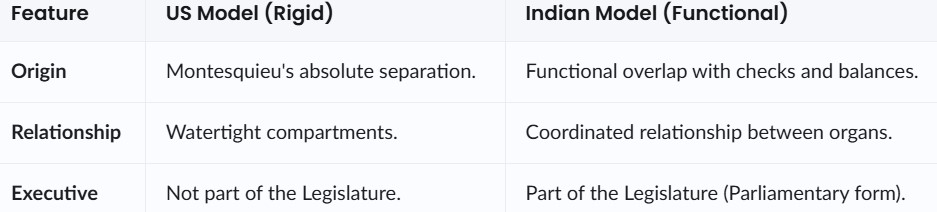
Unlike the rigid model in the US, India follows a system of functional overlap with a strong mechanism of checks and balances.
- Article 50: Directs the State to separate the judiciary from the executive in public services (DPSP).
- Articles 121 and 211: Restrict Parliament and State Legislatures from discussing the conduct of judges except during impeachment proceedings.
- Articles 122 and 212: Restrict the courts from inquiring into the validity of proceedings in Parliament and State Legislatures.
Comparative Perspective