

SHANTI Act: How thorium can power India’s path to energy independence
Indian Express
Key Arguments of the Article
India’s Energy Security Challenge
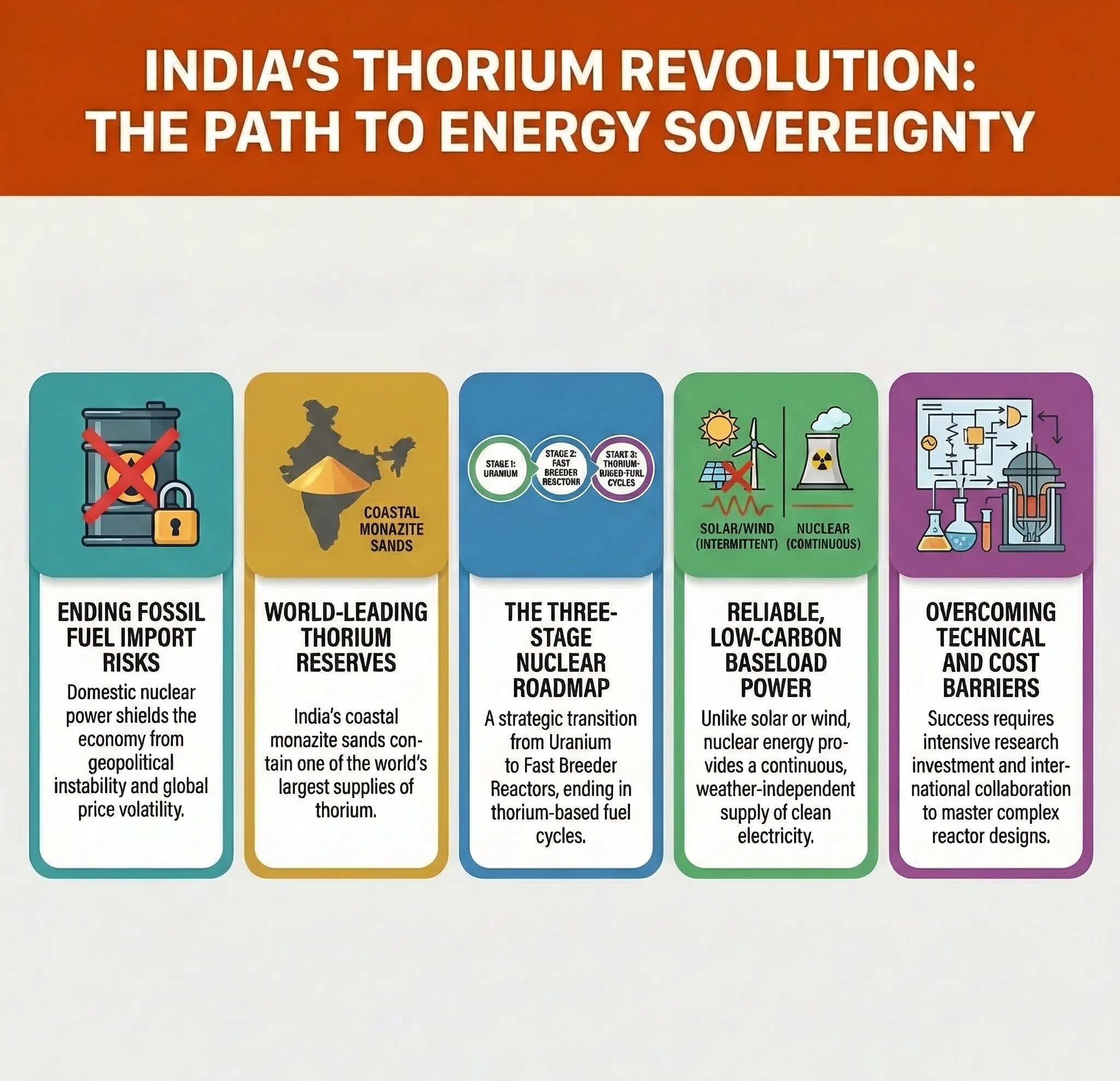
The article begins by emphasising India’s growing energy demand driven by rapid economic growth, industrialisation, and urbanisation. Currently, a significant portion of India’s energy supply depends on fossil fuel imports.
This dependence exposes the economy to geopolitical risks and price volatility in global energy markets.
Strategic Importance of Nuclear Energy
Nuclear power is presented as a reliable and low-carbon energy source capable of providing stable baseload electricity. Unlike renewable sources such as solar and wind, nuclear energy ensures continuous power supply regardless of weather conditions.
Expanding nuclear energy capacity is therefore seen as essential for meeting India’s long-term energy needs.
Thorium as India’s Strategic Resource
India possesses one of the world’s largest reserves of thorium, particularly in coastal regions rich in monazite sands. The article argues that thorium-based reactors could provide a sustainable domestic energy source.
Thorium fuel cycles could reduce reliance on imported uranium and support long-term energy independence.
Three-Stage Nuclear Power Programme
The article refers to India’s long-standing three-stage nuclear programme designed to eventually utilise thorium.
• Stage 1: Pressurised Heavy Water Reactors using natural uranium
• Stage 2: Fast Breeder Reactors producing plutonium
• Stage 3: Advanced reactors using thorium-based fuel cycles
This programme aims to maximise the utilisation of domestic nuclear resources.
Need for Technological Innovation and Investment
Developing thorium-based nuclear reactors requires significant research, technological development, and infrastructure investment. The article emphasises the importance of advanced reactor designs and international collaboration in accelerating technological progress.
Public and private sector partnerships may be required to scale up nuclear capacity.
Author’s Stance
The author strongly supports expanding India’s nuclear energy programme, particularly through thorium-based technologies. The article portrays thorium as a strategic asset capable of transforming India’s energy landscape.
The tone reflects a technological optimism regarding India’s nuclear capabilities.
Possible Biases
Nuclear Energy Advocacy
The article emphasises the benefits of nuclear energy and thorium technology while giving relatively limited attention to risks or public concerns.
Technological Optimism
The discussion assumes that technological barriers in thorium reactor development can be overcome relatively quickly.
Strategic Perspective
The article prioritises national energy security and strategic autonomy.
Advantages of Thorium-Based Nuclear Energy
Energy Independence
Using domestically available thorium can reduce dependence on imported fuels.
Low Carbon Emissions
Nuclear power produces minimal greenhouse gas emissions compared to fossil fuels.
Long-Term Fuel Security
Thorium reserves can sustain nuclear power generation for decades.
Technological Leadership
Developing thorium reactors could position India as a global leader in advanced nuclear technologies.
Challenges and Concerns
Technological Complexity
Thorium fuel cycles require advanced reactor designs and complex fuel processing technologies.
High Initial Costs
Developing nuclear infrastructure requires significant capital investment.
Nuclear Safety Concerns
Public concerns about nuclear safety, waste management, and radiation risks remain significant.
Regulatory and Institutional Constraints
Expanding nuclear energy requires strong regulatory frameworks and institutional capacity.
Policy Implications
Strengthening Nuclear Research
Investment in advanced nuclear research institutions and technology development is essential.
Accelerating the Three-Stage Programme
Policy support is needed to ensure progress in fast breeder reactors and thorium fuel cycles.
International Collaboration
Strategic partnerships with other countries can accelerate nuclear technology development.
Expanding Nuclear Infrastructure
Developing nuclear power plants and associated fuel cycle facilities will strengthen energy security.
Real-World Impact
If thorium-based nuclear energy is successfully developed:
• Greater energy independence
• Reduced fossil fuel imports
• Lower carbon emissions
• Enhanced technological capability
If technological challenges persist:
• Continued reliance on fossil fuel imports
• Slow expansion of nuclear energy capacity
• Delayed progress in energy transition goals
Alignment with UPSC GS Papers
GS Paper III
Energy security, nuclear technology, science and technology in development.
GS Paper II
Energy policy and international cooperation in nuclear technology.
GS Paper I
Geography of natural resources and energy systems.
Balanced Assessment
Thorium-based nuclear energy offers a promising pathway for strengthening India’s long-term energy security. By leveraging domestic thorium reserves, India can reduce dependence on imported fuels while supporting low-carbon power generation.
However, technological complexity, high costs, and safety considerations require careful planning and sustained investment.
Future Perspective
As global energy systems transition toward cleaner sources, nuclear energy may play a crucial role in ensuring reliable power supply. India’s unique thorium resources provide a strategic opportunity to develop advanced nuclear technologies.
For policymakers and civil services aspirants, the debate highlights the intersection of energy policy, technological innovation, and national security in shaping India’s energy future.
