

Shifting Sands on the Aravallis: The Legal and Environmental Debate on Mining
The Tribune
I. Central Theme and Context
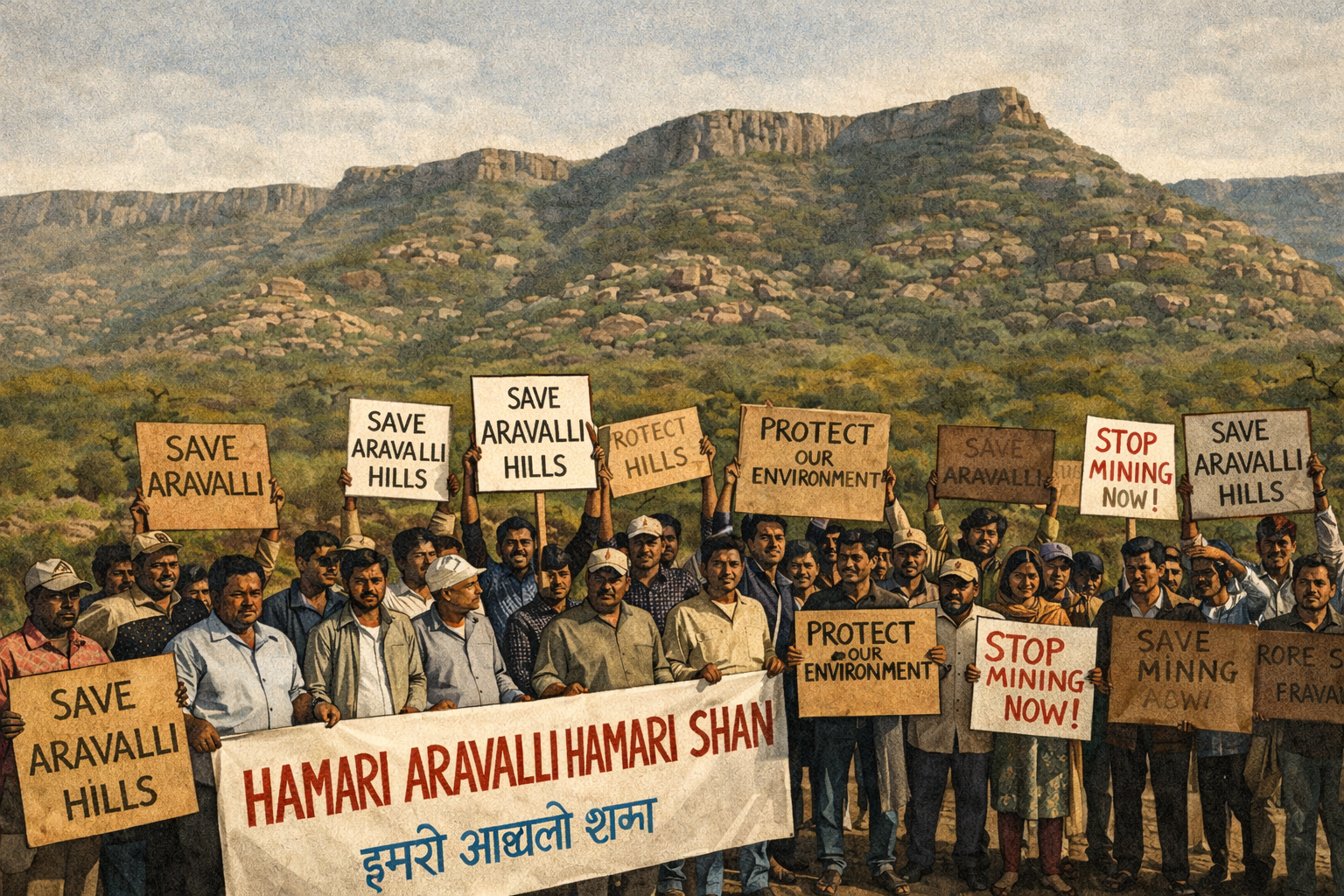
The article discusses the dispute over the Aravalli hills, a critical geographical feature in northern India that serves as an important ecological barrier against desertification. At the heart of the debate is the Supreme Court’s ruling on the mining ban, and the conflicting positions between the Central Government, environmentalists, and state governments, particularly regarding the Aravalli’s protection and future exploitation.
The policy dilemma involves balancing the economic utility of mining in this mineral-rich region against the environmental cost of disrupting the biodiversity and geological integrity of the area. The debate also ties into the larger issue of how to define and protect environmental heritage in the face of ongoing developmental pressures.
II. Key Arguments Presented
1. Legal and Environmental Confusion
The article highlights the Supreme Court's mandate, which restricted mining on the Aravallis to protect the fragile ecosystem, yet it simultaneously set up a committee to resolve confusion regarding the boundaries of the mining prohibition. This marks a lack of clarity in governmental directions.
2. Politicisation and Bureaucratic Disagreement
Congress's accusations of political overreach and the environment ministry’s indecision complicate the enforcement of environmental protection laws. There is also governmental inconsistency in the decision to regulate or stop mining.
3. Scientific and Cultural Significance of the Aravallis
The article places the Aravallis within the larger discourse on environmental conservation, acknowledging the scientific perspective on its significance. Rajasthan’s state government and local communities are seen as prioritising economic exploitation over environmental health.
4. The Role of Experts and Legal Mechanisms
The article outlines the role of scientific bodies like the Geological Survey of India (GSI) in evaluating the ecosystem’s integrity, noting that debates about mining definitions remain unresolved. Furthermore, the Central and State governments continue to contest land-use classifications, creating gaps in enforcement.
5. The Environmental Justice Perspective
Finally, the article presents an environmental justice framework. While acknowledging the need for economic growth, it stresses that environmental protection should not be sacrificed for short-term financial gains, particularly when the long-term ecological costs can be far-reaching.
III. Author’s Stance
The author takes a critical stance on the government’s inconsistent policy regarding the Aravallis, emphasising the need for stronger environmental governance. The author also underscores the importance of scientific research and legal clarity in ensuring that ecological protection takes precedence over economic exploitation.
IV. Biases and Editorial Slant
1. Strong Environmental Advocacy
The author strongly supports environmental protection over economic exploitation, portraying the environment as a public good that must be safeguarded from the pressures of commercial interests.
2. Implicit Critique of Political Influence
There is an implicit bias against political interference in environmental governance, particularly pointing out the role of state governments in pushing for mining despite the environmental implications.
3. Limited Exploration of Economic Necessities
The article leans heavily on the environmental argument, underplaying the potential economic advantages of mining for local communities and the state, such as job creation and revenue generation.
V. Strengths of the Argument
1. Clear Moral and Legal Position
The article presents a clear moral and legal standpoint, emphasizing the constitutional duty to protect the environment and the long-term benefits of preserving natural resources.
2. Integration of Legal and Scientific Analysis
By combining legal frameworks with scientific perspectives, the article presents a well-rounded analysis of the issue.
3. Acknowledgement of State–Centre Tensions
The author effectively captures the complexity of federal governance, highlighting the challenges in balancing state autonomy with national priorities in environmental protection.
VI. Weaknesses and Gaps
1. Limited Consideration of Local Stakeholders' Interests
While the article touches upon economic concerns, it doesn’t delve deeply into the local community’s role in advocating for or against mining. A more comprehensive examination of local livelihoods could have added depth.
2. Lack of Detailed Policy Recommendations
The article critiques the current policies but does not offer concrete suggestions for bridging the gap between economic development and environmental protection. Policy solutions for compromise or alternative energy/resource use could have been explored more fully.
3. Overemphasis on Legal Aspects
While the article presents valid critiques of the judicial system’s role, it doesn’t sufficiently explore the operational challenges in implementing environmental protections on the ground.
VII. Policy Implications
1. Clear Policy Framework for Environmental Protection
A unified policy framework that balances economic exploitation with environmental safeguards is essential, particularly in ecologically sensitive areas like the Aravallis.
2. Strengthened Centre-State Coordination
Greater coordination between the Centre and State on environmental matters, especially through decentralised mechanisms, is necessary to ensure that national laws are enforced effectively at the local level.
3. Incentives for Alternative Economic Models
States reliant on resource extraction, like Rajasthan, must consider diversified economic strategies, including sustainable tourism and alternative energy sources, to reduce dependence on destructive industries.
VIII. Real-World Impact
For Environmental Policy
• Stronger legal frameworks and more rigorous enforcement mechanisms for environmental protection
• Increased accountability for state and local governments in safeguarding ecologically sensitive areas
For Local Communities
• Potential loss of livelihood opportunities if mining operations are halted without alternative economic options in place
• Long-term ecological health of the region at risk from over-exploitation of resources
For the National Economy
• Short-term economic gains from mining may be offset by long-term costs in environmental degradation and reduced sustainable resource use.
IX. UPSC GS Paper Alignment
GS Paper II – Polity & Governance
• Federalism and intergovernmental relations in environmental policy
• Judiciary and its role in public governance
GS Paper III – Environment
• Ecological and environmental issues, including sustainability, biodiversity, and conservation policies
• Environmental law and governance
GS Paper I – Indian Society
• Social and cultural dimensions of environmental challenges, particularly in rural areas
• Role of civil society in advocating for sustainable development
X. Balanced Conclusion
The article effectively conveys the environmental importance of the Aravalli hills and the challenges posed by the current policy framework. It critiques the piecemeal approach to environmental governance while calling for coherent national policies. However, the focus on legal and judicial solutions could have been complemented by more robust discussions on economic transition and social acceptance in mining-dependent regions.
XI. Future Perspectives
• Comprehensive national policy on resource extraction with clear safeguards for ecological health
• Implementation of alternative livelihoods and sustainable resource management in affected areas
• Greater public participation in environmental decision-making, especially in ecologically sensitive regions like the Aravallis
