

Should men get paternity leave in India?
The Hindu
1. Key Arguments
A. Gendered Division of Care Work
Women disproportionately bear childcare and domestic responsibilities.
Absence of paternity leave reinforces traditional gender roles and workplace inequality.
B. Child Development Perspective
Early childhood benefits from involvement of both parents.
Paternity leave supports emotional, cognitive, and social development.
C. Workplace Inequality and Motherhood Penalty
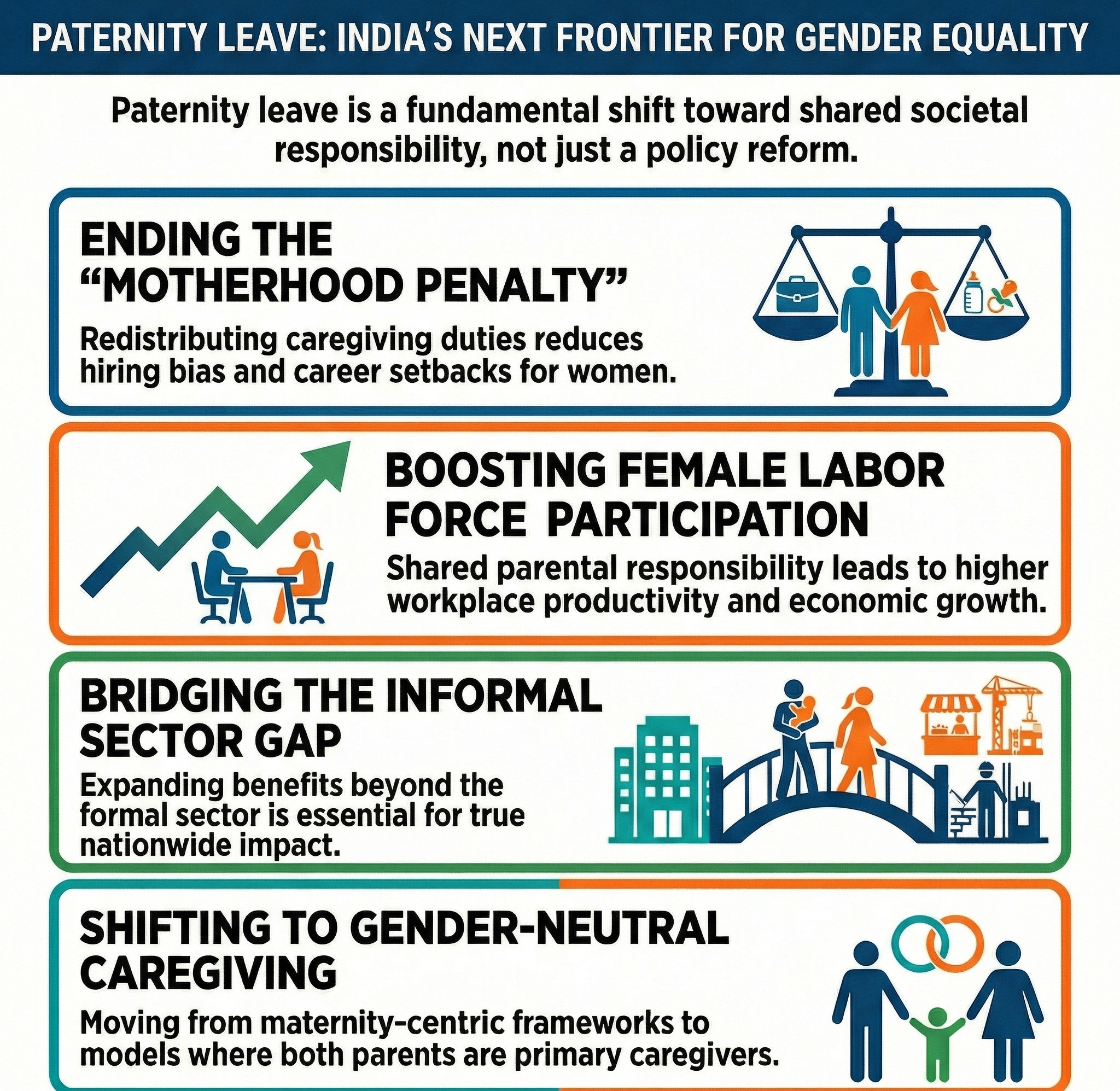
Women face career setbacks due to caregiving expectations.
Paternity leave can redistribute responsibilities and reduce hiring bias against women.
D. Limited Coverage of Existing Policies
India lacks a universal paternity leave law.
Maternity benefits exist, but coverage is largely restricted to the formal sector.
E. Informal Sector Constraints
Majority of workforce is outside formal employment.
Extending paternity leave universally is difficult due to economic and structural limitations.
F. Global Comparisons and Models
Countries with shared parental leave show better gender outcomes.
Nordic models highlight benefits of non-transferable paternity leave.
2. Author’s Stance
Balanced and reform-oriented
Supports introduction of paternity leave
Recognises its importance for gender justice.
Pragmatic about implementation challenges
Acknowledges economic and labour market constraints.
3. Biases and Limitations
Urban/formal sector bias
Focus is more on organised sector realities.
Normative gender equality lens
Assumes policy change will directly alter social norms.
Limited fiscal analysis
Cost implications for employers and government are underexplored.
4. Strengths (Pros)
Strong linkage between gender and labour markets
Highlights structural inequalities.
Multi-dimensional analysis
Covers social, economic, and developmental aspects.
Policy relevance
Addresses an emerging issue in labour reforms.
5. Weaknesses (Cons)
Limited implementation roadmap
Does not specify how to scale policy across sectors.
Underexplored cultural resistance
Patriarchal norms may hinder uptake.
Insufficient focus on small enterprises
Economic burden on MSMEs not deeply analysed.
6. Policy Implications
A. Introduction of Paternity Leave Framework
Legal recognition of paternity leave
Clear guidelines on duration and eligibility.
B. Shared Parental Leave Model
Encouraging equal participation of both parents
Non-transferable leave for fathers.
C. Extending Coverage Beyond Formal Sector
Innovative models for informal workers
Social security-based benefits.
D. Workplace Reforms
Flexible work arrangements and childcare support
Reducing burden on families.
E. Behavioural Change Initiatives
Promoting gender-sensitive norms
Awareness campaigns and incentives.
7. Real-World Impact
Gender Equality
Redistribution of unpaid care work
Improved participation of women in workforce.
Child Development
Better early childhood outcomes
Stronger parental bonding.
Economic Impact
Increased female labour force participation
Boost to productivity and growth.
Challenges
Cost burden and compliance issues
Particularly for small firms and informal sector.
8. UPSC GS Paper Linkages
GS Paper I (Society)
- Gender roles and inequality
- Family and social structure
GS Paper II (Governance)
- Labour laws and social justice
- Welfare policies
GS Paper III (Economy)
- Labour force participation
- Informal sector challenges
GS Paper IV (Ethics)
- Gender justice
- Equity and fairness
9. Balanced Conclusion
Paternity leave is a progressive reform with significant social and economic benefits, but its success depends on careful design and inclusive implementation.
Without addressing structural constraints, it risks remaining limited to privileged segments.
10. Future Perspective
Towards gender-neutral parental policies
Moving beyond maternity-centric frameworks.
Integrating informal sector workers
Expanding social security systems.
Changing societal norms
Encouraging shared caregiving responsibilities.
Balancing equity and feasibility
Designing policies that are both inclusive and economically viable.
Final Insight
True gender equality begins at home—paternity leave is not just a policy reform, but a shift in societal values and responsibilities.
