

Soil Health Crisis and Fertiliser Policy Reform

Soil Health Crisis and Fertiliser Policy Reform
GS Paper: GS-III (Agriculture, Subsidies, Environment) |
Source: Indian Express
Why in News?
The Union Agriculture Minister launched the rabi campaign "Khet Bachao Abhiyan" (Save the Farm Campaign) at Karnal, Haryana on 22 October, urging farmers to apply balanced chemical fertilisers as per state agricultural university recommendations. An ICRIER policy brief has flagged that the imbalance has worsened.
The Problem: Imbalanced Nutrient Use
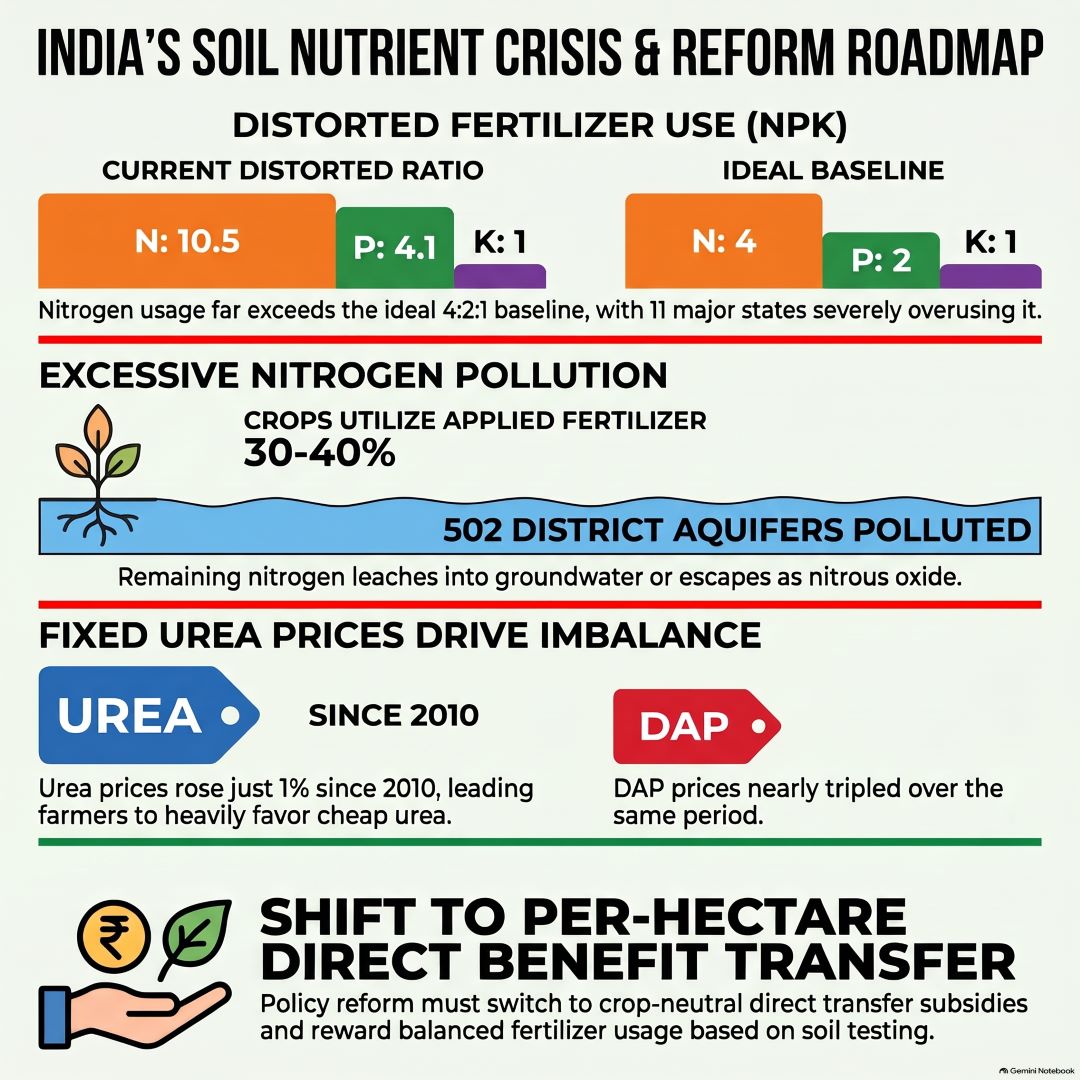
• Ideal N:P:K ratio is 4:2:1 (the article cites the derived normative ratio of 2.8:1.5:1). Actual ratio is 10.5:4.1:1.
• Nitrogen use has moved from 7% below the recommended dose to 6% above it (2009-10 to 2024-25). Potash deficit deepened from 48% to 72%.
• 11 of 20 major states overuse nitrogen, led by Jharkhand (72%) and Punjab (65%).
• Soil Health Card data (2025-26): 72% of samples low in nitrogen, 52% low in organic carbon, 42% low in boron, 37% low in zinc.
• Crops use only 30-40% of the nitrogen applied; the rest escapes as nitrous oxide (273 times as potent as CO2) or leaches into groundwater (nitrate above safe limits in 502 districts, causing "blue baby syndrome").
Why Did the Nutrient-Based Subsidy (NBS) Fail?
• NBS (2010) freed phosphatic and potassic fertiliser prices, but urea was kept at a fixed price.
• DAP prices nearly tripled and MOP rose six-fold between 2010-11 and 2024-25, whereas urea rose just 1%. Farmers therefore chose cheap urea.
• Fiscal stress: the 2026-27 subsidy budget is Rs 1.71 lakh crore, but disruption in the Strait of Hormuz could push it to Rs 2.5-3 lakh crore. Subsidy is also skewed by region (Punjab gets Rs 25,700 per hectare, 10 times Kerala's) and, with MSP procurement and free power, locks in rice-wheat rotation and depletes aquifers.
Four-Step Reform Roadmap
1. Shift to Direct Benefit Transfer (DBT) on a per-hectare basis, neutral across nutrients and crops. AgriStack's farmer IDs and a Fertiliser Sale Framework can support it. Alternatively, bring urea under NBS.
2. Reward balance: fix and speed up PM-PRANAM, which has so far disbursed nothing.
3. Plough savings into drip irrigation and fertigation, coated or customised fertilisers, nano-fertilisers, biofertilisers and gene-edited seeds with higher nitrogen use efficiency.
4. Follow the 4Rs (right source, rate, time, place) based on soil tests. Rotating cereals with pulses can cut nitrogen needs by 20-30%.
|
Key Schemes and Concepts • Nutrient Based Subsidy (NBS): since 2010; fixed per-kg subsidy on N, P, K and S; urea is outside it. • PM-PRANAM: PM Programme for Restoration, Awareness, Nourishment and Amelioration of Mother Earth (2023); rewards states that reduce chemical fertiliser use. • Soil Health Card Scheme (2015): soil testing and crop-wise recommendations. • Nano urea (IFFCO): liquid fertiliser that can cut conventional urea needs. • Related: Neem-coated urea, Paramparagat Krishi Vikas Yojana, natural farming mission, AgriStack and Digital Agriculture Mission.
|