

Sorry state of education
The Statesman
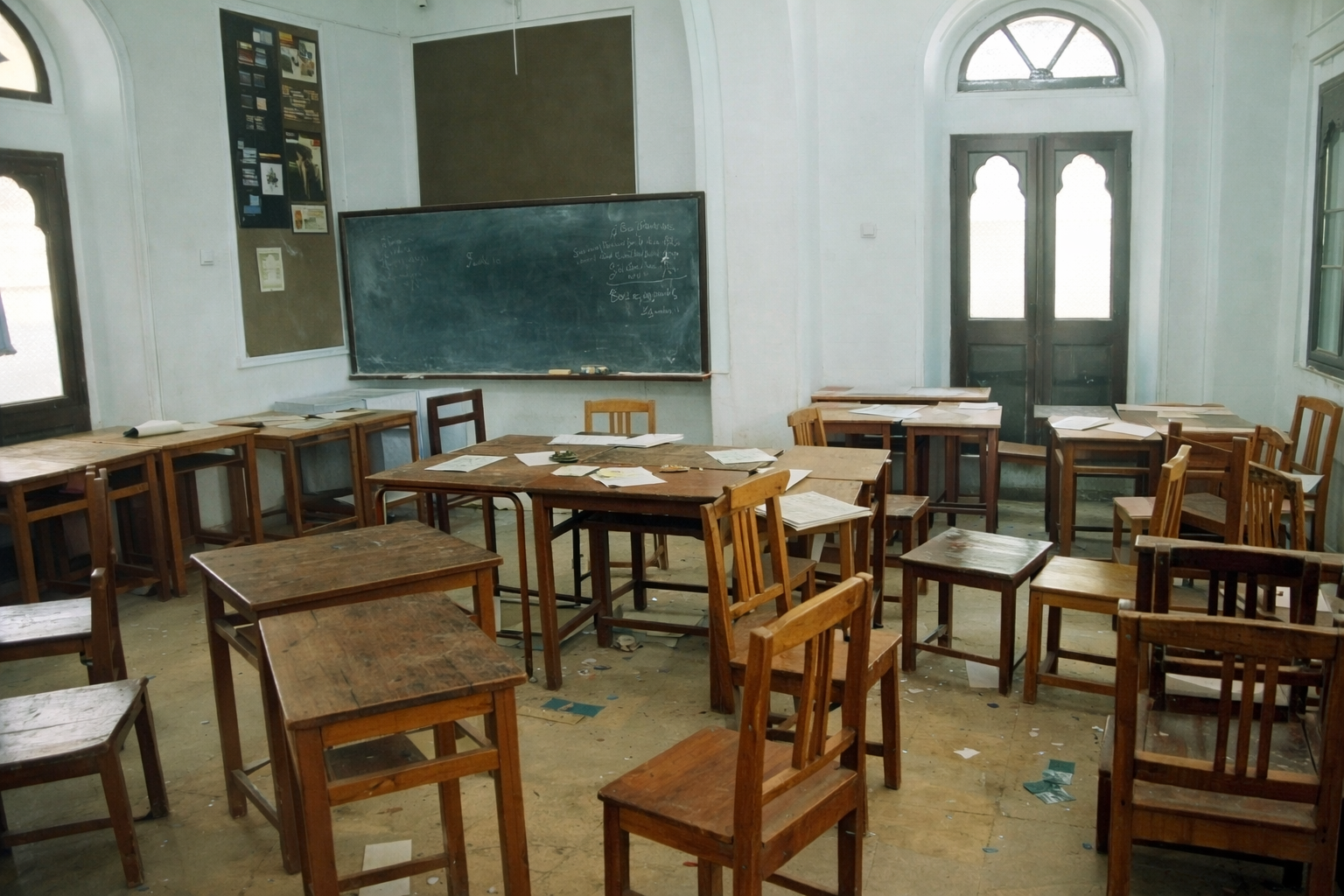
Context and Central Concern
The article is a sharp critique of India’s contemporary education landscape in the context of the National Education Policy (NEP) 2020. It juxtaposes the ambitious promises of reform—foundational learning, multidisciplinary education, autonomy, and global competitiveness—with the persistent structural decay visible in schools and higher education institutions. The central concern is that policy vision has raced far ahead of institutional capacity, financing, and governance reform.
Key Arguments Presented
1. Learning Outcomes Crisis at the School Level
The article foregrounds:
- Poor foundational literacy and numeracy despite decades of schooling
- High enrolment masking low learning achievement
- Declining teacher morale and inadequate teacher preparation
The argument is that access has been achieved without quality, making learning deficits cumulative and irreversible for large sections of students.
2. Over-ambition of NEP 2020 Without Ground Capacity
The author argues that:
- NEP 2020 is conceptually sound but administratively over-extended
- Structural prerequisites—trained teachers, academic autonomy, assessment reform, and funding—are missing
- Reforms are announced top-down, without addressing school-level realities
The policy is portrayed as aspirational in design but fragile in execution.
3. Funding Deficit and Resource Misalignment
A major criticism is that:
- Education spending remains well below promised targets
- Expansion of universities, digital infrastructure, and research goals is attempted without fiscal backing
- Public universities face declining autonomy combined with rising compliance
The article suggests that financial neglect undermines every reform promise.
4. Regulatory Overreach and Institutional Distrust
The piece highlights:
- Excessive centralisation and bureaucratic control over curricula, hiring, and evaluation
- Lack of trust in universities and teachers as self-regulating academic communities
- Regulatory uniformity stifling institutional diversity and innovation
The system is described as one where compliance replaces creativity.
5. Skill–Employability Disconnect
The author argues that:
- Degrees increasingly fail to translate into employable skills
- NEP’s skill integration remains rhetorical without industry–academia ecosystems
- Youth unemployment reflects systemic failure, not individual deficiency
Education is framed as producing credentials rather than capabilities.
Author’s Stance
The author adopts a deeply critical yet reformist stance:
- Not opposed to NEP 2020 in principle
- Strongly sceptical of state capacity and intent to execute reforms honestly
- Advocates realism over rhetoric
The tone is cautionary, bordering on alarmist, but grounded in long-standing evidence of systemic inertia.
Biases and Editorial Leanings
1. Institutional Skepticism
The article:
- Assumes chronic government incapacity for sustained reform
- Risks underplaying recent incremental improvements
This may tilt the narrative toward pessimism.
2. Public-System-Centric Lens
The focus is primarily on:
- Government schools and public universities
- Less engagement with private-sector heterogeneity
This limits the scope of systemic comparison.
3. Normative Preference for Academic Autonomy
There is:
- A clear bias in favour of decentralisation and institutional freedom
- Less attention to accountability failures that autonomy can also enable
Pros and Cons of the Argument
Pros
- Accurately diagnoses the learning outcomes crisis
- Highlights mismatch between vision and capacity
- Exposes the political economy of underfunded reform
- Encourages aspirants to avoid uncritical praise of NEP
Cons
- Limited acknowledgment of long-term reform timelines
- Underplays regional and state-level variation
- Less emphasis on implementation success stories
Policy Implications
1. Education Governance
- Need to shift from announcement-driven reform to capacity-driven reform
- Greater trust in teachers and institutions as agents of change
2. Public Finance
- Education reform requires sustained fiscal commitment, not episodic schemes
- Budgetary priorities must match policy ambition
3. Human Capital Strategy
- Foundational learning must precede higher-order curricular innovation
- Skill integration needs ecosystem-level planning
Real-World Impact
- Continued learning deficits risk demographic liability instead of dividend
- Rising graduate unemployment fuels social frustration and political discontent
- Inequality widens as quality education becomes increasingly stratified
For aspirants, the article reinforces that education is not merely a social sector issue but a core governance challenge.
UPSC GS Paper Alignment
GS Paper II – Governance and Social Justice
- Education policies
- Role of the state in human development
- Accountability and institutional reform
GS Paper I – Society
- Social mobility
- Inequality and access to opportunity
GS Paper III – Economy
- Human capital formation
- Demographic dividend and productivity
Balanced Conclusion and Future Perspective
The article persuasively argues that India’s education crisis is not one of ideas, but of execution, trust, and political will. NEP 2020 offers a broad and imaginative framework, but without foundational learning reform, teacher empowerment, fiscal commitment, and regulatory restraint, it risks becoming another visionary document undermined by systemic inertia. The future of Indian education depends not on new policy slogans, but on patient institutional rebuilding, where learning outcomes, not announcements, become the true measure of reform success.
