

Special Intensive Revision (SIR) of Electoral Rolls

Special Intensive Revision (SIR) of Electoral Rolls
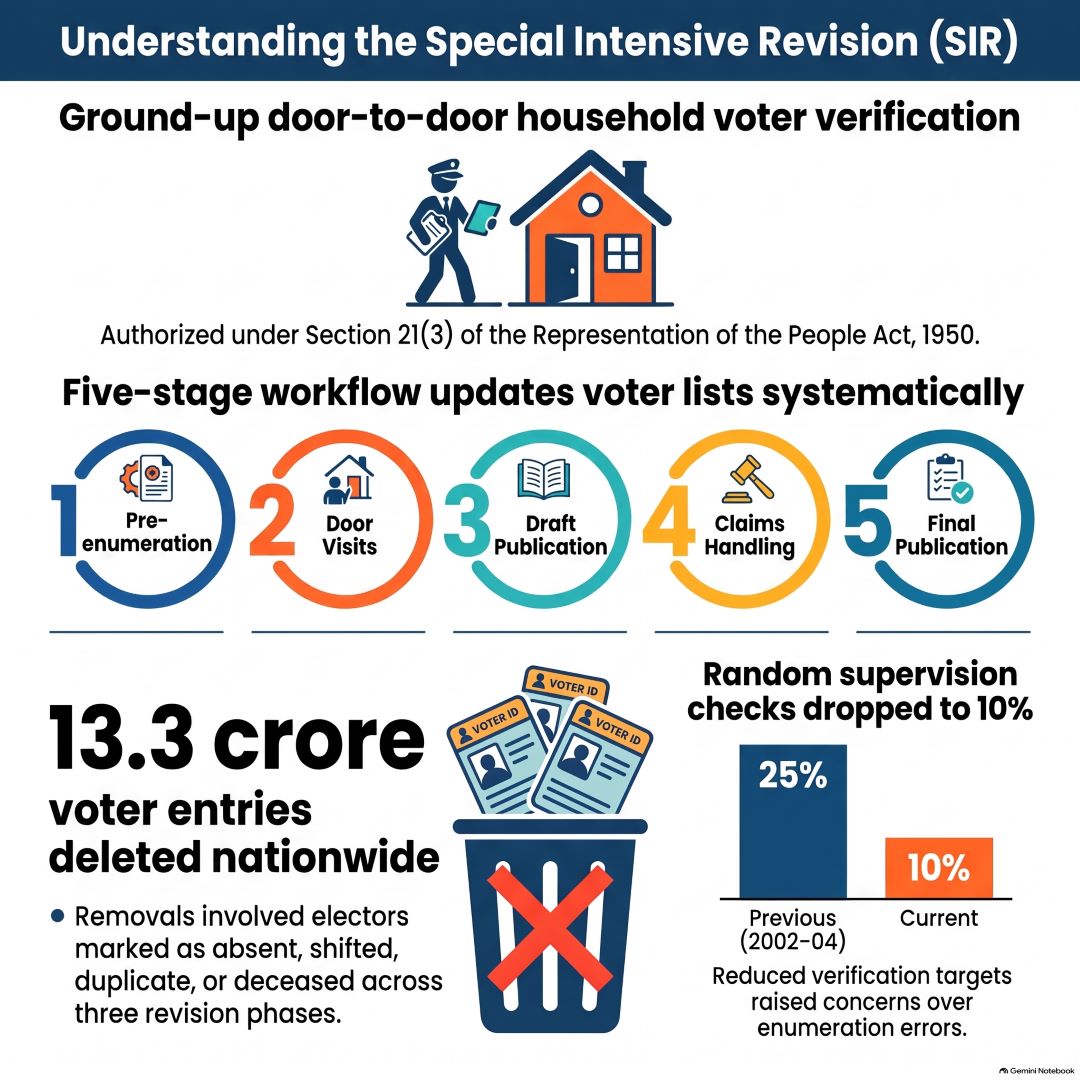
Overview and Legal Basis
- The Special Intensive Revision (SIR) is an exercise conducted by the Election Commission of India (ECI) to comprehensively verify and update electoral rolls.
- Section 21(3) of the Representation of the People Act, 1950, empowers the ECI to conduct a special revision of electoral rolls in any constituency or part of a constituency.
- Its objectives include identifying deceased electors, duplicate entries, voters who have shifted residence and eligible citizens whose names have been omitted.
- The ECI initiated a nationwide SIR in June 2025, beginning with Bihar.
|
The Special Intensive Revision (SIR) is a comprehensive, ground-up exercise conducted by the Election Commission of India (ECI) to prepare a fresh electoral roll through house-to-house enumeration. Unlike the routine Special Summary Revision (SSR), which typically updates existing lists, SIR involves a granular verification of every household to eliminate duplicates, remove deceased or migrated voters, and ensure no eligible citizen is left behind. |
SIR Process During 2002–04
- Door-to-door enumeration: Enumerators visited households using preliminary electoral rolls. Elected Panchayat members could voluntarily assist.
- Multi-level supervision: Supervisors were required to randomly verify at least 25% of households covered by enumerators. EROs, AEROs and District Election Officers were also assigned verification responsibilities.
- Verification targets: AEROs, EROs and District Election Officers were required to check at least 12%, 5% and 2% of households, respectively. Supervisors had to personally verify houses reported locked after repeated visits.
- Treatment of shifted electors: Such electors were marked with an “S” in preliminary rolls rather than being immediately deleted. Their new addresses were recorded, and coordination between electoral authorities facilitated enrolment at new locations and removal of old entries.
- Citizenship and objections: First-time applicants had to establish eligibility, while the guidelines recognised the evidentiary value of an applicant’s presence on an existing electoral roll. Bulk claims and objections submitted by individuals, organisations or political parties were to be summarily rejected. Final rolls were to be published after disposal of claims and objections.
Major Concerns Regarding the 2025–26 SIR
- Voter exclusion: Electors unavailable during enumeration or unable to submit forms risked exclusion from draft rolls. Unlike the earlier process, shifted electors were not necessarily enrolled at their new addresses.
- Reduced supervision: The reported random household-verification requirement in Bihar was 10%, compared with 25% during 2002–04, raising concerns about enumeration errors.
- Burden of proof: Voters were required to trace their or their parents’ names in earlier electoral rolls or provide citizenship-related documents, potentially placing an excessive burden on eligible electors.
- Automated discrepancies: Software flags involving spelling variations, more than six voters linked to one ancestor and parent–child age gaps outside 15–45 years reportedly contributed to discrepancies requiring verification.
- Claims and appeals: Bulk objections through Form 7 raised concerns about possible misuse. On October 9, the ECI limited the number of objections an individual could file. Delays in processing Form 6 applications, re-enrolment requests and appeals remain concerns.
|
Key Features of SIR
The Process Workflow
|
Scale, Implications and Reform Priorities
- Approximately 13.3 crore voter entries were reportedly deleted across the three phases of the current SIR. The largest category comprised electors classified as absent, shifted or deleted for other reasons. Deletion does not necessarily mean permanent ineligibility; eligible individuals may seek re-enrolment through the prescribed process.
- Audit electoral rolls already finalised to identify procedural errors and wrongful exclusions.
- Ensure systematic door-to-door verification, particularly where electors cannot be contacted during initial enumeration.
- Strengthen supervisory checks and require adequate verification before deleting entries flagged by automated systems.
- Expedite the processing of eligible claims, re-enrolment applications and appeals, with transparent procedures and timely decisions.
- Publish final rolls only after claims and objections have been duly considered.
- Apply the proviso to Section 21(3) of the Representation of the People Act, 1950, where applicable, to maintain existing electoral rolls for upcoming State elections while revision is completed through due process.
Conclusion
Electoral-roll revision must ensure both accuracy and universal access to the franchise. Strong verification, transparent procedures, effective grievance redressal and safeguards against wrongful deletion are essential to maintaining public confidence in elections and protecting eligible citizens’ voting rights.