

Special Intensive Revision (SIR) of Electoral Rolls: Citizenship Authority and Global Comparisons (Part 2)
Relevance: GS Paper II (Elections, Election Commission of India, Citizenship, Comparative Polity)

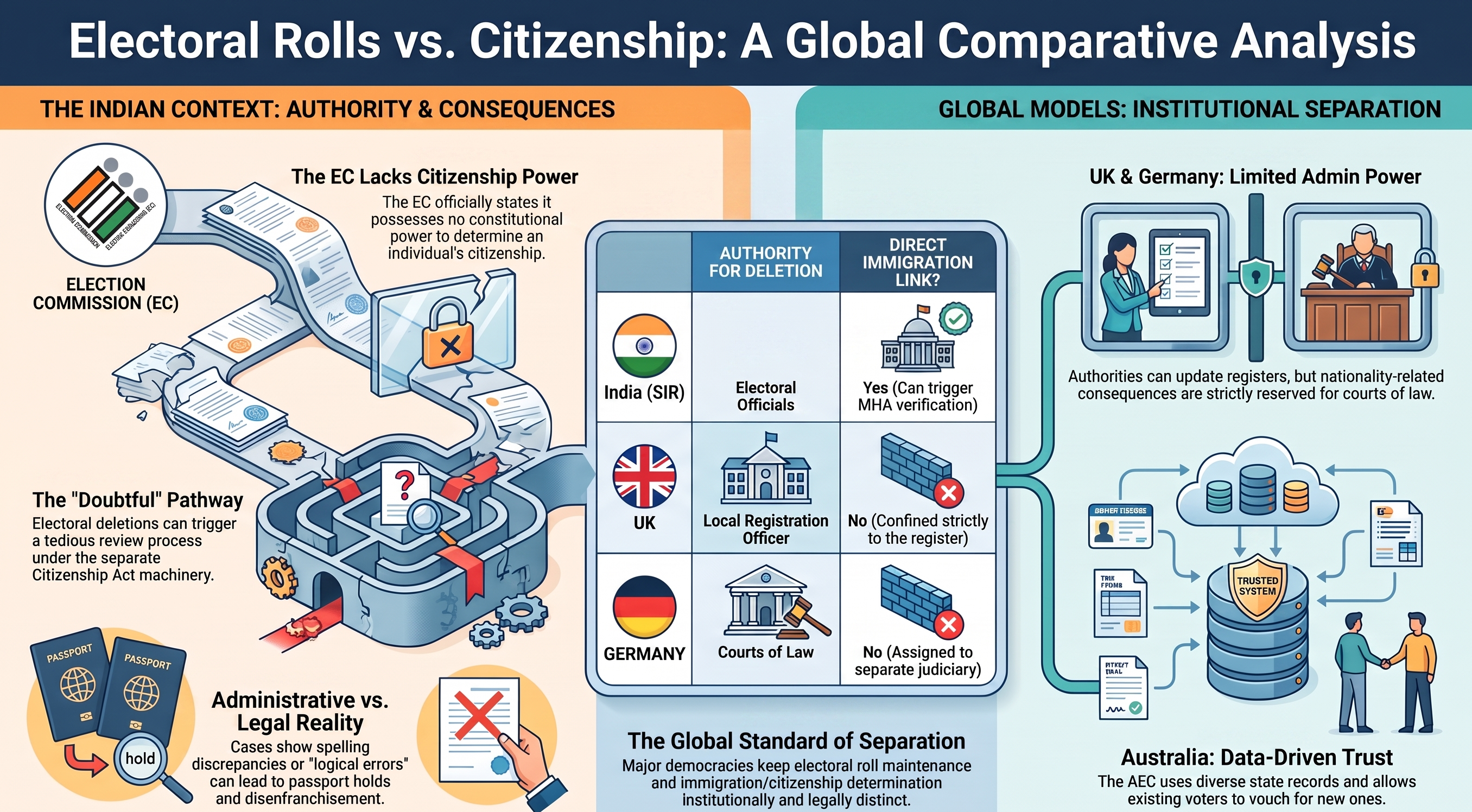
Does the EC Have Authority Over Citizenship?
- The Election Commission's own position, recorded in an affidavit before the Supreme Court, is that it does not possess constitutional power to determine citizenship.
- It can only exclude names from electoral rolls — an act that does not by itself establish foreign-national status, but can trigger a review by the Citizenship Act machinery, placing an individual on a separate, potentially more tedious path to prove their citizenship.
The Multi-Layered Revision Schedule

High-Octane Revision Techniques
- Active Recall: Instead of re-reading a chapter, close the book and write down everything you remember about a topic (e.g., "Powers of the President"). Check what you missed. This strengthens neural pathways.
- Mind Mapping: Use single-page visual summaries for complex topics like National Income or Ocean Currents. Connect static facts with recent developments.
- Flashcards: Use digital or physical cards for high-yield data:
- Polity: Vital Articles and Constitutional Amendments.
- Environment: National Parks, IUCN status, and International Conventions.
- Economy: Key ratios (CRR, SLR) and Recent Schemes.
Illustrative Cases of Consequences
- R. Rajagopal, former editor of The Telegraph, Kolkata: his passport renewal was held up for months after Kolkata police submitted an adverse report citing deletion of his name from West Bengal's electoral rolls under the "logical discrepancy" category — a category that led to deletion of over 27 lakh voters.
- Mohtab Sheikh, a Congress candidate: his name was deleted despite holding a passport, Aadhaar card, and voter ID, due to a spelling discrepancy in his father's name. His name was restored by the Appellate Tribunal only after the Supreme Court ordered a priority hearing; he ultimately won his seat despite the threat of exclusion.
- The Supreme Court has since directed that only names deleted specifically on grounds of doubtful citizenship — not all SIR deletions — should be forwarded to the Ministry of Home Affairs for verification, and clarified that citizenship cannot be denied solely based on electoral roll deletion, pending determination by the competent authority.
- Despite this, cases like Rajagopal's suggest the line between an administrative electoral finding and an actual citizenship determination has been weakened in practice.
The Assam Precedent
- This trajectory previously played out in Assam following the 1997 intensive revision, which created the category of "D" (doubtful) voters.
- Aheda Khatun, a resident of Nagaon district, was declared a foreigner by a Foreigners' Tribunal in 2019 and pushed across the border into Bangladesh in December 2025.
- Sunali Khatun, a pregnant woman from West Bengal, was mistakenly pushed into Bangladesh but drew wider attention as she managed to return to India after five months, following state government intervention.
How Other Democracies Handle Electoral Roll Revision?
United Kingdom
- Since 2014, the UK uses Individual Electoral Registration, requiring only name, address, date of birth, and National Insurance number.
- This number is checked automatically against Department for Work and Pensions records; no birth certificate or passport is required routinely (alternative documents like a tax authority letter may be accepted case-by-case).
- Authority to add/delete names rests with the local Electoral Registration Officer (ERO), but this power is confined strictly to the register — there is no mechanism for deletion based on nationality or direct referral to immigration authorities.
Germany
- Germany dispenses with citizen-initiated registration entirely — voting eligibility flows automatically from the general civil population registry, with every citizen automatically registered upon turning 18.
- Where voting rights are to be withdrawn from an individual, this power vests squarely with courts of law, not any administrative or electoral official.
- The local Wahlleiter (returning officer) administers the roll but holds no power to revoke voting rights or initiate immigration consequences — these are separately assigned to the judiciary and immigration authorities respectively.
Australia
- Federal elections are overseen by the Australian Electoral Commission (AEC), which draws on state driver's licence records, tax office data, and birth/death/marriage registries to build and update the roll.
- The AEC allows an already-enrolled voter to vouch for a prospective voter's identity — markedly different from India's approach.
- Where an electoral offence is suspected, the AEC can refer serious cases for prosecution rather than acting unilaterally; there is no statutory mechanism by which an AEC roll decision automatically triggers immigration consequences.
United States
- The system varies by state; several states require documentary proof of citizenship (birth certificate, passport, or naturalisation certificate) at registration.
- A federal bill, the Safeguard American Voter Eligibility (SAVE) Act, seeks to extend similar requirements nationwide.
- This raises parallel concerns to India's SIR, since a large share of US voters lack ready documentary proof of citizenship, valid passports, or birth certificates.
- States that have implemented such document requirements have reportedly disenfranchised thousands of verified citizens.
- However, these US laws apply prospectively to new registrants only — not as a retroactive re-verification of the entire existing electorate — and operate under duly enacted legislation.
- Consequences for illegal voter registration in the US can include imprisonment and immigration consequences (including deportation), but these run through a separate machinery — the Department of Justice and federal immigration courts — not the electoral body itself.
The Core Tension
The SIR sits at the intersection of two legitimate but competing democratic concerns:
- The integrity of an electoral roll that has not undergone comprehensive revision in over two decades.
- The principle that the burden of proving one's right to participate in self-governance should not disproportionately fall on citizens least equipped to discharge it.
Key Comparative Takeaway
Across the UK, Germany, and Australia, a common thread emerges: electoral roll maintenance and citizenship/immigration determination are kept institutionally separate, with courts or dedicated immigration authorities — not electoral officials — holding power over nationality-related consequences. This contrasts with concerns raised about India's SIR, where an administrative electoral finding (deletion from rolls) can trigger a citizenship-doubt pathway with serious real-world consequences for affected individuals.
