

States, Parliament and the Mining Question

States, Parliament and the Mining Question
Why in News?
- Parliament passed the Mines and Minerals (Development and Regulation) Amendment Bill, 2026, seeking greater uniformity, transparency and predictability in mineral taxation across States.
- The amendment has revived a constitutional debate over the respective powers of Parliament and States to regulate and tax mineral resources.
Background: Mineral Levies
- Mineral-producing States impose several taxes, cesses, royalties and other charges on mining.
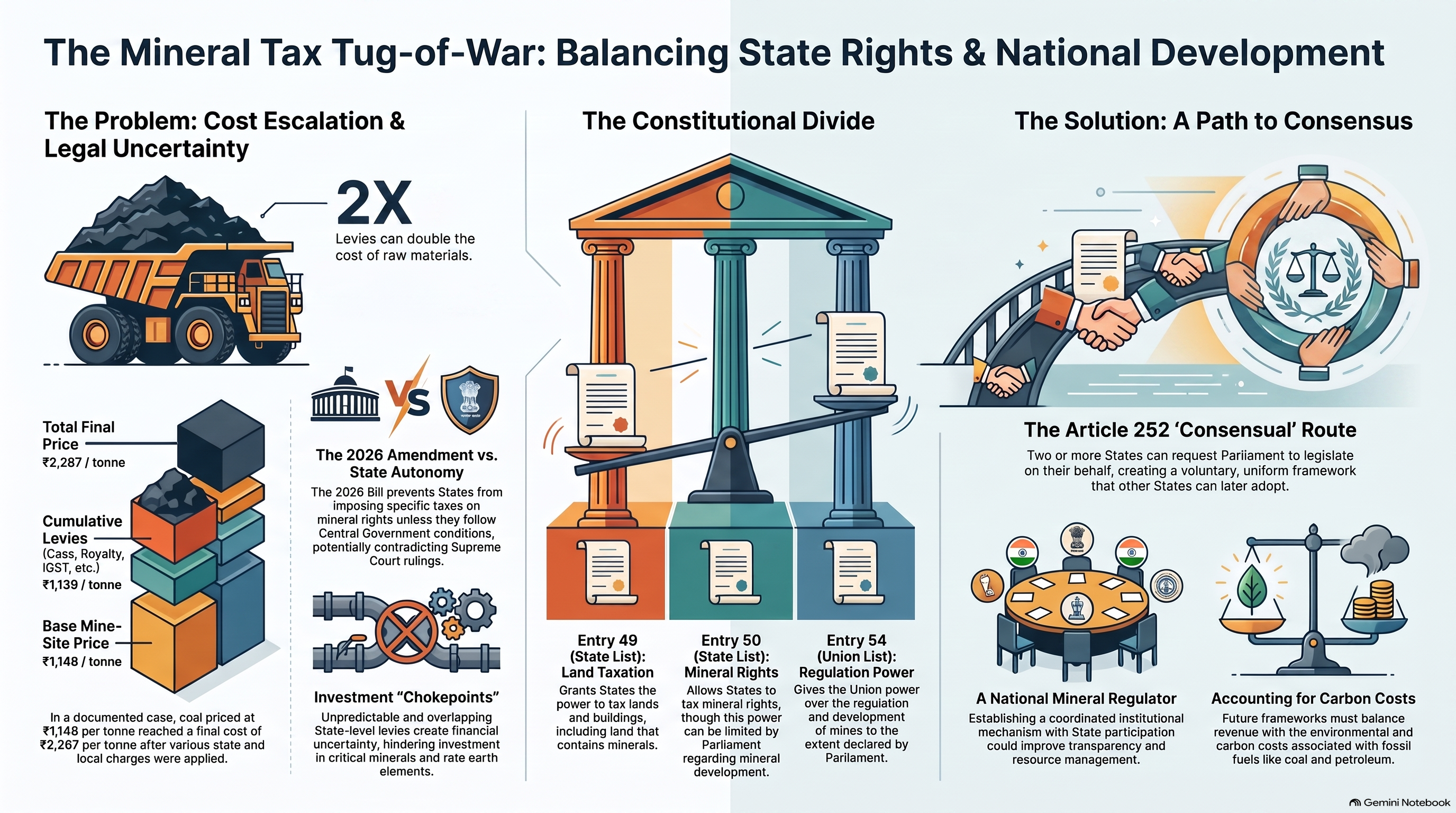
- For example, coal mined in Jharkhand and used for thermal power generation in Punjab may attract multiple charges in addition to the basic mine-site price.
- In the example cited, coal priced at ₹1,148 per tonne attracted additional levies of about ₹1,139 per tonne, taking the total to ₹2,287 per tonne.
- These included mineral land cess, royalty, District Mineral Foundation contribution, forest transit fee, IGST and National Mineral Exploration Trust contribution.
Supreme Court's 2024 MADA Judgment
- In Mineral Area Development Authority v. Steel Authority of India (2024), a nine-judge Constitution Bench, by an 8:1 majority, overruled the earlier India Cements v. State of Tamil Nadu (1989) judgment to the extent that it treated royalty as a tax.
- The Court clarified that States have constitutional authority to tax mineral-bearing land under Entry 49 of the State List.
- Entry 50 of the State List also permits States to impose taxes on mineral rights, subject to limitations imposed by Parliament relating to mineral development.
- The Court distinguished taxation powers from Parliament's power over regulation and development of mines and minerals.
Constitutional Division of Powers
- Entry 49, State List: Taxes on lands and buildings, including mineral-bearing land.
- Entry 50, State List: Taxes on mineral rights, subject to limitations imposed by Parliament relating to mineral development.
- Entry 54, Union List: Regulation of mines and mineral development to the extent Parliament declares such regulation and development to be under Union control.
- The MMDR Act, 1957, is the principal legislation through which Parliament exercises its powers under Entry 54.
Issue with the 2026 Amendment
- The amendment introduces restrictions on State taxation of mineral rights and mineral-bearing land.
- It provides that States cannot impose specified taxes, cesses or other levies on mineral rights or mineral-bearing land except according to conditions or restrictions prescribed by the Central Government.
- This raises a constitutional question: whether Parliament, using its power over mineral development under Entry 54, can restrict the State's independent power to tax land under Entry 49 merely because that land contains minerals.
- The concern arises because the Supreme Court's 2024 judgment explicitly recognised State taxation powers over mineral-bearing land.
Why Reform is Considered Necessary?
- Multiple State-level levies can increase the cost of minerals and create uncertainty for mining companies.
- Greater transparency and predictability could encourage investment and reduce dependence on imported minerals, including critical minerals and rare earth elements.
- At the same time, States depend significantly on mineral revenues, particularly mineral-rich States.
- Mining also creates environmental costs that vary according to the location and nature of individual mines, making some form of resource-based taxation necessary.
Alternative: Article 252 Route
- The article suggests using Article 252 to develop a consensual framework for mineral taxation.
- Under Article 252, if two or more State legislatures pass resolutions requesting Parliament to legislate on a matter in the State List, Parliament can enact a law on that subject.
- Other States can subsequently adopt that legislation through resolutions.
- This mechanism has previously been used for legislation relating to water pollution.
- A similar consensus-based approach could provide a more cooperative framework for mineral taxation while respecting federal principles.
Way Forward
- A comprehensive framework should balance:
- State revenue interests
- Predictability for the mining industry
- Environmental costs of mining
- India's strategic need for critical minerals
- Federal distribution of legislative and taxation powers
- The emerging carbon market also makes it necessary to account for the carbon costs associated with coal, petroleum and natural gas.
- A coordinated institutional mechanism could improve transparency and resource management.
- The article proposes considering a national regulator for mines, established with the consent and participation of States.
