

STs following Hindu customs can’t be excluded from Hindu marriage law: HC
Times Of India
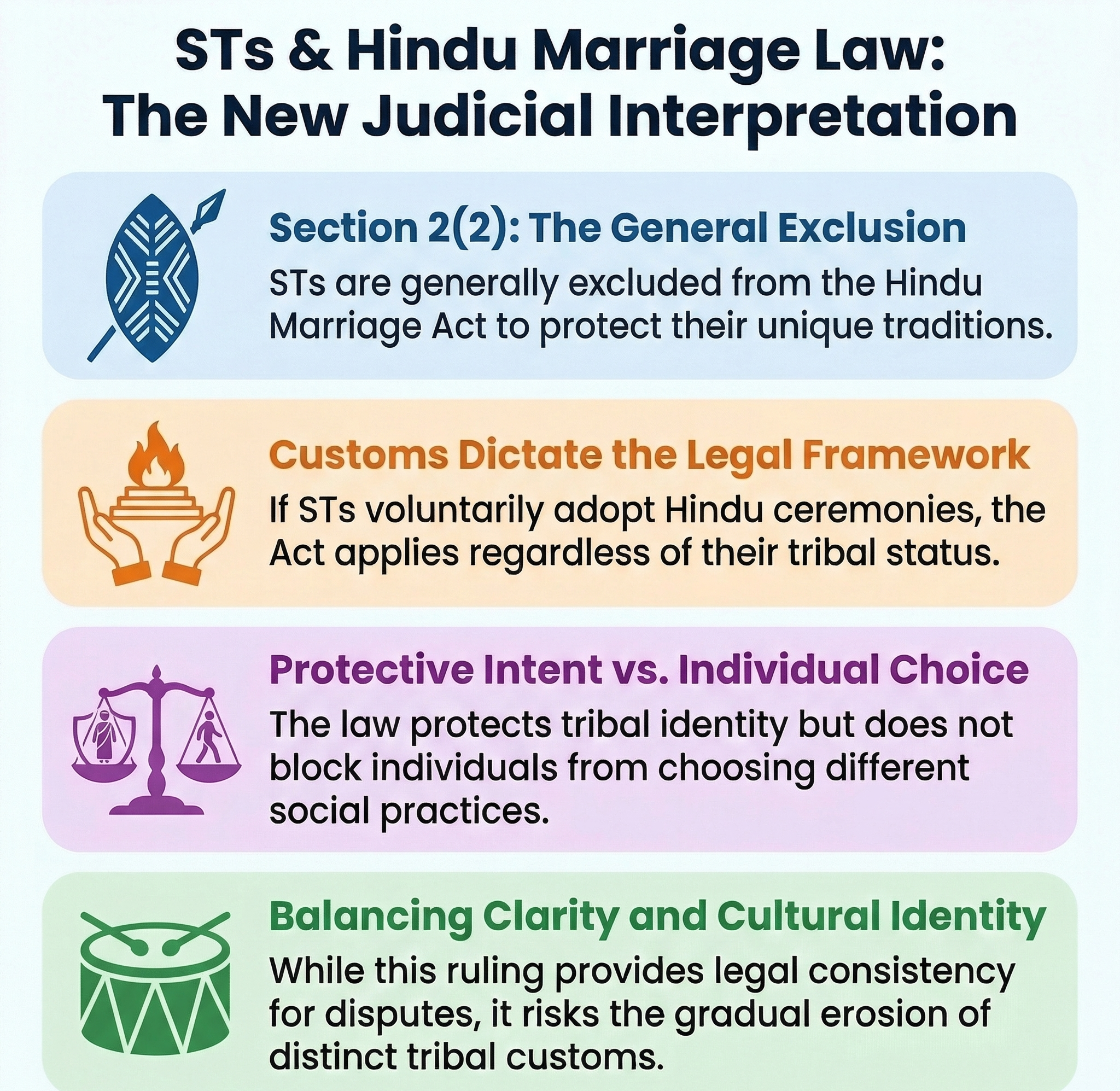
Key Arguments of the Article
Applicability of Hindu Marriage Act to Tribal Communities
Under Section 2(2) of the Hindu Marriage Act, Scheduled Tribes are generally excluded from the Act unless the Central Government directs otherwise through notification.
However, the High Court observed that when members of tribal communities voluntarily follow Hindu customs and rites, they may fall within the scope of the Act.
Voluntary Adoption of Hindu Customs
The court emphasised that individuals or communities adopting Hindu traditions—such as rituals and marriage ceremonies—cannot simultaneously claim exclusion from Hindu personal law provisions.
Thus, legal applicability may depend on the social practices followed by the individuals involved.
Judicial Interpretation of Protective Provisions
The judgment clarified that Section 2(2) was designed as a protective provision to safeguard tribal customs and traditions. It was not intended to exclude individuals who consciously adopt different social practices.
This interpretation attempts to balance protection of tribal identity with legal consistency.
Precedents and Judicial Reasoning
The court referred to earlier judicial interpretations indicating that when tribal communities adopt Hindu customs and practices, certain personal laws governing Hindus may apply in matters such as marriage and succession.
This reflects the evolving nature of personal law jurisprudence in India.
Author’s Stance
The article adopts a largely neutral and descriptive tone, reporting the legal reasoning of the court. However, the narrative implicitly underscores the significance of judicial interpretation in reconciling customary law with codified personal law frameworks.
The focus is primarily on constitutional legality and judicial reasoning rather than normative commentary.
Possible Biases
Legal-Centric Perspective
The article focuses mainly on legal interpretation and does not extensively discuss sociological or cultural perspectives of tribal communities.
Limited Anthropological Context
The complexities of tribal identity, customary practices, and cultural autonomy are not deeply explored.
Institutional Framing
The narrative relies heavily on the court’s interpretation without presenting counterarguments from tribal rights advocates or scholars.
Advantages of the Court’s Interpretation
Legal Clarity
The ruling clarifies ambiguity regarding the applicability of personal laws to individuals who voluntarily adopt practices of another legal tradition.
Protection of Individual Choice
Recognising voluntary adoption of customs supports personal autonomy in matters of marriage and family law.
Consistency in Legal Framework
Applying the Hindu Marriage Act in such cases ensures uniformity in adjudicating matrimonial disputes.
Concerns and Criticisms
Cultural Identity Issues
Applying Hindu personal law to tribal communities may blur distinct tribal cultural identities and customary practices.
Risk of Legal Assimilation
The decision could contribute to gradual assimilation of tribal communities into dominant legal frameworks.
Complex Determination of Custom
Determining whether individuals genuinely follow Hindu customs may create practical challenges in courts.
Policy Implications
Need for Clear Legal Guidelines
Legislative or judicial clarification may be required to define how personal laws interact with tribal customs.
Protection of Tribal Autonomy
Policies should ensure that tribal communities retain the right to practice and preserve their customary traditions.
Legal Awareness
Tribal populations require better legal awareness regarding rights under personal laws and customary systems.
Harmonisation of Customary and Codified Law
A balanced approach is needed to reconcile tribal customary practices with the broader personal law framework.
Real-World Impact
If interpreted carefully:
• Greater clarity in matrimonial disputes involving tribal individuals
• Recognition of personal choice in adopting religious customs
• Strengthening of judicial interpretation of personal laws
If misapplied:
• Potential erosion of tribal customary systems
• Increased legal disputes over cultural practices
• Confusion regarding applicability of personal laws
Alignment with UPSC GS Papers
GS Paper II
Judicial interpretation, personal laws, constitutional safeguards for Scheduled Tribes, role of the judiciary in governance.
GS Paper I
Indian society, diversity of cultural traditions, tribal communities and social institutions.
GS Paper III
Issues relating to inclusive development and governance of tribal populations.
GS Paper IV
Ethical issues concerning cultural autonomy, equality before law, and respect for diversity.
Balanced Assessment
The High Court’s ruling reflects the complexity of India’s plural legal system, where customary practices coexist with codified personal laws. By emphasising voluntary adoption of customs, the judgment attempts to balance cultural protection with legal consistency.
However, careful implementation is necessary to ensure that tribal identity and customary autonomy are not unintentionally weakened.
Future Perspective
India’s legal system will continue to face challenges in reconciling diverse customary traditions with modern statutory frameworks. As tribal communities undergo social and cultural change, courts and policymakers must ensure that legal interpretations respect both constitutional equality and cultural diversity.
For civil services aspirants, the issue illustrates the broader governance challenge of managing legal pluralism in a diverse society while safeguarding the rights of historically marginalised communities.
