

STUDY SHEDS LIGHT ON EARLY WARNING SIGNS BEFORE ERUPTION OF SOLAR FLARES

STUDY SHEDS LIGHT ON EARLY WARNING SIGNS BEFORE ERUPTION OF SOLAR FLARES
Context
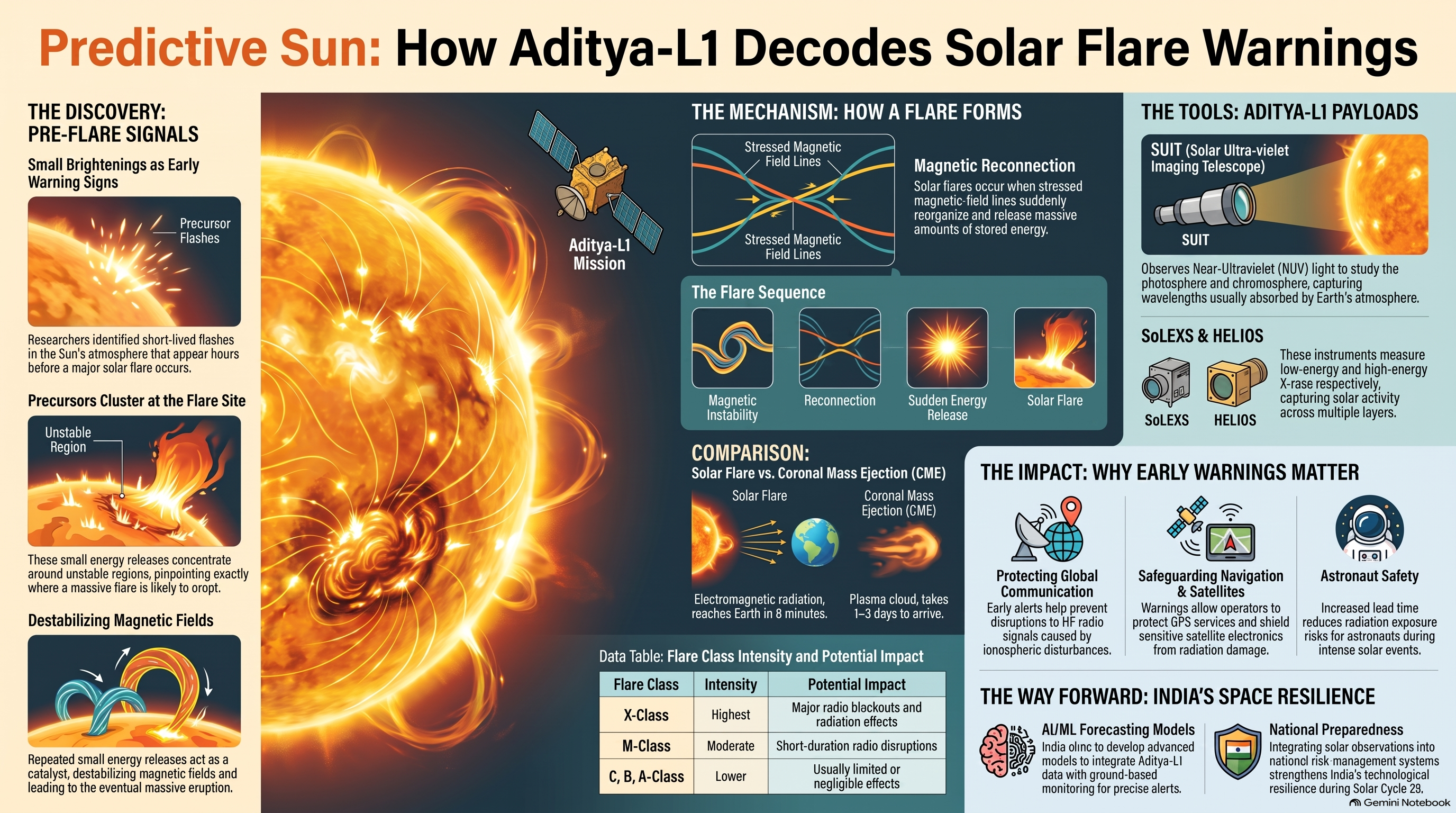
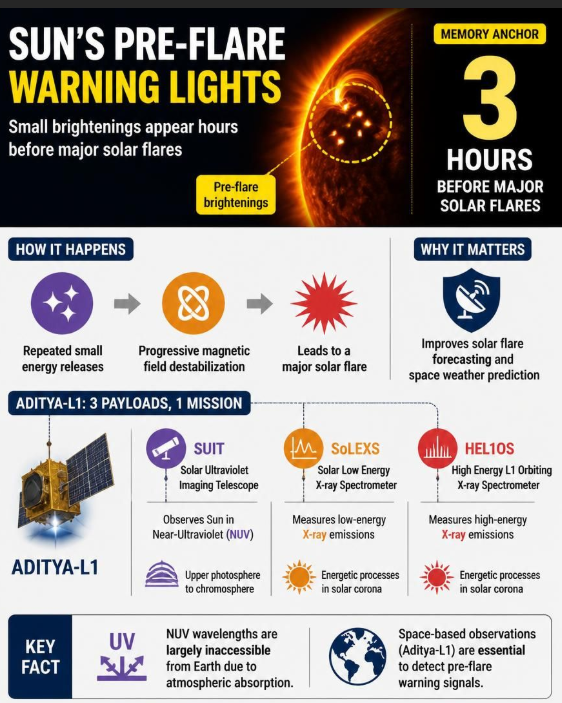
A recent study using data from Aditya-L1 identified small, short-lived brightenings in the Sun’s atmosphere hours before major solar flares. These observations could improve space-weather forecasting and help protect satellites, communication and navigation systems.
Key Findings
|
Finding |
Significance |
|
Small brightenings occur hours before major flares |
Potential precursor/early-warning signal |
|
Brightenings cluster around the eventual flare site |
Helps identify unstable solar regions |
|
Repeated small energy releases destabilise magnetic fields |
Provides insight into flare initiation |
|
UV + X-ray observations used |
Captures activity across different solar layers |
Scientists from the Manipal Centre for Natural Sciences, Manipal Academy of Higher Education and Indian Space Research Organisation conducted the study.
Aditya-L1: Relevant Payloads
|
Payload |
Function |
|
SUIT |
Observes near-ultraviolet (NUV); studies photosphere–chromosphere |
|
SoLEXS |
Measures low-energy X-rays |
|
HEL1OS |
Measures high-energy X-rays |
NUV observations are particularly valuable because several such wavelengths are absorbed by Earth’s atmosphere.
Solar Flares: Basics
 A solar flare is an intense, localised eruption of electromagnetic radiation, generally associated with magnetically active sunspot regions. It occurs through magnetic reconnection, when stressed magnetic-field lines suddenly reorganise and release stored energy.
Magnetic instability → Reconnection → Sudden energy release → Solar flare
Classification
|
Class |
Intensity |
Impact |
|
X |
Highest |
Major radio blackouts/radiation effects |
|
M |
Moderate |
Short-duration radio disruptions |
|
C, B, A |
Lower |
Usually limited/negligible effects |
Common UPSC Trap: Flare vs CME
|
Solar Flare |
CME |
|
Electromagnetic radiation |
Plasma + magnetic field |
|
Reaches Earth in ~8 minutes |
Usually takes ~1–3 days |
|
Causes ionospheric/radio disturbances |
Major geomagnetic storms and auroras |
Impacts of Solar Flares
- Communication: Disrupts HF radio signals through ionospheric disturbances.
- Navigation: Can affect GPS and other satellite-based services.
- Satellites: Radiation can damage electronics and solar panels.
- Astronauts: Increased radiation exposure during intense events.
- Space infrastructure: Extreme space weather can disrupt critical services.
Significance for India
The discovery strengthens India’s capability in space-weather monitoring and forecasting, particularly during the active Solar Cycle 25.
Better prediction can help India:
- protect satellites and communication infrastructure;
- improve navigation and aviation preparedness;
- safeguard human spaceflight missions;
- develop timely space-weather alerts;
- integrate solar observations into national risk-management systems.
Way Forward
India should integrate Aditya-L1 observations with ground-based solar and geomagnetic monitoring, develop AI/ML-based flare-forecasting models, strengthen international scientific cooperation and establish operational alerts for satellite, aviation, communication and navigation sectors.
Conclusion
The discovery of pre-flare brightenings provides a promising precursor signal for understanding and forecasting major solar flares. Although it does not yet enable precise prediction, it can improve early-warning capabilities. For an increasingly space-dependent India, space-weather forecasting is becoming an important component of technological resilience and national preparedness
