

Surrogate Advertising

Surrogate Advertising
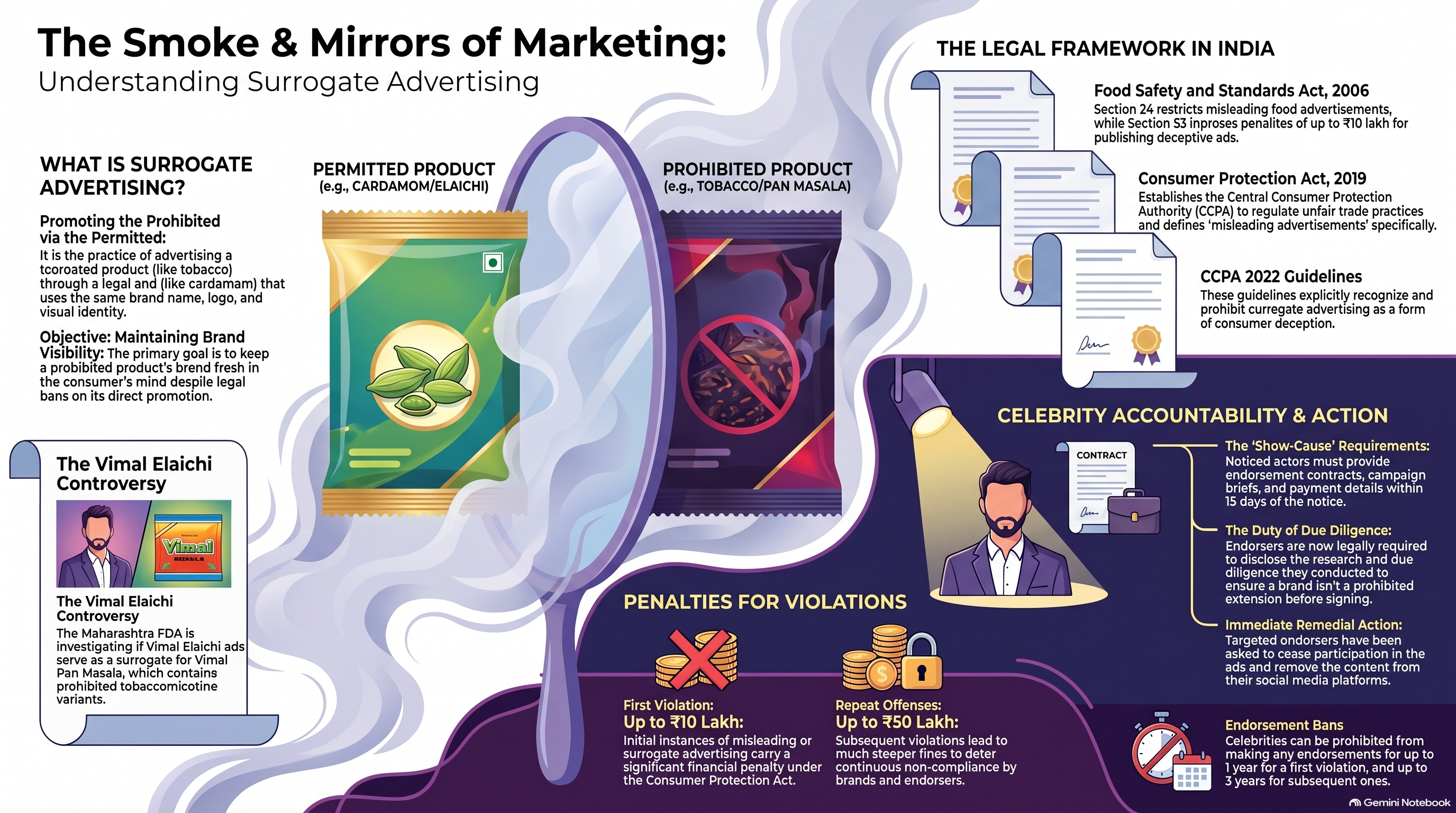
Why in News?
- Maharashtra's Food and Drug Administration (FDA) issued show-cause notices to actors Shah Rukh Khan, Ajay Devgn and Tiger Shroff over their endorsement of Vimal Elaichi.
- The FDA is examining whether the advertisement amounts to surrogate advertising for Vimal Pan Masala, whose tobacco/nicotine-containing variants are prohibited in Maharashtra.
- This is reportedly the first instance of the Maharashtra FDA examining a case specifically from the perspective of surrogate advertising.
Meaning and Legal Framework
- Surrogate advertising promotes a prohibited or restricted product indirectly through another permitted product carrying a similar brand name, logo, packaging or visual identity.
- It is commonly associated with products such as tobacco, pan masala and alcohol that face advertising restrictions.
- The objective is to maintain the prohibited product's brand visibility among consumers despite restrictions on its direct advertising.
- Maharashtra has prohibited gutkha and pan masala containing tobacco or nicotine since 2012 under Section 30(2)(a) of the Food Safety and Standards Act, 2006. The prohibition is renewed annually.
- The FDA has invoked:
- Section 24 of the FSS Act, which restricts misleading or deceptive food advertisements.
- Section 53, which provides a penalty of up to ₹10 lakh for anyone party to the publication of a misleading advertisement.
- Food Safety and Standards (Advertising and Claims) Regulations, 2018.
- Under Section 10 of the Consumer Protection Act, 2019, the Central Consumer Protection Authority (CCPA) was established to deal with consumer protection and misleading advertisements.
- Section 2(28) of the Consumer Protection Act defines a misleading advertisement to include false descriptions or guarantees, unfair trade-practice implications or concealment of material information.
- The CCPA's 2022 guidelines specifically recognise surrogate advertising as advertising a permitted product to indirectly promote a prohibited product.
Action and Penalties
- The actors have been given 15 days to submit written explanations.
- They have been asked to discontinue participation in the advertisement and remove it from their social-media handles.
- They must provide endorsement contracts, campaign briefs, product information and payment details.
- They must disclose the due diligence conducted before endorsing the product and establish whether Vimal Elaichi is independently marketed or functions as a brand extension of Vimal Pan Masala.
- They must also disclose any material connection with the advertiser or brand owner as required under the CCPA Guidelines, 2022.
- Under Section 21 of the Consumer Protection Act, 2019:
- First violation: penalty up to ₹10 lakh.
- Subsequent violations: penalty up to ₹50 lakh.
- Endorsers can be prohibited from making endorsements for up to 1 year for a first violation and up to 3 years for subsequent violations.
Regulatory History and Significance
- In 2018, the Directorate General of Health Services issued show-cause notices to Vishnu Pouch Packaging Pvt Ltd, alleging indirect tobacco advertising.
- In January 2024, the Delhi High Court dismissed the DGHS appeals and allowed the company to advertise its tobacco-free product, observing that businesses have a fundamental right to carry on lawful business involving tobacco-free pan masala.
- The Vimal Elaichi case highlights the difficulty of distinguishing genuine advertising of a permitted product from indirect promotion of a prohibited product.
- It also raises the issue of celebrity accountability and due diligence before endorsing products whose branding may be associated with prohibited goods.
