

THE BEIJING MODEL OF INNOVATION

THE BEIJING MODEL OF INNOVATION
Subject: Science & Technology | Economy | Innovation & Industrial Policy
Source: The Hindu, 7 August 2026
Why in News?
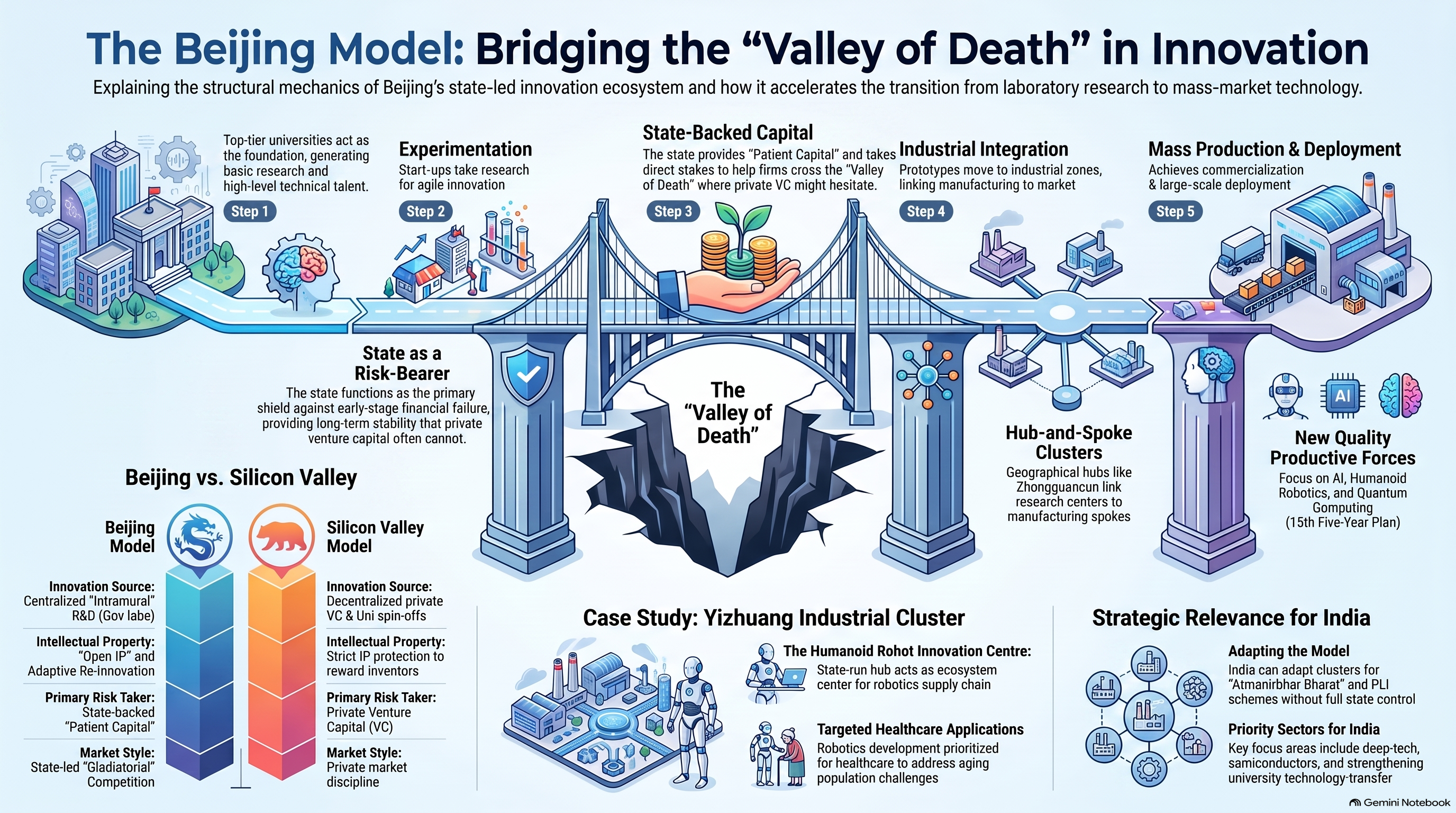
Beijing’s innovation ecosystem is attracting attention for integrating universities, start-ups, industry and the state to convert research into commercially viable technologies, particularly in AI and humanoid robotics.
The Core Model
The Beijing model seeks to bridge the “Valley of Death” — the gap between promising laboratory research and commercially sustainable products.
Universities → Research & Talent → Start-ups → State-backed Capital → Industry → Commercialisation → Mass Production
|
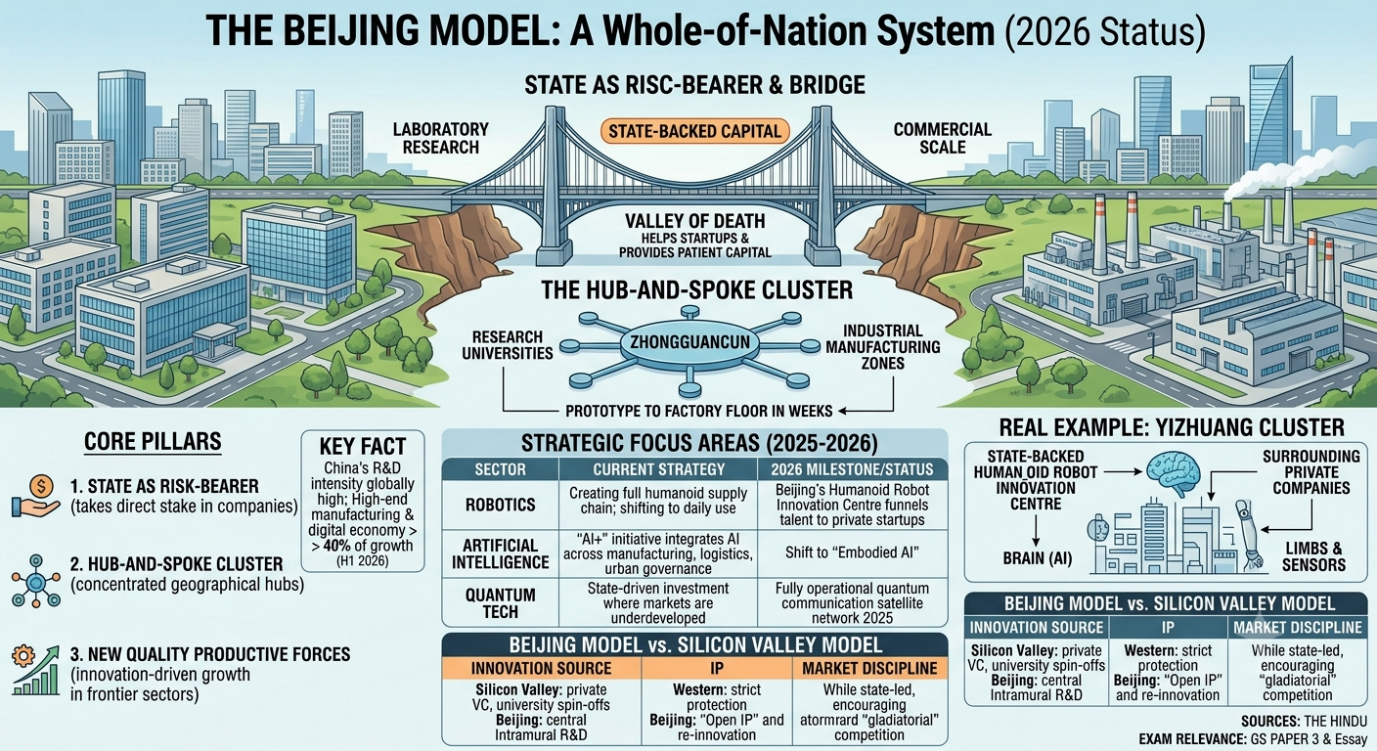
Core Pillars of the Beijing Model The model is defined by three primary characteristics that distinguish it from the Silicon Valley "bottom-up" approach:
|

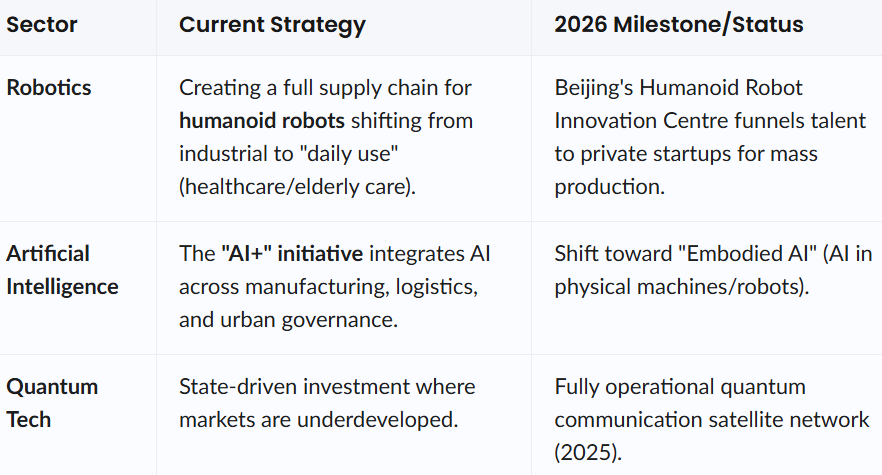
AI & Humanoid Robotics
Yizhuang industrial cluster demonstrates the model at the manufacturing level.
- State-run Humanoid Robot Innovation Centre acts as the hub.
- Surrounding firms form the spokes, creating an integrated ecosystem.
- Focus: full supply chain + mass production + industrial and everyday applications.
- Healthcare is viewed as a major future application because of China’s ageing population.
- Shows the transition from research → prototype → industrial production → large-scale deployment.
Strategic Focus Areas (2025–2026)
The current iteration of the Beijing model is laser-focused on technological sovereignty to mitigate external supply chain shocks.
Beijing vs. Silicon Valley Models
For the UPSC examiner, understanding the structural differences is key to analyzing India's own "Atmanirbhar Bharat" and "PLI Schemes":
- Innovation Source: Silicon Valley relies on decentralized private VC and university spin-offs; Beijing relies on centralized "Intramural R&D" (research within government labs).
- Intellectual Property (IP): The Western model prioritizes strict IP protection to reward inventors; the Beijing model (especially in hubs like Shenzhen) often favors "Open IP" and "re-innovation" (adaptive modification) to achieve speed and scale.
- Market Discipline: While state-led, the Beijing model encourages "gladiatorial" competition between private giants (e.g., Baidu vs. Tencent) to ensure only the most efficient firms survive.
Relevance for India
India can adapt the ecosystem without replicating China's state-centric model.
Universities: basic research + talent
Start-ups: experimentation + innovation
Industry: market demand + manufacturing
Government: infrastructure + regulation + patient capital
Priority areas include deep-tech, AI, semiconductors, robotics, advanced manufacturing and university technology-transfer mechanisms.
The key requirement is to strengthen the institutional bridge between Indian research capabilities and commercial markets, while retaining market discipline and ensuring transparent use of public funds
