

The broken promise of right to work

The broken promise of right to work
Context
The "Right to Work" in India has always been a paradox—a promise enshrined in the Directive Principles but lacking the teeth of a Fundamental Right. As of September 2026, this debate has reached a fever pitch following the dismantling of the two-decade-old MGNREGA and its replacement with the VB-GRAM G Act.
1. The Constitutional Dissonance
The Indian Constitution does not explicitly grant a fundamental "Right to Work." Instead, it is distributed across various articles that conflict in their enforceability.
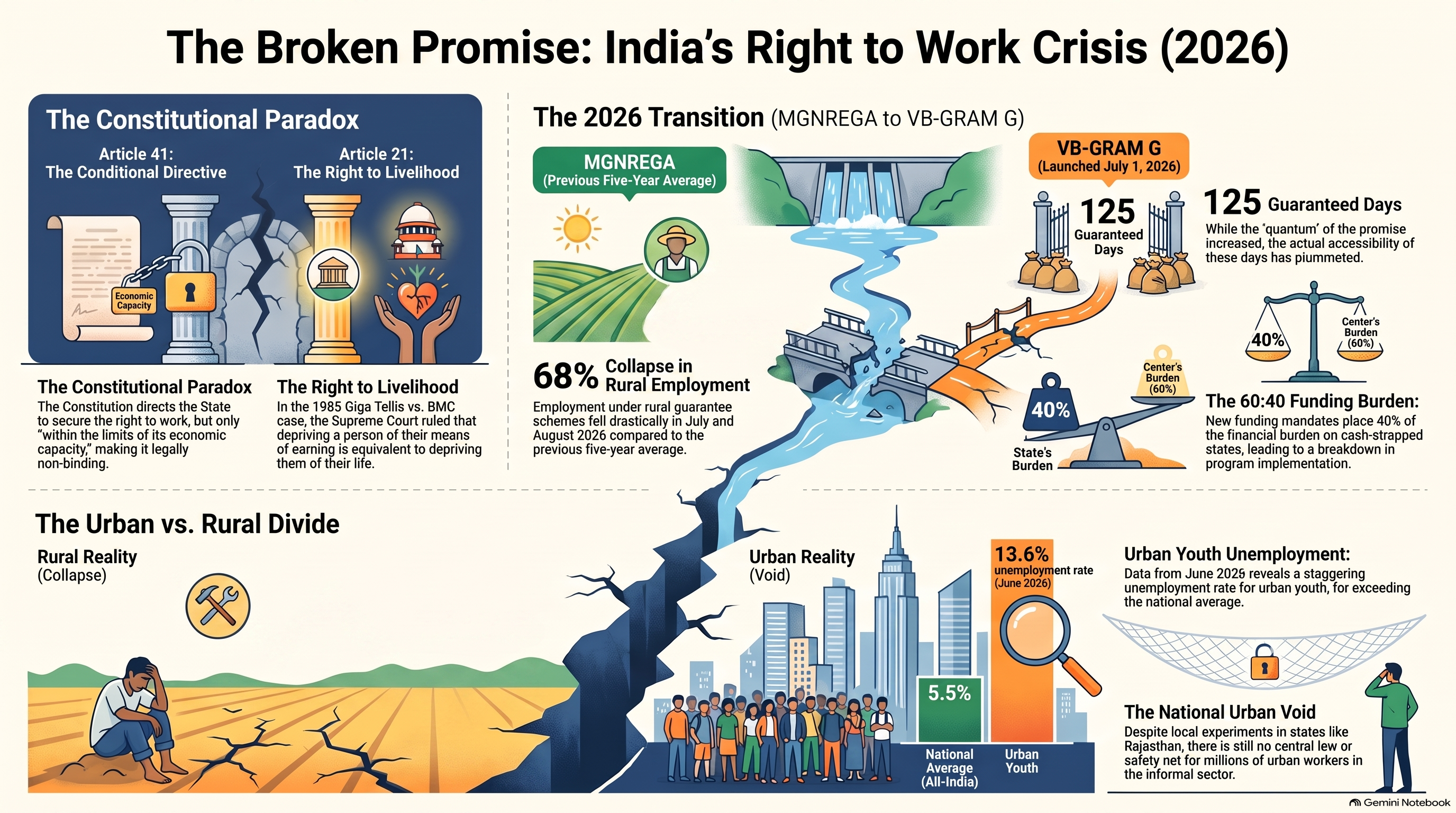
- Article 41 (DPSP): Directs the State to secure the right to work, but explicitly "within the limits of its economic capacity."
- Article 21 (Right to Life): The Supreme Court has repeatedly expanded this to include the Right to Livelihood. In the landmark Olga Tellis vs. BMC (1985), the court ruled that if the right to livelihood is not treated as part of the right to life, the easiest way of depriving a person of their life would be to deprive them of their means of earning.


2. MGNREGA to VB-GRAM G: Reform or Retreat?
The Viksit Bharat–Guarantee for Rozgar and Ajeevika Mission (Gramin), which rolled out on July 1, 2026, represents the most significant shift in rural labor policy since 2005.


3. The Current Crisis (Data 2026)
Despite the promise of more days, the implementation has faced a rocky start:
- Employment Slump: Employment under rural guarantee schemes fell by 68% in July and August 2026 compared to the previous five-year average, primarily due to the transition and the new 60:40 funding burden on cash-strapped states.
- Unemployment Trends: Latest PLFS data (June 2026) shows the all-India unemployment rate at 5.5%, but urban youth unemployment remains a staggering 13.6%, highlighting the lack of a similar "Right to Work" in urban areas.
4. The Urban Void
The most visible broken promise is the absence of a national Urban Employment Guarantee Scheme. While states like Rajasthan and Himachal Pradesh have experimented with local versions, the Union has yet to notify a central law for urban workers, leaving millions in the informal sector without a safety net during inflationary cycles.
The transition in 2026 suggests that while the "quantum" of the promise (125 days) has increased, the "quality" of the guarantee (enforceability and funding) has been significantly diluted, effectively moving the right back into the realm of discretionary state policy.
