

The Challenge of India's Digital Sovereignty
The Challenge of India's Digital Sovereignty
Source: The Hindu (23-06-2026)
1. Core Thesis
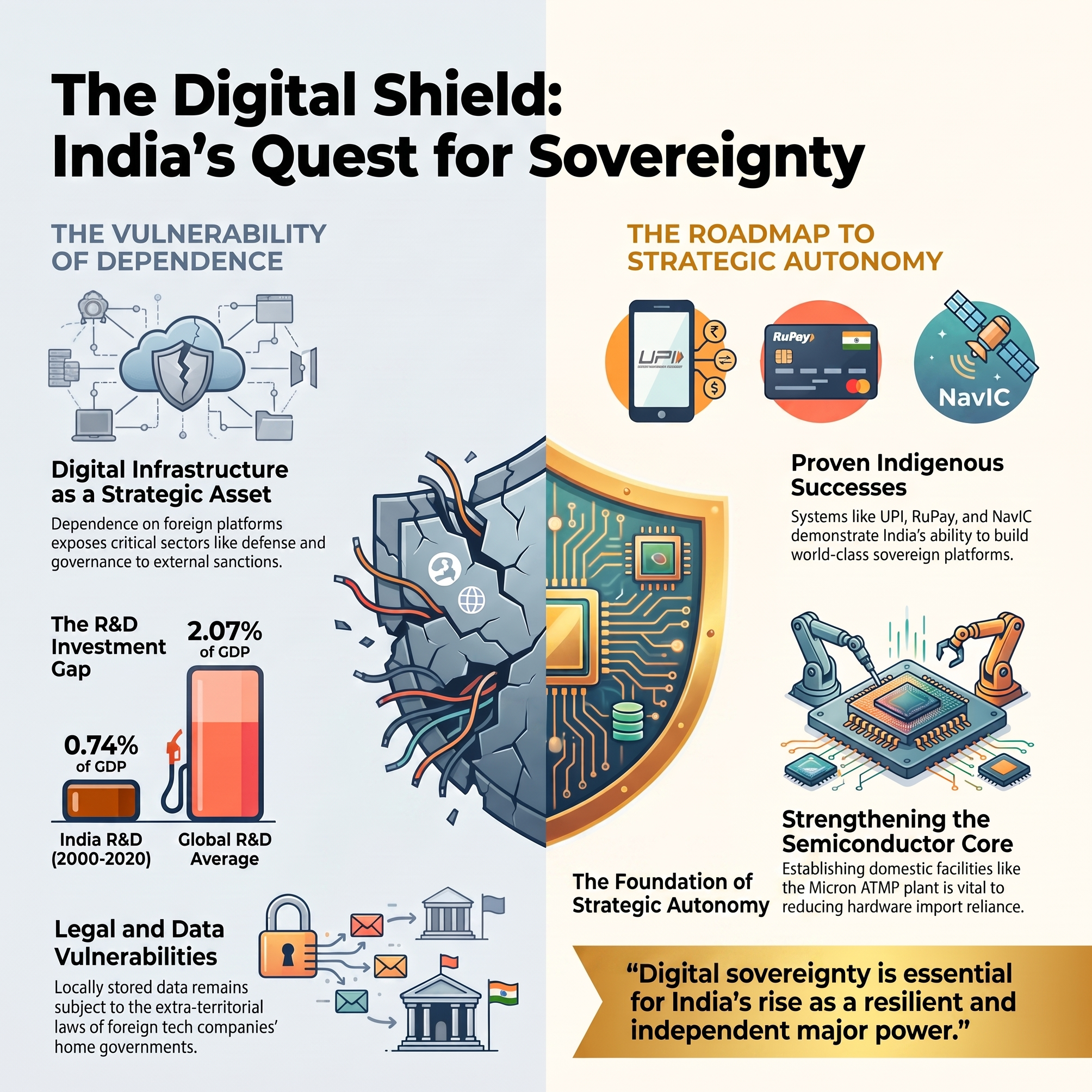
Digital sovereignty has emerged as a critical component of national security and strategic autonomy. India's dependence on foreign-controlled digital platforms and technologies exposes the country to economic, technological and geopolitical vulnerabilities.
2. Background
• Modern economies and governance increasingly depend upon digital infrastructure, cloud services and software platforms.
• Recent incidents have highlighted the risks associated with dependence on foreign technologies.
• In April 2026, hostile actors reportedly exploited vulnerabilities in CCTV systems linked to Chinese software.
• In July 2025, Nayara Energy temporarily lost access to Microsoft services following sanctions linked to its Russian shareholder Rosneft.
• These incidents raised concerns regarding control over critical digital infrastructure.
3. Why Digital Sovereignty Matters
National Security
• Dependence on foreign technologies may create vulnerabilities in strategic sectors.
• Contemporary defence systems increasingly rely on software, communications and digital networks.
Economic Security
• Disruptions in cloud services or digital platforms can adversely affect businesses and manufacturing.
Data Sovereignty
• Foreign technology companies may be subject to laws and directives issued by their home governments.
• Even locally stored data may remain vulnerable to extra-territorial legal regimes.
Strategic Autonomy
• Indigenous capabilities reduce dependence on external powers and strengthen policy autonomy.
4. Global Trend Towards Digital Sovereignty
• France plans to replace foreign video-conferencing tools in government departments with sovereign platforms.
• Several European countries are exploring alternatives to U.S.-based cloud and software services.
• The European Union is promoting independent cloud and digital infrastructure.
• Türkiye is pursuing greater technological self-reliance.
5. India's Existing Initiatives
Indigenous Digital Platforms
• Unified Payments Interface (UPI).
• RuPay payment system.
• Adoption of indigenous email and productivity solutions such as Zoho by some government departments.
Space and Navigation
• Development of NavIC satellite navigation system following limitations experienced during the Kargil conflict.
Semiconductor Ecosystem
• Strengthening domestic semiconductor manufacturing capabilities.
• Establishment of Micron Technology's Assembly, Test, Marking and Packaging (ATMP) facility at Sanand, Gujarat.
Defence Indigenisation
• Promotion of private-sector participation in defence manufacturing.
• Competitive development of the Advanced Medium Combat Aircraft (AMCA).
International Technology Partnerships
• India-Russia collaboration in the BrahMos missile programme.
• Participation in Pax Silica, the U.S.-led initiative on AI and supply-chain security.
6. Challenges
Dependence on Foreign Platforms
• Cloud computing, productivity software and authentication systems remain dominated by foreign firms.
Weak Research and Development Ecosystem
• India's gross expenditure on R&D averaged only 0.74% of GDP during 2000-2020.
• The global average stood at around 2.07%.
Semiconductor Dependence
• India remains dependent on imports for advanced semiconductor technologies.
Cybersecurity Threats
• Vulnerabilities in imported hardware and software can be exploited by hostile actors.
Technological Competition
• Growing strategic competition among major powers is increasingly centred around technology and supply chains.
7. Significance
• Digital infrastructure has become a strategic asset equivalent to physical infrastructure.
• Technological self-reliance enhances economic resilience and national security.
• Indigenous capabilities support India's aspiration for strategic autonomy.
• Digital sovereignty is essential for achieving the objectives of Atmanirbhar Bharat and Viksit Bharat.
8. Way Forward
Strengthen Domestic Innovation
• Increase public and private expenditure on research and development.
• Encourage indigenous development of cloud infrastructure, AI systems and cybersecurity technologies.
Promote Public-Private Partnerships
• Replicate the successful model adopted in defence and digital payments.
Diversify Technology Partnerships
• Build trusted partnerships with like-minded countries to reduce excessive dependence on any one source.
9. Conclusion
As technology increasingly determines economic and strategic power, digital sovereignty has become indispensable for national security. India must build resilient and trusted digital ecosystems through a combination of indigenous innovation, strategic partnerships and increased investment in research and development.
10. Final Takeaway
Digital sovereignty is the technological foundation of strategic autonomy. In an era where power increasingly flows through data, software and digital infrastructure, securing control over critical technologies will be essential for India's rise as a major power.

