

The Deliberate Unmaking of India’s Right to Work
The Hindu
I. Context and Central Theme
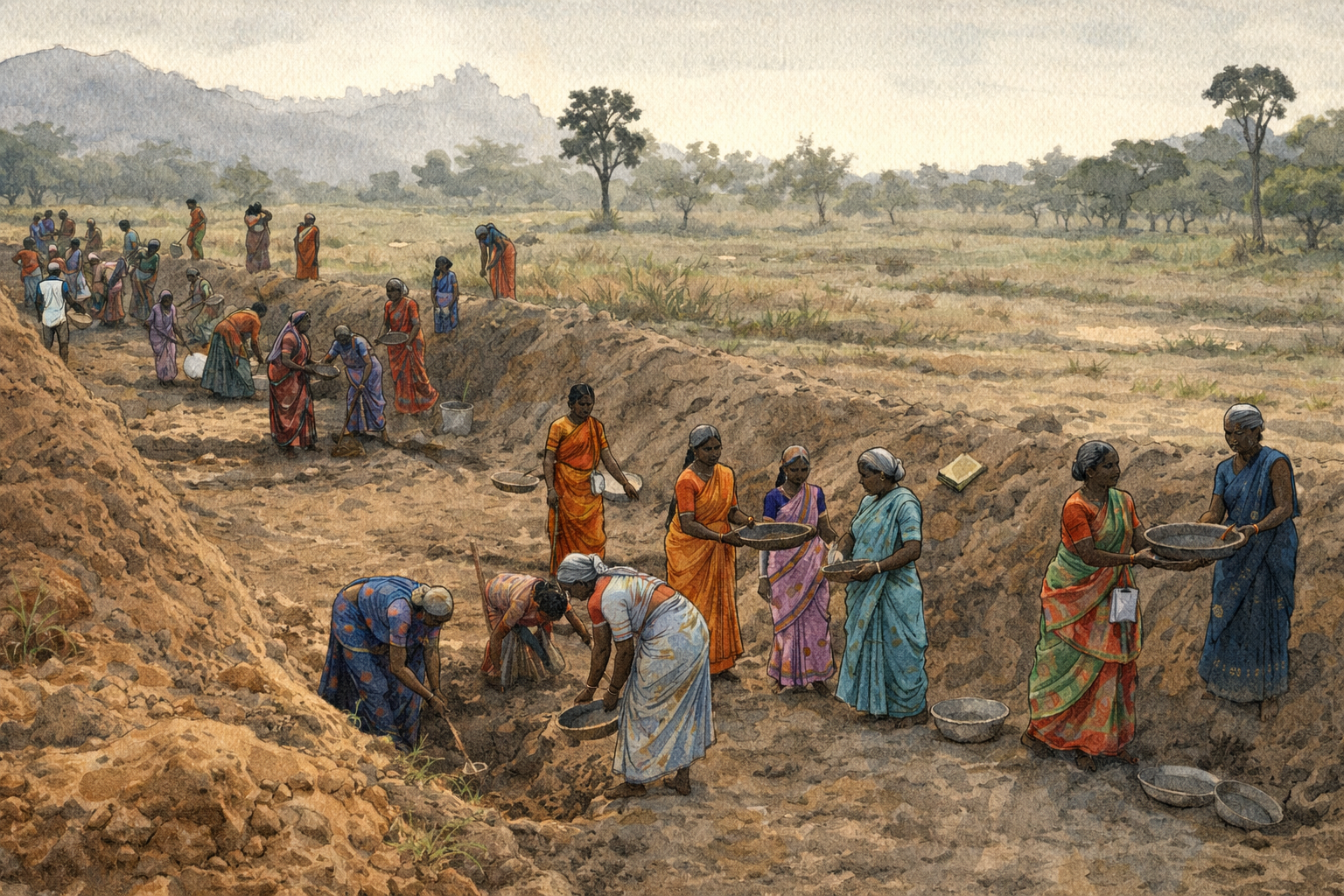
The article situates recent changes to India’s rural employment framework within a larger constitutional and moral debate on the right to work as a core pillar of social citizenship. It argues that the restructuring and effective dilution of the Mahatma Gandhi National Rural Employment Guarantee framework is not an administrative fine-tuning exercise, but a conscious ideological retreat from a rights-based welfare state.
The broader context is India’s post-pandemic economic recovery narrative, fiscal consolidation pressures, and a shift in governance philosophy from entitlement-based welfare to targeted, discretionary schemes.
II. Key Arguments Presented
1. MGNREGA as a Rights-Based Guarantee, Not a Scheme
The article emphasises that MGNREGA was conceived as a legal entitlement anchored in dignity, demand-driven employment, and decentralised planning, rather than as a poverty alleviation programme dependent on executive discretion.
2. Gradual Erosion Through Administrative and Legislative Changes
It highlights how budgetary constraints, delayed payments, restricted workdays, altered eligibility norms, and the introduction of alternative frameworks cumulatively hollow out the right to work without formally repealing it.
3. Fiscal Prudence as a Political Choice
The author contests the framing of fiscal discipline as an unavoidable necessity, arguing instead that reduced allocations and tighter controls reflect political priorities rather than economic inevitability.
4. From Universal Entitlement to Targeted Relief
A key concern is the shift away from universality toward selective assistance, which undermines the self-selecting nature of MGNREGA and weakens its role as a labour market stabiliser.
5. Democratic Accountability and Federal Stress
The article points to growing Centre–State tensions, where states bear the political and social costs of unmet employment demand while lacking fiscal autonomy to compensate for central shortfalls.
III. Author’s Stance
The author adopts a normative and constitutionalist stance, clearly positioning the right to work as integral to democratic citizenship and social justice. The argument is rooted in a belief that employment guarantees are not merely economic tools but ethical commitments of the state.
IV. Biases and Editorial Slant
1. Strong Rights-Based Orientation
The article privileges a rights-based welfare framework and is sceptical of efficiency-driven or market-oriented alternatives.
2. Limited Engagement with Fiscal Constraints
While fiscal pressures are acknowledged, the article tends to underplay competing demands on public finances and macroeconomic trade-offs.
3. Ideological Clarity Over Policy Neutrality
The language and framing indicate a deliberate normative position rather than a neutral policy assessment.
V. Strengths of the Article
1. Constitutional Depth
It effectively links employment guarantees to constitutional values such as dignity, equality, and substantive democracy.
2. Political Economy Insight
The piece exposes how policy dilution can occur incrementally without formal repeal, avoiding public scrutiny.
3. Relevance to Rural Distress
It foregrounds the lived realities of rural workers, particularly during periods of agrarian stress and economic slowdown.
VI. Weaknesses and Gaps
1. Limited Policy Alternatives
The article critiques the rollback effectively but offers fewer concrete pathways for reforming MGNREGA while addressing concerns of efficiency and leakages.
2. Insufficient Engagement with Implementation Failures
Issues such as corruption, asset quality, and local elite capture are not explored in depth.
3. Urban Employment Dimension Missing
The discussion remains largely rural, despite growing debates on urban employment guarantees.
VII. Policy Implications
Social Policy
• Reaffirmation of employment as a legal right rather than a welfare benefit
• Need to restore demand-driven funding mechanisms
Fiscal Federalism
• Clearer Centre–State responsibility sharing
• Timely fund releases and automatic compensation mechanisms
Labour Markets
• Recognition of MGNREGA as a wage floor and counter-cyclical stabiliser
• Protection against informalisation and distress migration
Governance
• Strengthening transparency without weaponising technology to exclude beneficiaries
VIII. Real-World Impact
Economic Impact
• Reduced rural purchasing power
• Weakened consumption demand and local economies
Social Impact
• Increased vulnerability of women, SCs, STs, and landless workers
• Erosion of dignity linked to assured employment
Political Impact
• Heightened Centre–State friction
• Declining trust in statutory welfare commitments
IX. UPSC GS Paper Alignment
GS Paper I – Indian Society
• Rural livelihoods
• Social justice and inequality
• Migration and distress employment
GS Paper II – Polity & Governance
• Rights-based legislation
• Centre–State relations
• Accountability and transparency
GS Paper III – Economy
• Employment generation
• Rural demand and consumption
• Fiscal policy and welfare economics
X. Balanced Conclusion
The article persuasively argues that the weakening of the right to work is neither accidental nor purely administrative, but part of a broader reorientation of the Indian state away from rights-based welfare. MGNREGA’s dilution risks undermining one of the most significant post-independence social contracts between the state and its citizens.
At the same time, legitimate concerns about efficiency, asset creation, and fiscal sustainability cannot be ignored. The challenge lies not in abandoning the right to work, but in renewing it with institutional integrity and political commitment.
XI. Future Perspectives
• Reimagining employment guarantees as part of a broader labour-market strategy
• Integrating rural and urban employment frameworks
• Strengthening decentralised planning and social audits
• Reconciling fiscal responsibility with constitutional obligations
